Green Wheat Fields, Auvers
Vincent van Gogh · 1890
Explore the painting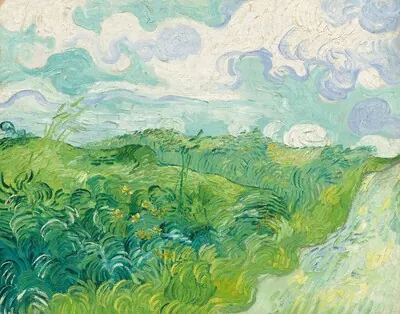
The painting’s story and details
The green field comes almost up to us. A narrow road remains on the right, with pale clouds above it. Van Gogh painted this landscape in Auvers in 1890 after returning from southern France. No figure provides the story’s protagonist. Plants, earth and sky occupy the entire canvas. To hold our attention on such a simple subject, the painter makes the movement of paint itself unusually expressive.
Ears of wheat and grasses gather into groups of curved strokes. Some rise, others lean right, and others curl into near-semicircles. The museum relates this movement to wind. Close up, an individual mark does not yet resemble a plant. At a distance, neighbouring lines join into a dense field. The image seems to assemble itself afresh whenever we change our viewing distance.
The road on the right is lighter than the field. It narrows towards the horizon, helping us judge distance. Yet green, blue and yellow strokes also cover its surface. Colours pass from one part of the painting into another. The road is clearly legible as a separate strip of ground while remaining within the movement shared by the whole landscape.
Clouds occupy much of the sky. Van Gogh traces them with blue and lilac arcs, leaving broad pale areas between them. Below, paint breaks into the short lines of plants; above, it gathers into large rounded forms. This change of scale creates a sense of open space. Sky and field move differently, although both retain the visible trace of the brush.
Near the horizon, plants form an uneven green edge. With almost no trees or buildings, familiar objects give little help in measuring distance. The field can feel enormous, although we are seeing only a selected piece of terrain. Without a large building or solitary tree, our gaze spends longer following related shades and recurring lines.
Yellow flowers and isolated pale strokes appear among the foreground greens. The thickness of the paint is especially noticeable here. We recognize vegetation while also seeing a surface worked by hand. This is characteristic of Van Gogh’s painting. A convincing landscape emerges without concealing how it was made; the brushmarks remain an independent part of the experience.
Van Gogh’s late fields are often viewed through knowledge of his approaching death. Yet energetic brushwork alone does not prove anxiety, just as pale colours cannot establish peace of mind. The Van Gogh Museum cautions against such ready-made accounts of his final works. This landscape lets us stay with another question: how much expression can an ordinary stretch of field acquire when a painter changes our accustomed way of seeing it?
Featured in tours
After Impressionism. Four different answers
Seurat, Cézanne, Van Gogh and Gauguin changed painting for different reasons.
More paintings to compare
 Vincent van Gogh
The Bedroom. Second version
September 1889 Vincent van Gogh
Self-Portrait
1887 Vincent van Gogh
Madame Roulin Rocking the Cradle (La berceuse)
1889 Vincent van Gogh
Irises
1890 Vincent van Gogh
Self-Portrait with a Straw Hat (obverse: The Potato Peeler)
1887 Vincent van Gogh
Wheat Field with Cypresses
1889Period, style and subject
- Movement
- Post-Impressionism
- Genre
- Landscape
- Medium
- oil on canvas
- Collection
- National Gallery of Art, Washington
- Dimensions
- Overall, 72.39 × 91.44 cm
- Accession number
- 2013.122.1
Sources
Reproduction of a public-domain artwork. Image licence