Wheat Field with Cypresses
Vincent van Gogh · 1889
Explore the painting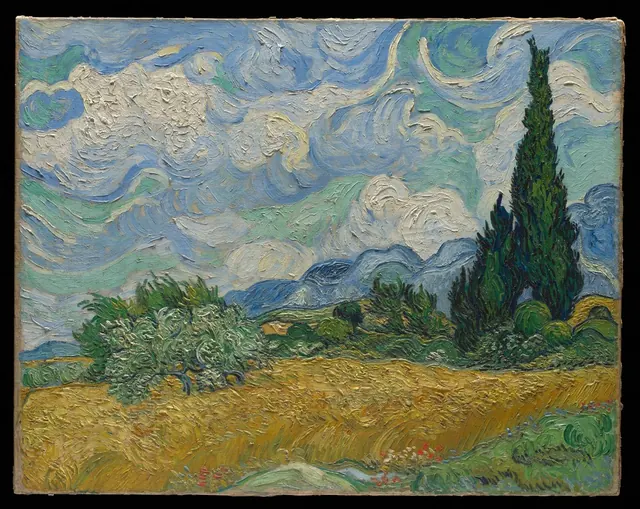
The painting’s story and details
In late June 1889 Van Gogh painted this field outdoors near Saint-Rémy in Provence. He was living at the Saint-Paul-de-Mausole asylum and continued working when his health allowed. Cypresses became a major new subject. In a letter to Theo he compared his ambition for them with his sunflower series. This is the first painted version of the composition. In September he returned to it indoors and made two further versions. One is in London’s National Gallery; the smaller one was intended as a gift for his mother and sister.
The tall cypress on the right rises through most of the sky. Its slender proportions and deep green interested the artist. In a letter he compared the tree’s shape to an Egyptian obelisk. Here the dark tree consists of many distinct strokes, its irregular edge clearly visible against a pale cloud. On 25 June he explained how difficult it was to find the right shade for this dark patch in a sunlit landscape. His interest in the tree begins with the observation of colour and proportion.
Short yellow, ochre, and greenish strokes build the field, bending and overlapping. Thick paint distinguishes dense ears of wheat from sparse growth at the edge. Outdoor work preserves the speed of individual brush movements, while the areas of colour are carefully distributed across the canvas. Close viewing reveals ridges of paint. Each stroke casts a small shadow as light falls on the surface. The effect depends on both the depicted field and the canvas’s actual relief.
The rounded silvery-green trees at the left are much lighter than the cypresses. Blue mountains separate them from the sky. This sequence gives the landscape depth, even as undulating lines recur at every distance. Van Gogh varies the direction of his strokes with each subject while maintaining movement across the painted surface. The cypress’s dark vertical crosses these horizontal bands. It gives the whole composition a firm point of reference amid the many smaller curves.
Clouds occupy more than half the painting. White paint is laid on thickly, its ridges remaining visible at close range. The sky’s texture is as pronounced as that of the trees and wheat, giving the sky a substantial presence of its own.
Red flowers interrupt the golden field near the lower edge. Van Gogh had to translate such colour differences into black ink when he drew this composition for Theo. On 2 July he sent his brother a group of drawings after paintings in progress. Their correspondence also showed the work to the person who helped supply his paints and financial support.
Van Gogh returned to this view through drawings and painted repetitions. In a September letter he distinguished the summer studies from finished versions he was making in his room. Today the Met’s outdoor study is presented as a substantial painting in its own right. The series raises a question about what we regard as finished. We may value the uneven, thick strokes for the traces of work that the painter intended to reconsider. The same correspondence records the expenses. Theo paid for materials and storage while sales still failed to cover costs. This landscape depended on months of observation, family support and actual bills for paint.
Featured in tours
After Impressionism. Four different answers
Seurat, Cézanne, Van Gogh and Gauguin changed painting for different reasons.
More paintings to compare
 Vincent van Gogh
The Bedroom. Second version
September 1889 Vincent van Gogh
Self-Portrait
1887 Vincent van Gogh
Madame Roulin Rocking the Cradle (La berceuse)
1889 Vincent van Gogh
Irises
1890 Vincent van Gogh
Self-Portrait with a Straw Hat (obverse: The Potato Peeler)
1887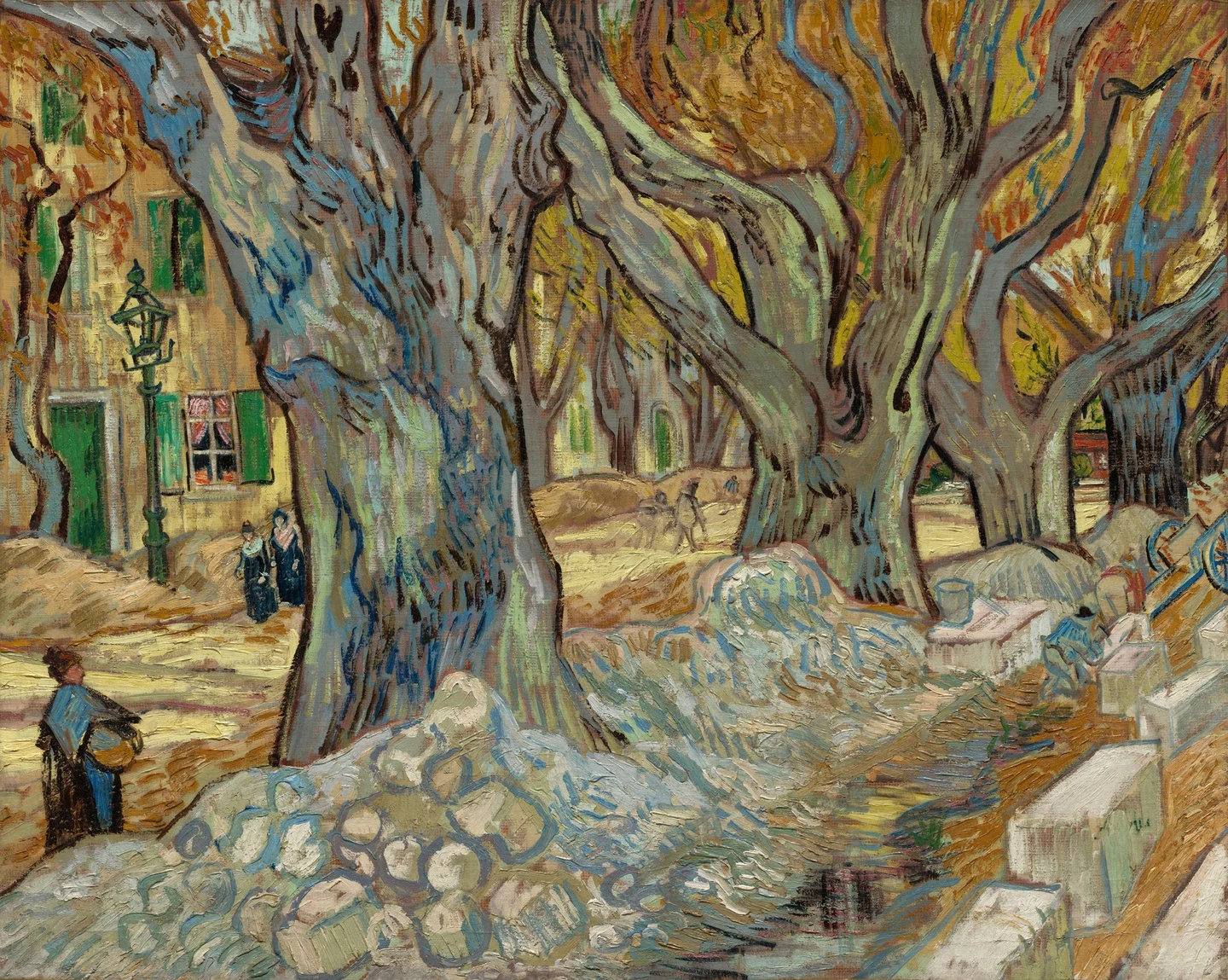 Vincent van Gogh
The Large Plane Trees (Road Menders at Saint-Rémy)
1889Period, style and subject
- Movement
- Post-Impressionism
- Genre
- Landscape
- Medium
- Oil on canvas
- Collection
- The Metropolitan Museum of Art
- Dimensions
- 73.2 × 93.4 cm
- Accession number
- 1993.132
Sources
Image provided under CC0. Image licence