Irises
Vincent van Gogh · 1890
Explore the painting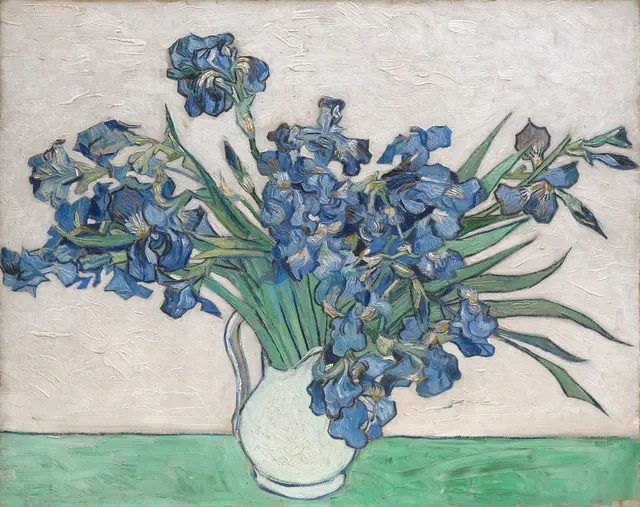
The painting’s story and details
These irises were originally violet against a pink background. Van Gogh painted them in May 1890, before leaving the asylum at Saint-Rémy. In a short period he made four large flower still lifes, two with irises and two with roses. They formed a series of experiments with color and format. This painting now differs substantially from his description because some of its red pigments have faded.
The irises spread broadly above the pitcher, their lateral growth accommodated by the horizontal canvas. The upright version in the Van Gogh Museum arranges the bouquet differently against yellow. The painter compared different relationships among the same colors. For this version he described a gentle combination of pink, green, and violet, treating the objects as parts of a deliberate color arrangement.
Blue, white, and dark strokes appear in the petals, changing direction with each flower’s turn. Their meeting creates volume while individual marks remain distinct in the dense paint. Loss of the red component shifted violet toward blue. The cool bouquet familiar today is therefore partly a product of aging, even though its drawing and brushwork belong to the painter.
Near the upper edge, one flower rises separately from the main mass. The surrounding space makes its branching silhouette easy to follow. Visible strokes also cover the background, which originally played an active chromatic role. Fading changed more than an isolated hue: it altered the color relationship between flowers and surroundings.
Long green leaves cross at the right and lead back toward the vessel. Their narrow shapes differ from broad, folded petals. Van Gogh constructs the bouquet through these differences while preserving numerous independent parts. A flower still life offered rich forms without the need to find a sitter. In a letter to his sister, he recalled working intensely on bouquets during his last days at Saint-Rémy.
The pale pitcher rests on a green surface, its large rounded form supporting the spreading bouquet. Van Gogh left the still lifes in Saint-Rémy to dry and later received them in Auvers. Writing to Theo on June 24, he noted that the irises had dried well and hoped his brother would find something in them. They continued to concern him as finished works after his move.
This still life and Roses remained with the painter’s mother until her death in 1907. In 2015 the Met reunited all four bouquets and presented pigment research. Their history raises a difficult conservation question. Restoring the intended colors would mean intervening in the authentic surface. Letters, pigment analysis, and cautious digital reconstructions instead help us imagine the original appearance alongside the painting time has preserved.
Featured in tours
After Impressionism. Four different answers
Seurat, Cézanne, Van Gogh and Gauguin changed painting for different reasons.
Still life. The value and structure of things
Food, flowers, vessels, books and instruments in an owner’s life and a painter’s work.
More paintings to compare
 Vincent van Gogh
The Bedroom. Second version
September 1889 Vincent van Gogh
Self-Portrait
1887 Vincent van Gogh
Madame Roulin Rocking the Cradle (La berceuse)
1889 Vincent van Gogh
Self-Portrait with a Straw Hat (obverse: The Potato Peeler)
1887 Vincent van Gogh
Wheat Field with Cypresses
1889 Vincent van Gogh
The Large Plane Trees (Road Menders at Saint-Rémy)
1889Period, style and subject
- Movement
- Post-Impressionism
- Genre
- Still life
- Medium
- Oil on canvas
- Collection
- The Metropolitan Museum of Art
- Dimensions
- 73.7 × 92.1 cm
- Accession number
- 58.187
Sources
Image provided under CC0. Image licence