Portrait of a Youth
Sandro Botticelli · c. 1482/1485
Explore the painting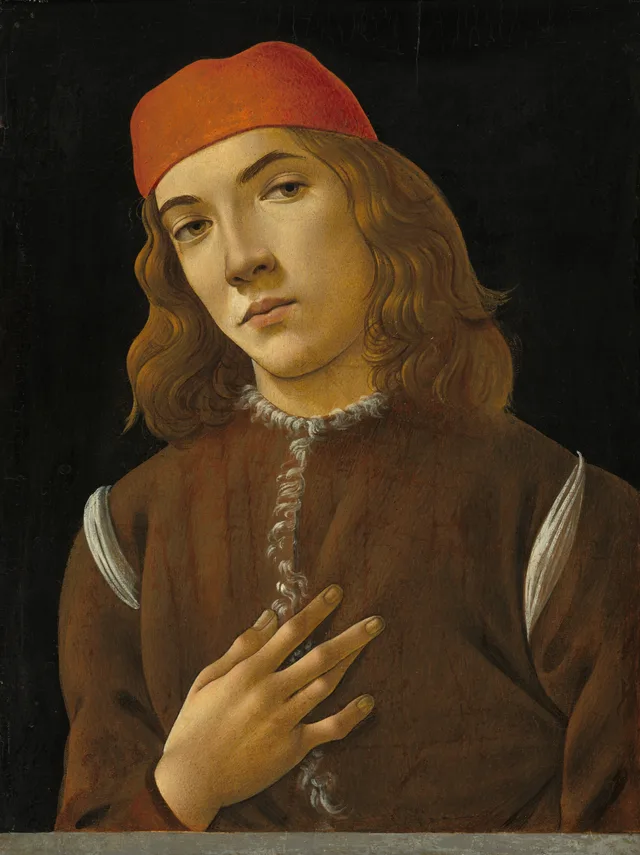
The young man’s name is unknown. Botticelli painted him around 1482–1485, when he was also producing major religious and mythological compositions in Florence. Here the focus falls on a single person. Unlike portraits carrying a coat of arms or commemorative inscription, this painting offers little help in establishing his position. It preserves his particular features and an unusually prominent gesture.
His head tilts while his eyes look sideways, giving the pose a slight movement. Botticelli leaves a narrow dark gap between the lips and carefully distinguishes the eyelid and eyebrow. Small differences create an individual face. Pride or thoughtfulness are tempting descriptions, yet the expression changes depending on which feature receives our attention.
His fingers rest on his chest, partly overlapping. The hand occupies almost as much space as the face. Its angle echoes the tilt of the head, bringing the two parts of the pose together. The precise meaning of the gesture is unknown. Its pictorial role is clearer: it gives the figure movement and a distinctive way of holding himself.
The red cap stands out against black. Its simple shape anchors the upper composition, while wavy hair frames the face. Botticelli’s reliance on drawing becomes clear here. Each curl’s outline matters even where the color hardly changes. In his larger pictures, a similar attention to line makes folds and figures immediately recognizable.
White underclothing appears through a slit at the shoulder. The narrow light strips separate arm from torso and reveal how the garment is constructed. There is no lavish jewelry, but clothing still contributes to the sitter’s presentation. Artist and patron chose the appearance that others would remember. Simplicity could be as deliberate as a display of expensive possessions.
A narrow strip of stone closes the lower edge. It suggests a window ledge while separating the sitter from us. Behind him there is neither room nor landscape. We cannot extend the scene into an imagined setting, so attention repeatedly returns to face, hand, and clothing. The portrait works through this restriction of available information.
The object’s history also changed its meaning. At a Paris sale in 1865 it was listed as a work by Masaccio; the museum now attributes it to Botticelli. The artist’s identity has become clearer while the sitter’s remains unknown. A confident museum label can coexist with a substantial gap in the human history preserved by the image.
More works by Sandro Botticelli


- Medium
- tempera on poplar panel
- Collection
- National Gallery of Art, Washington
- Dimensions
- 43.5 × 46.2 cm
- Accession number
- 1937.1.19
Sources
Museum reproduction. Public domain, NGA Open Access. Image licence