A Polish Nobleman
Rembrandt van Rijn · 1637
Explore the painting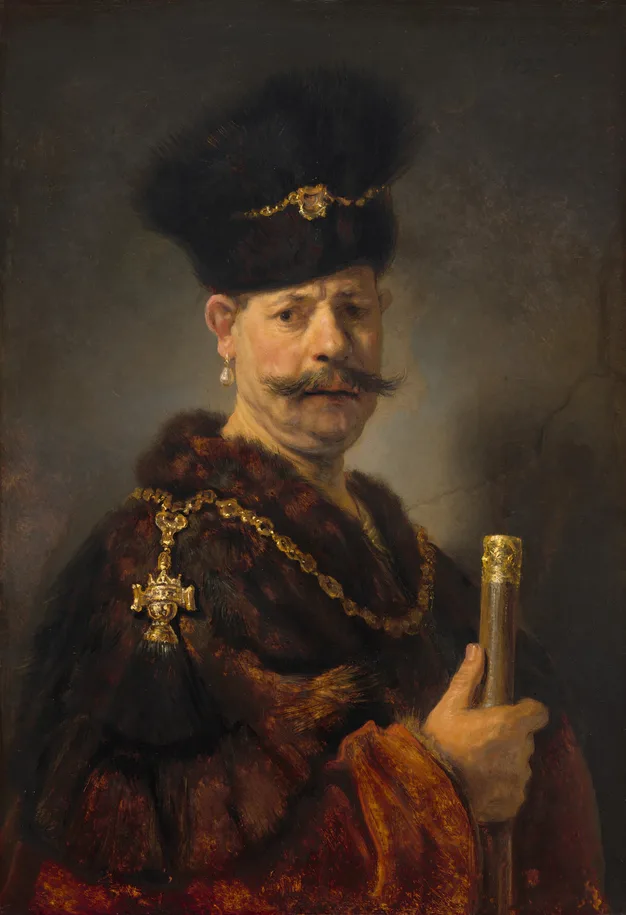
A fur hat, heavy chain, and staff suggest an influential dignitary. Yet the title A Polish Nobleman rests on no identified sitter. Rembrandt painted the work in 1637, when he often produced expressive heads in unusual costumes. Such images allowed freer experiments with lighting, character, and paint texture than portraits tied to a particular patron.
Light strikes the face from the side, leaving the eyes beneath the brows’ shadow. Nose and cheek receive the strongest accents, giving the features an almost sculpted volume. Paint thickness contributes to the effect. Separate strokes become visible close up, then coalesce into convincing skin at a distance.
The tall fur hat, chain, and medallion enlarge the head’s silhouette and lend ceremony to the figure. Rembrandt exploits contrasts between soft fur, bright metal, and skin. The costume invites associations with distant places and elevated rank, though those associations do not amount to a biography.
A heavy gold chain crosses the chest. Small highlights describe its links against dark clothing, beside an elaborate pendant with a tassel. The painter assembles authority from objects viewers associate with it. The picture offers a chance to notice how readily expensive materials make an unfamiliar person seem important.
The hand firmly grips a staff or cane with a metal top. Its vertical shape supports the torso’s turn. Face and shoulders point in different directions, keeping the figure mobile. Rather than a flat presentation of insignia, the arrangement suggests an encounter with someone who has turned toward us.
Fur on the shoulder is loosely painted with short light touches. Beside smooth metal it looks particularly soft. Baroque painting often strengthens presence through tactile differences between materials. Here those differences make the figure convincing before viewers begin asking whom they are actually seeing.
The painting also traveled geographically. It entered Catherine II’s collection in the eighteenth century and was sold from the Hermitage to Andrew Mellon in 1931. An early Russian catalogue called it a portrait of a Turk. Changing titles reveal viewers projecting their ideas of foreign costume onto the same image, while the man’s imagined nationality shifted.
More works by Rembrandt van Rijn


- Medium
- oil on panel
- Collection
- National Gallery of Art, Washington
- Dimensions
- 96.8 × 66 cm
- Accession number
- 1937.1.78
Sources
Museum reproduction. Public domain, NGA Open Access. Image licence