The Last Tavern at the City Gates
Vasily Perov · 1868
Explore the painting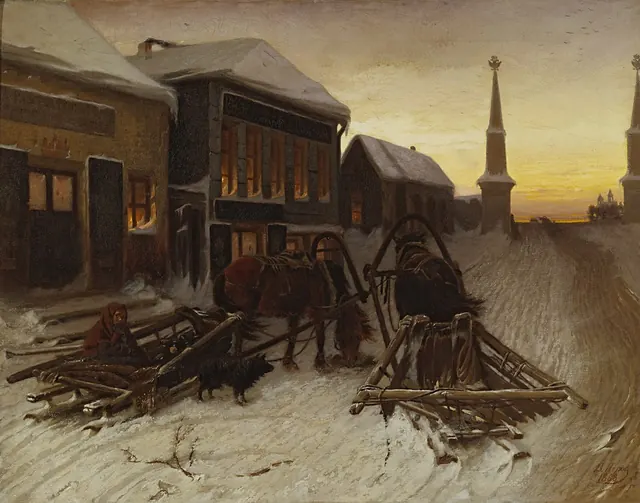
The painting’s story and details
A woman waits in a sledge outside a tavern while the road to the city gates grows dark. Vasily Perov painted this small canvas in 1868. His genre paintings often explored social questions through several characters’ actions. Here people are scarcely visible. Light, distances and sledges left outside establish their circumstances. At the city’s edge, some travellers’ stop means another person waiting in the cold.
The seated woman is wrapped in a reddish shawl. The sledge conceals her lower body, leaving her face as a small patch of light. In the museum’s interpretation, her companions have lingered in the tavern. Perov neither brings them outside nor shows the drinking. The scene is viewed from the waiting person’s side, making the stationary sledge and distance from the lit building more important.
Orange windows glow among grey snow and brown walls. The light looks warm, but we cannot see inside. It suggests shelter from the winter evening, yet for the woman that light remains beyond a wall. Colour separates people whose faces never appear together. An ordinary window becomes part of the story by marking a space occupied by some and beyond another person’s reach at this moment.
The horses stand with lowered heads. Harness arches rise above them, while runners and shafts cross the foreground. A journey has paused by the entrance; the broad road on the right remains clear. The difference between readiness to travel and continued immobility makes waiting tangible. Horses, sledges and a person share the interruption, whose cause lies beyond the wall.
The gateposts stand against the bright sky, crowned by double-headed eagles—state emblems within an everyday road scene. They mark the city boundary named in the title. Beside their imposing silhouettes, the woman looks very small.
Small church domes appear far to the right. No highlighted path leads towards them, and their silhouette almost dissolves into the evening sky. The large illuminated building nearby holds our attention much more strongly. This relationship permits a moral reading while remaining a spatial observation. Within the visible journey, the tavern is the most conspicuous stopping place.
Long runner marks score the road. Nearby, uneven visible strokes describe snow; farther away, lines converge towards the gates. Many travellers have left traces, yet the open space is almost empty now. Sunset passes above the dark roofs and reaches the road’s edge. Perov builds a story of delay within a landscape whose tracks, perspective and sledges all suggest the possibility of movement.
The woman may initially escape notice in the lower left corner. This distribution of attention changes the city view. At first we see a winter evening and bright windows; then we discover someone waiting in the cold. That knowledge sends us back through the landscape. Sympathy develops through a change in our own looking: the small figure becomes more important than the building that first commanded our attention.
Featured in tours
Russian life. Estate, city and village
How nineteenth-century painters depicted work, wealth, education and changes in everyday life.
More paintings to compare


Period, style and subject
- Movement
- Realism
- Genre
- Everyday life
- Medium
- Oil on canvas
- Collection
- State Tretyakov Gallery
- Dimensions
- 51.5 × 65.8 cm
- Accession number
- 367
Sources
Public domain. Reproduction from Wikimedia Commons. Image licence