Russian life. Estate, city and village
How nineteenth-century painters depicted work, wealth, education and changes in everyday life.
Open the tour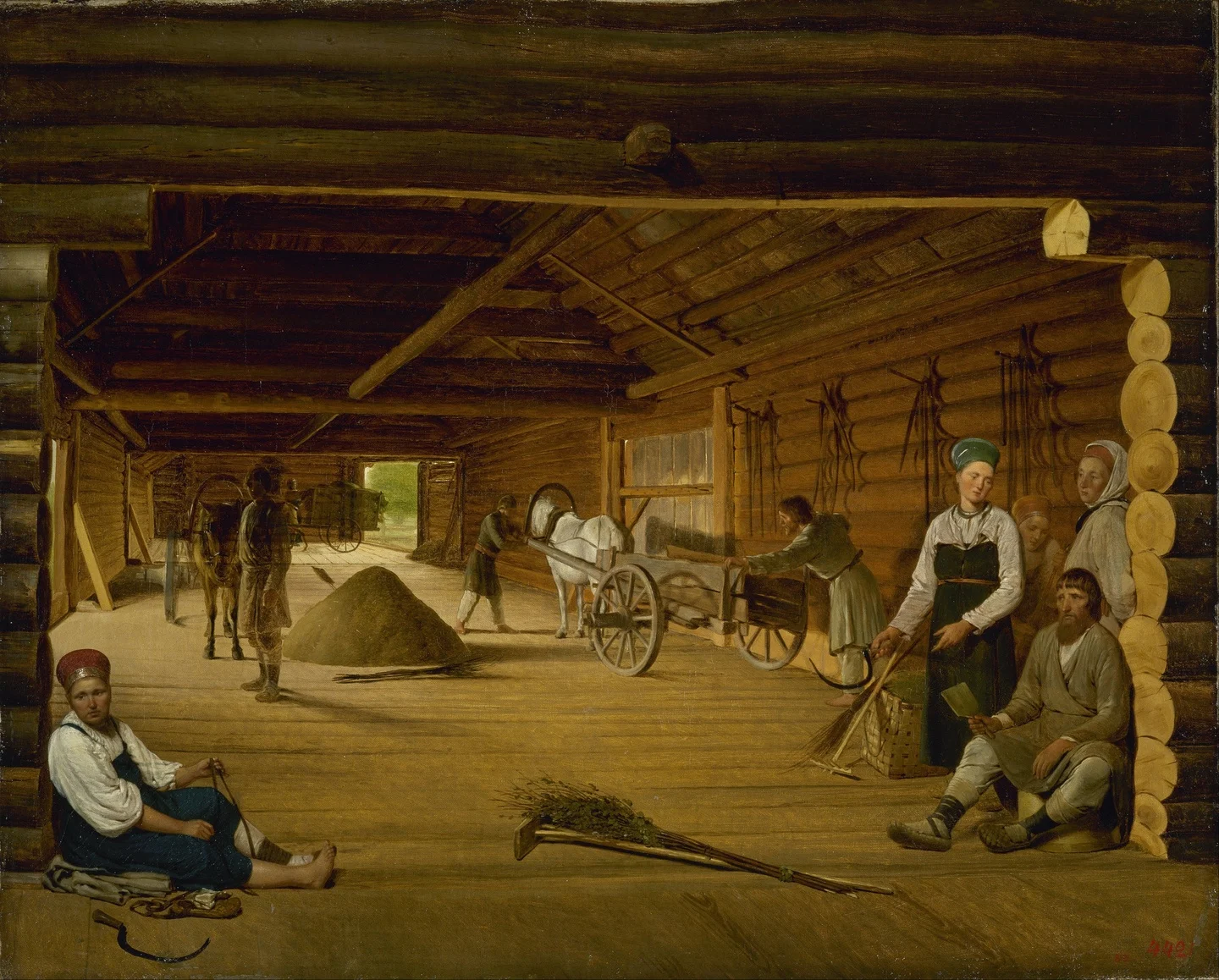 Alexey Venetsianov
The Threshing Floor
1822–1823 Pavel Fedotov
Breakfast of an Aristocrat
1849–1850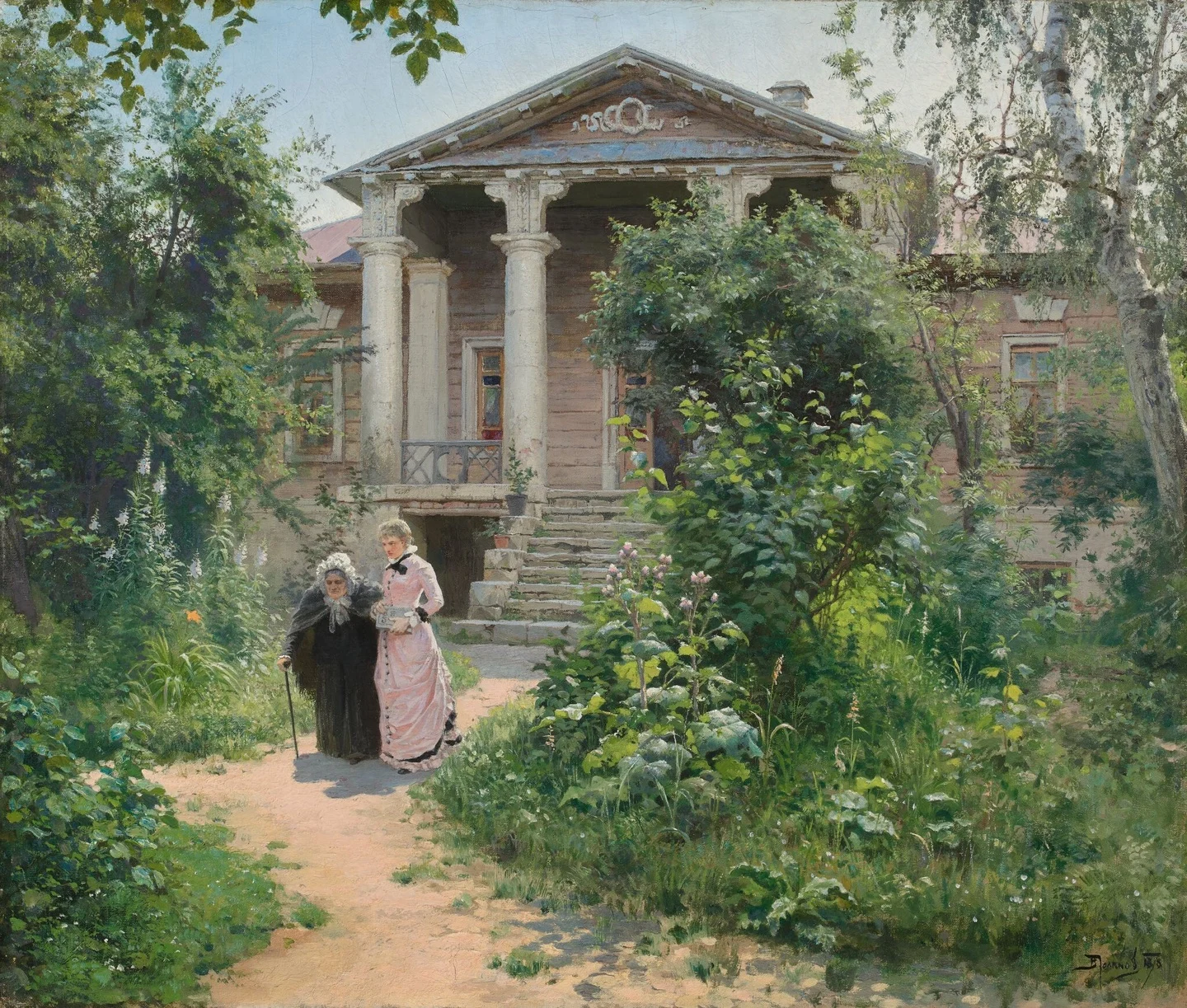 Vasily Polenov
Grandmother’s Garden
1878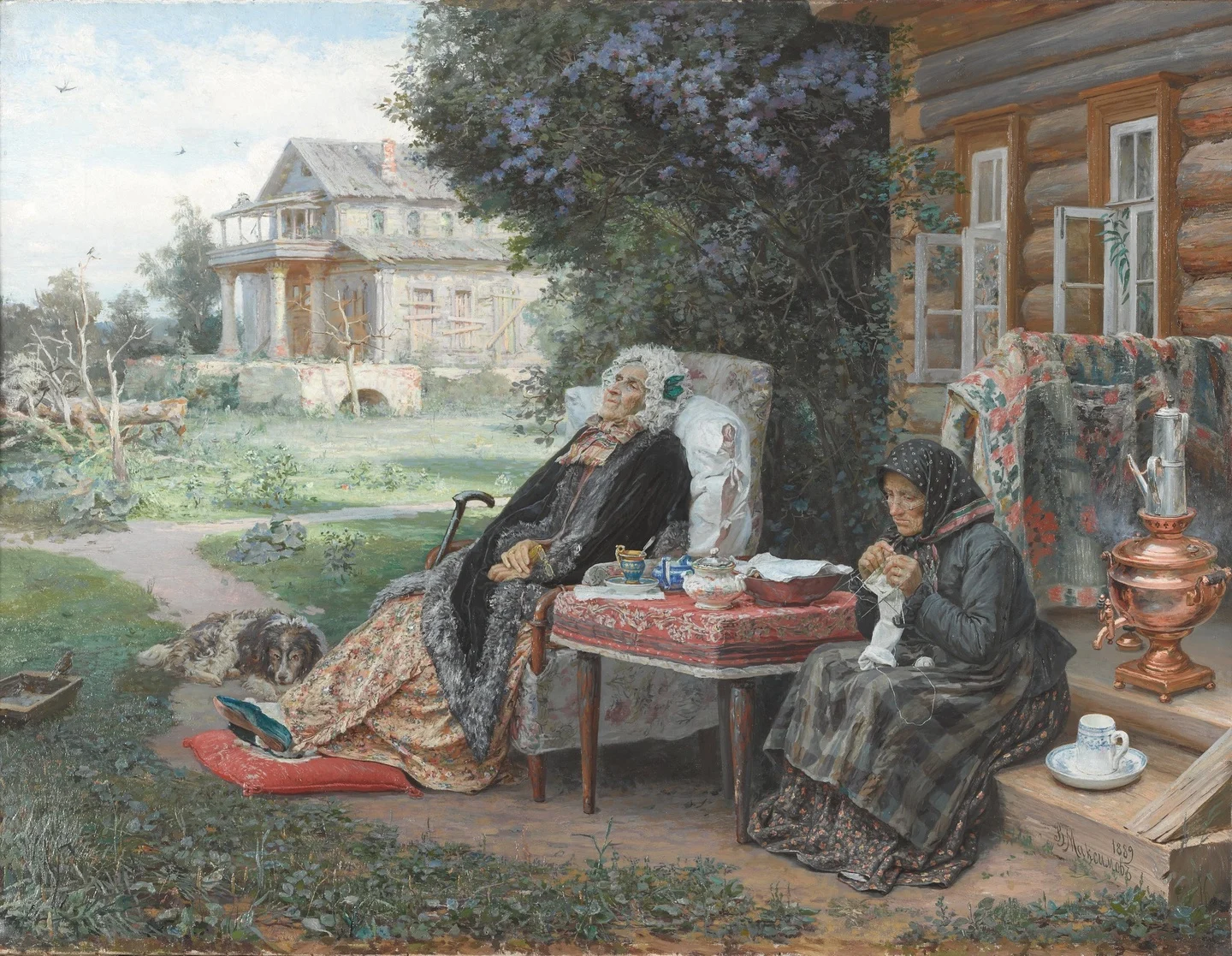 Vasily Maximov
All in the Past
1889How nineteenth-century painters depicted work, wealth, education and changes in everyday life.
Familiar paintings stand beside works less often encountered on the first pages of art-history books. We begin with an estate and domestic life, then look at new public institutions, a bank, a school and a railway. The final section follows changes in painting itself around the turn of the century: colour, brushwork and landscape composition.
The home and social position
Homes and occupations help reveal social arrangements. Work, leisure and memories of the past coexist on the estate.
The Threshing Floor
Alexey Venetsianov · 1822–1823
Venetsianov painted peasants on his own estate. His experiment with space took place within a landowner’s economy.
Breakfast of an Aristocrat
Pavel Fedotov · 1849–1850
Fedotov uses household objects to reveal the gap between desired prosperity and the owner’s actual means.
Grandmother’s Garden
Vasily Polenov · 1878
Polenov’s old manor links an everyday scene to the memory of earlier generations.
All in the Past
Vasily Maximov · 1889
Maximov’s mistress and servant continue familiar routines beside an empty large house.
After the reforms
The zemstvo, bank and village school became recognisable settings of contemporary life. Painters addressed the expectations and inequalities surrounding them.
The Zemstvo Dines
Grigory Myasoedov · 1872
Members of a new local government eat in different conditions. Myasoedov addresses equal rights through food and the placement of people.
Bank Collapse
Vladimir Makovsky · 1881
A bank failure moves the subject of vulnerability to circumstances into the urban world of depositors.
At the School Door
Nikolai Bogdanov-Belsky · 1897
A peasant boy at the school threshold links education to the prospect of a changed life.
Life Everywhere
Nikolai Yaroshenko · 1888
The railway transports prisoners here. Yaroshenko depicts those on the other side of the bars.
The Last Tavern at the City Gates
Vasily Perov · 1868
Perov turns to a person waiting beside a road. The winter landscape conveys almost as much about the situation as the figure itself.
Orphaned
Nikolai Kasatkin · 1891
Kasatkin leaves two children beside a grave. Worn clothes and the empty setting establish the scene’s social dimension.
The present looks at the past
The Wanderers also addressed history. Their choice of moments and relationships reflected questions of their own time.
Peter I Interrogating Tsarevich Alexei at Peterhof
Nikolai Ge · 1871
Ge shows a ruler alone with his son. The painting was discussed in 1871, when the cost of state reforms remained a live issue.
Light and everyday observation
Everyday action occupies less space in these works. Painters increasingly investigate how light changes the colour of familiar settings.
Moscow Courtyard
Vasily Polenov · 1878
Polenov’s Moscow courtyard preserves almost village-like activities. Daylight joins its church, buildings and people.
After the Rain
Arkhip Kuindzhi · 1879
Kuindzhi chooses a brief change in the weather. Light on the ground becomes the landscape’s main event.
Calm Before the Storm
Nikolai Dubovskoy · 1889–1890
Dubovskoy relates the cloud’s scale to small buildings. A rural setting becomes part of a large weather event.
In a Boat
Konstantin Korovin · 1888
Korovin brings people and foliage together through coloured strokes. The impression of light unites landscape and figures.
The Pond
Victor Borisov-Musatov · 1902–1903
Borisov-Musatov turns an estate outing into a composed scene with identifiable models.
In the Evening
Abram Arkhipov · c. 1910
Arkhipov retains a village subject while painting figures and buildings in broad areas of colour, changing the language of a familiar theme.
What changed in Russian life
Everyday life offered a way to discuss society. Venetsianov studied the space of his own estate; Myasoedov, the position of zemstvo representatives; Makovsky, the fate of depositors; Bogdanov-Belsky, access to education. Similar genre subjects could address different questions.
Towards the century’s end, landscape and colour increasingly acquired an independent role. Polenov, Korovin, Dubovskoy and Arkhipov show observation of daily life continuing through experiments with light and painted surfaces.
Artists in the tour
Sources
- Alexey Venetsianov — The Threshing Floor
- Pavel Fedotov — Breakfast of an Aristocrat
- Vasily Polenov — Grandmother’s Garden
- Vasily Maximov — All in the Past
- Grigory Myasoedov — The Zemstvo Dines
- Vladimir Makovsky — Bank Collapse
- Nikolai Bogdanov-Belsky — At the School Door
- Nikolai Yaroshenko — Life Everywhere
- Vasily Perov — The Last Tavern at the City Gates
- Nikolai Kasatkin — Orphaned
- Nikolai Ge — Peter I Interrogating Tsarevich Alexei at Peterhof
- Vasily Polenov — Moscow Courtyard
- Arkhip Kuindzhi — After the Rain
- Nikolai Dubovskoy — Calm Before the Storm
- Konstantin Korovin — In a Boat
- Victor Borisov-Musatov — The Pond
- Abram Arkhipov — In the Evening