Love of Winter
George Wesley Bellows · 1914
Explore the painting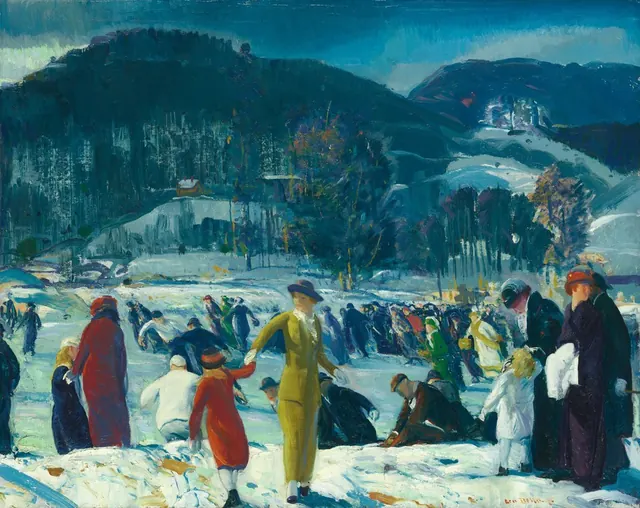
The painting’s story and details
In January 1914 Bellows wrote to a friend that he was waiting for snow and felt he had to paint at least one winter scene each year. A blizzard on February 13 finally supplied his subject. Love of Winter brings children and adults together at a skating pond. Their movements, clothes and activities show a great city at leisure.
A woman in yellow leads a girl in a red coat by the hand. The adult is moving towards the front of the picture, while the child looks back at the skating pond. Their joined arms stretch between two directions. Within the bustle, a small event becomes legible through their poses, even without clear facial expressions.
The girl’s red coat stands out against the bluish snow. Its hem swings sideways, her feet are unevenly placed and her head turns back. Bellows distributes movement across her whole body. Looking at the complete figure reveals an action that a quick glance might mistake for a still pose.
On the left, another woman holds a child’s hand. She faces the skating pond, her long red coat hanging almost still. Beside the first pair, this group introduces a different pace. Bellows builds the crowd from varied actions, so individual visitors retain their own activities within the larger landscape.
On the right stand two women in dark clothes and a child in white. A large pale muff is visible near the orange hat. Coats, hats and muffs remind us of the clothing a cold-weather outing required. These smartly dressed, standing figures form just one group among the park’s visitors.
At the ice’s edge, two adults bend towards the ground. Behind them, moving skaters spread their arms and lean forwards. Waiting, preparation and quick movement coexist. Many faces remain indistinct, yet the angle of a back or the placement of legs lets us distinguish skaters from people at rest.
Bellows’s snow contains white, blue, green and ochre passages. Long strokes follow the slope; shorter ones cross them at another angle. Up close, the brush’s path remains visible. From farther away, these separate marks become the uneven snow beneath the visitors’ feet.
The dark slope and trees occupy almost the entire upper half of the picture, making the light skating pond below appear especially bright. Bellows divides the park into large areas of colour, then places small red, yellow and green figures within them. This keeps the crowded scene legible from a distance.
Bellows moved to New York in 1904 and studied with Robert Henri. Their circle became known as the Ashcan School. These artists found subjects in streets, tenements and places of entertainment. Bellows painted boxing, construction work and city parks. Observing contemporary life allowed him to expand the subjects considered worthy of a major painting.
The varied clothing and the presence of children alongside adults suggest a shared urban leisure space. The painting alone cannot establish that recreation was equally accessible to everyone. It shows people who have already reached the park; those kept away by work, money or other circumstances cannot be identified within it. The scene can be read both as an observation of visitors and as an appealing representation of metropolitan life.
New York’s public parks brought together people of different ages and social backgrounds. The Art Institute of Chicago connects the visitors in Love of Winter with this shared use of public space. Returning to the whole picture, we can distinguish several stories within the outing: skating, pausing at the ice and a pair walking away. The landscape shows a place that city dwellers use together.
Featured in tours
How painting changed in the early twentieth century
Colour, the human figure and early experiments in abstraction.
More paintings to compare

Period, style and subject
- Movement
- Realism
- Genre
- Everyday life
- Medium
- Oil on canvas
- Collection
- Art Institute of Chicago
- Dimensions
- 81.6 × 101.6 cm
- Accession number
- 1914.1018
Sources
Image provided under CC0. Image licence
Adapted and translated from Art Institute of Chicago materials. · Text licence