All in the Past
Vasily Maximov · 1889
Explore the painting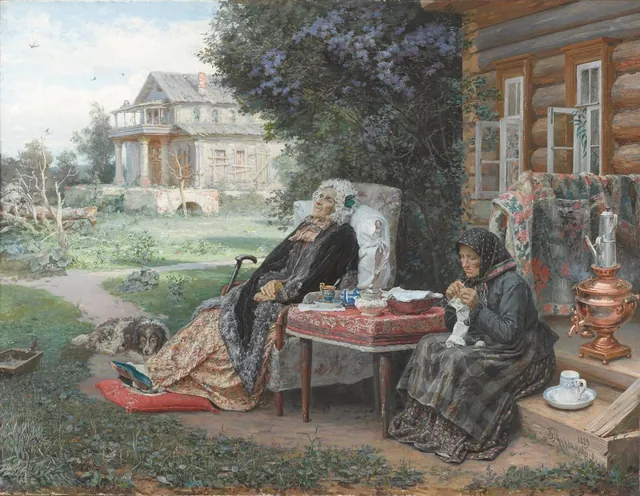
The painting’s story and details
Two elderly women sit beside a small wooden house. One rests in an armchair; the other knits. A boarded-up mansion stands behind them. Vasily Maximov painted All in the Past in 1889 from his knowledge of estate life. As a young drawing teacher he had heard stories of a noble family’s former grandeur. Later, the Lyubsha estate inherited by his wife’s family supplied material for the painting. Personal observations became a story about an ageing estate.
Boards cross the mansion’s windows. Columns still support its balcony, but plaster has fallen away in places and bare trees stand before the façade. We can see the formal front clearly, yet nobody approaches it. Life is concentrated elsewhere in the yard. This separation makes the title intelligible before we examine the women. The house retains its former scale while lacking visible signs of everyday use.
The mistress leans back against a large cushion, her hands folded. A white bonnet frames her face and a fur-trimmed wrap covers a patterned dress. Another cushion supports her feet. The objects create a comfortable resting place, almost as if an interior had been carried into the garden. They remain elegant beside the plain log façade. Cushions, fur and lace preserve her particular standing within this small household.
The servant sits on a step below her mistress. Needles and pale knitting fill her hands, and her gaze is lowered to the work. A table stands between the women, but their postures and occupations differ. Both have grown old, yet the division between rest and labour remains visible. This extends the painting beyond a general story of decline. Beside the cushions supporting her mistress, the servant continues working with her hands.
A copper samovar stands on the porch with a coffee pot above it. Dishes gather on the table beside the armchair, while a separate cup rests on the step near the servant. Shining metal and pale porcelain stand out against wood. Tea is carefully arranged. Even after a change of dwelling, a familiar order survives in where dishes stand and who can readily reach them.
A dog lies behind the chair, with a curving path farther back. It connects the inhabited foreground with the mansion. Distance therefore does not turn the buildings into independent views: they share one yard. Grass and bare earth lie close to us, while space opens beyond, allowing a comparison between the mansion’s elaborate silhouette and the low wooden building. That comparison carries the estate’s story.
Lilac blooms above the chair. Violet clusters scatter across dark foliage concealing part of the mansion. Spring growth appears beside worn possessions and ageing people. It complicates the title All in the Past. Flowering, knitting and tea continue within the picture. A particular way of life belongs to the past, while the yard remains a place of present activities and light.
Tretyakov acquired the painting in the year it was made. Its popularity led to numerous repetitions by the artist, while drawn versions helped introduce it to readers of publications. Nostalgia for estate life found a new audience. Attention to the servant shifts the story’s usual centre. A memory of an attractive past leaves a question about whose work sustained its comfort.
Featured in tours
Russian life. Estate, city and village
How nineteenth-century painters depicted work, wealth, education and changes in everyday life.
More paintings to compare

Period, style and subject
- Movement
- Realism
- Genre
- Everyday life
- Medium
- Oil on canvas
- Collection
- State Tretyakov Gallery
- Accession number
- 589
Sources
Reproduction: Wikimedia Commons · Public Domain