Croquet Scene
Winslow Homer · 1866
Explore the painting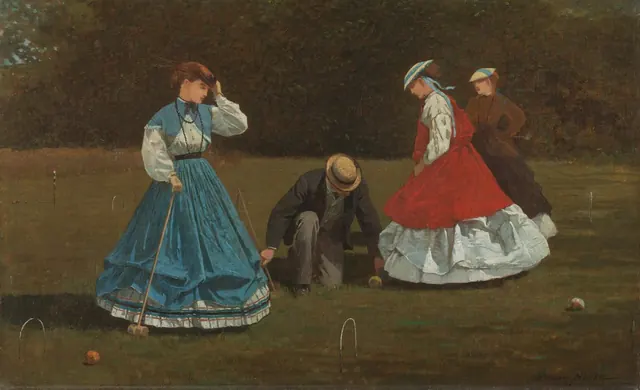
The painting’s story and details
After the American Civil War Homer increasingly turned from magazine illustration towards oil painting. He painted this croquet game in 1866. Recently introduced from Britain, the sport had become fashionable among prosperous Americans. Women and men share the lawn and the game, connected by the position of the balls and preparation for a stroke.
The woman in blue shields her eyes from sunlight. Illumination becomes behaviour as well as an effect on fabric. Broad light folds make her prominent, although she stands somewhat apart. Her role in the current move must be understood through her gaze and the equipment around her.
A crouching man positions a ball beside the woman in red. The museum explains that she is preparing a stroke that sends another ball away. Ownership of that second ball remains a probable interpretation. Rules reveal a particular stage in play rather than merely people gathered on grass.
The red dress spreads above a white underskirt. Colour distinguishes this player from the woman in blue and helps us follow their relation in the game. Women compete actively while retaining fashionable dress. The scene invites discussion of how shared leisure could expand participation without removing social expectations about appearance.
A figure behind is partly hidden by the red dress. Overlap creates depth on the relatively flat lawn. Dark clothing attracts less attention, but the head's position indicates shared observation. Homer distributes interest through unequal areas of colour rather than giving every participant equivalent emphasis.
Low wire hoops stand near the foreground. They seem minor until we recognise a game in which balls pass through a sequence of wickets. Small objects turn a lawn into an organised playing field. Rules define space without a high enclosure or substantial structure.
An orange ball stands apart on the grass, with others nearer the players. These small coloured marks help us follow previous action and anticipate a possible next move. Balls scattered across the grass connect the pause before a stroke with the continuing contest.
The woman on the left rests her mallet on the ground. Its long shaft connects her large figure with the small ball. Rest is temporary: the object is designed for striking. Alongside the crouching man it establishes a brief pause in an ongoing contest.
Homer made five croquet paintings. Skills of close observation developed through illustration now serve a scene of sunny leisure. Yet its calm belongs to a particular social environment. The date immediately after the war allows us to compare visible privileged recreation with the other aspects of American life outside this chosen lawn.
Featured in tours
American landscape. Land and its inhabitants
Nature, territorial expansion, the Civil War and urban life in American painting.
More paintings to compare
Period, style and subject
- Movement
- Realism
- Genre
- Everyday life
- Medium
- Oil on canvas
- Collection
- Art Institute of Chicago
- Dimensions
- 40.3 × 66.2 cm
- Accession number
- 1942.35
Sources
Image provided under CC0. Image licence
Adapted and translated from Art Institute of Chicago materials. · Text licence