The Combat of the Giaour and Hassan
Eugène Delacroix · 1826
Explore the painting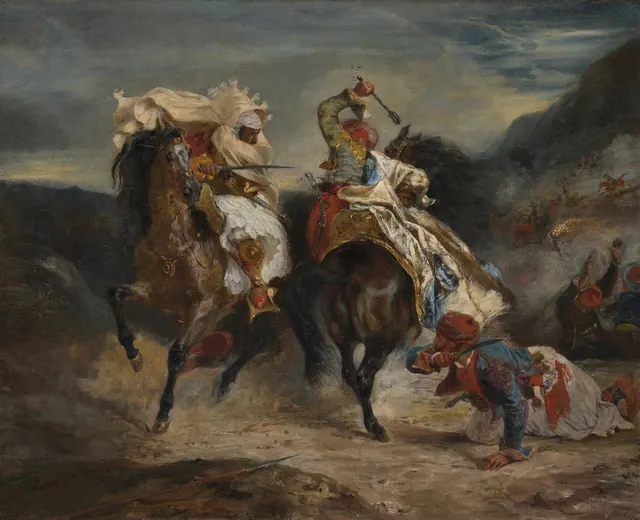
The painting’s story and details
Two horsemen clash in a narrow ravine. Delacroix painted the scene in 1826 from Byron’s The Giaour, first published in 1813. A Venetian avenges Leila, an enslaved woman killed by Hassan, whose harem she belonged to. “Giaour” is a derogatory term for a non-Muslim, here a Christian. The poem supplied passion, violence and a distant setting for a rushing encounter.
The horse on the left rears as its white-clad rider leans forward with a sword. This is the Giaour. His movement drives towards his opponent, but the rising animal destabilises him. Delacroix connects human action to the horse’s resistance and weight.
Hassan’s dark horse turns its hindquarters towards us. The animals seem to rotate around a shared centre. Faces and weapons appear above substantial bodies. Their confrontation involves intersecting forces rather than one isolated heroic gesture.
The Giaour’s face emerges from white fabric. Broad folds fly around head and shoulder. The fabric emphasizes the rider’s abrupt turn. Its pale surface keeps attention on the avenger and helps us read the entangled bodies.
Hassan raises his weapon, his turning head almost concealing the face. Responsible for Leila’s death in the poem, he now resists his own attacker. The horsemen’s visual resemblance reveals shared fury despite their different narrative roles.
A man on the right braces himself against the ground. Other participants appear behind him. The duel belongs to a larger encounter extending beyond its central pair. Their presence increases revenge’s cost, involving more lives in a private conflict.
Weapons lie in the foreground, pointing attention towards the horses. They recall fighting beyond the principal blow. Loose earth and dust receive freer brushwork. Blurred edges strengthen the sense of rapidly changing action.
Distant riders disappear among slopes. Delacroix had not yet visited North Africa; his Moroccan journey followed in 1832. This “Orient” developed from literature and available images. Movement and colour give the literary episode a vivid physical form.
Delacroix repeatedly returned to the Giaour’s story. Romantic admiration for an avenger comes readily, but Leila herself is absent from the battlefield. Her death sets male action in motion while leaving her no gesture or voice within it. That shift reveals both the story’s appeal and the limits of what the painter chose to show.
Featured in tours
History in painting. Events and memory
Who painted war, revolution and state power, and how long after the event.
More paintings to compare
Period, style and subject
- Movement
- Romanticism
- Genre
- History painting
- Medium
- Oil on canvas
- Collection
- Art Institute of Chicago
- Dimensions
- 59.6 × 73.4 cm
- Accession number
- 1962.966
Sources
Image provided under CC0. Image licence
Adapted and translated from Art Institute of Chicago materials. · Text licence