Arab Horseman Attacked by a Lion
Eugène Delacroix · 1849–50
Explore the painting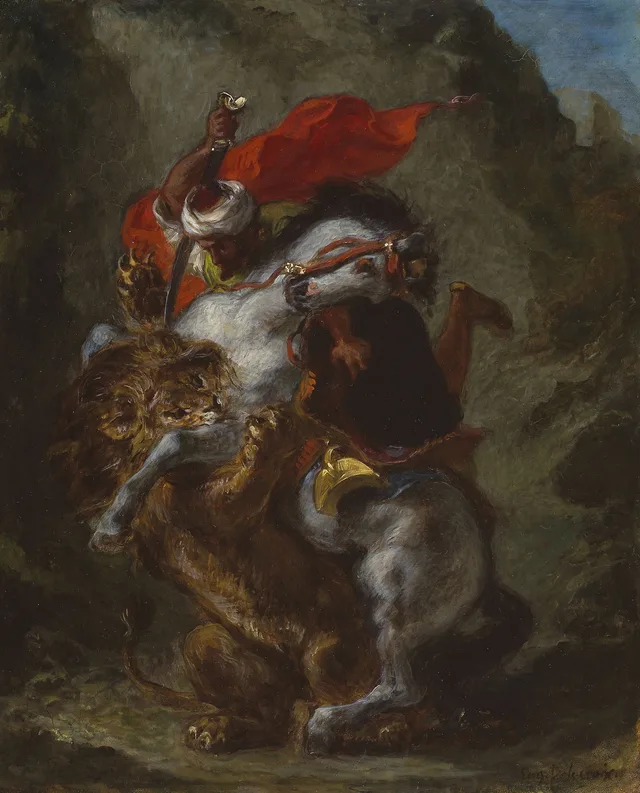
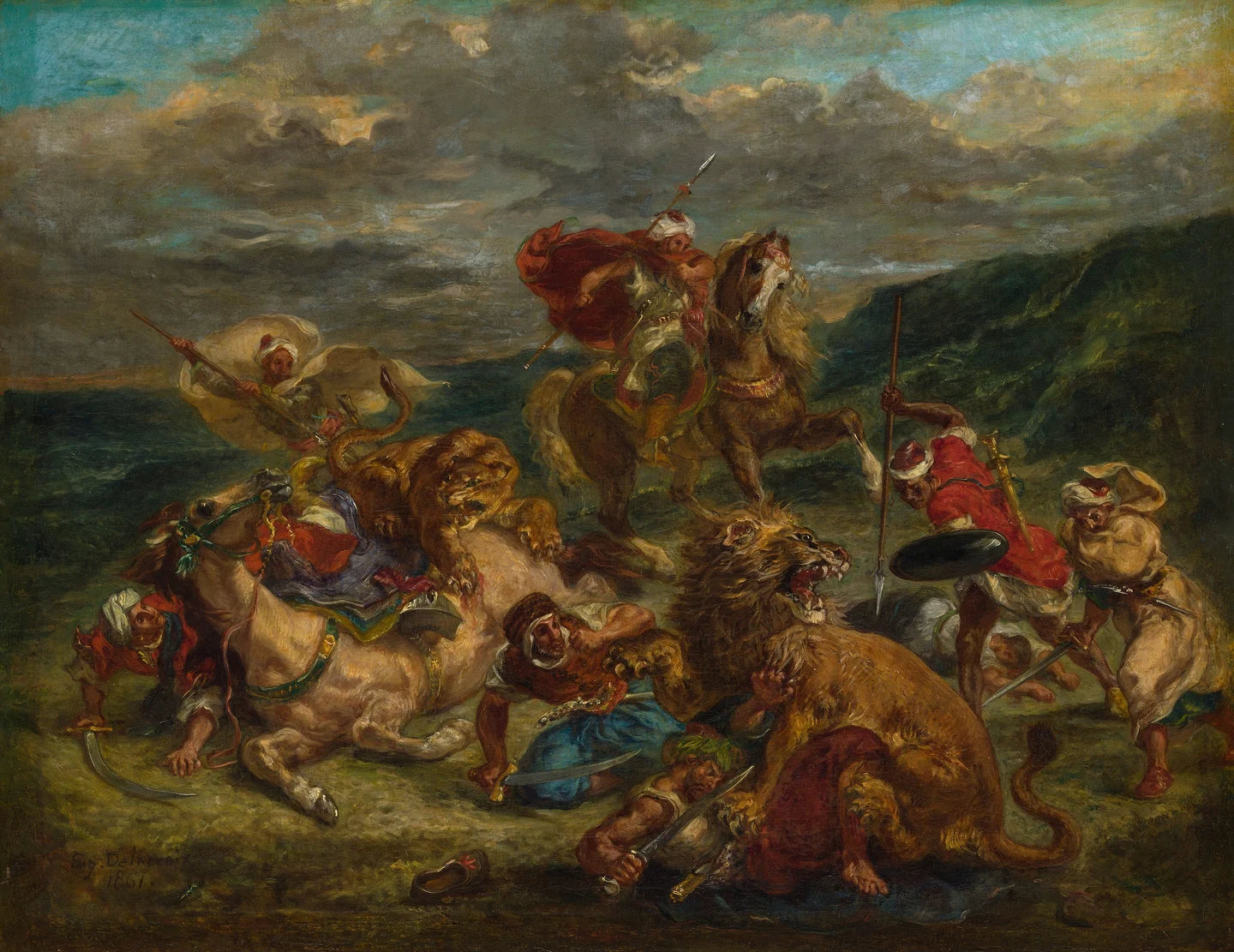
In 1849–50 Delacroix painted an imagined struggle between a lion and a horseman. The small vertical format makes man and animals nearly fill the space. He had long drawn on impressions from North Africa, but this is not a record of a specific incident. The dramatic event is constructed from observations of bodies, clothing and movement. Combining plausible parts makes the invention persuasive.
The rider raises a weapon above his head and bends towards the animal. His face is shadowed, but the arm and metallic glint stand out immediately. The intended movement becomes clear without a detailed facial expression. The steep diagonal of the arm points towards the struggle. One action connects the upper and lower picture, carrying the eye rapidly from man to animal.
The pale horse’s head is thrown backwards. Eye, nostrils and open mouth stand out against darkness, while the bridle reinforces the turn. The horse shares the danger although the man uses it for transport. Delacroix makes its reaction as expressive as the human gesture. This adds another vulnerability to the combat: a second living body stands between rider and predator.
The lion grips the horse, its paws crossing pale fur. Freely painted golden mane surrounds a face clear enough to establish the direction of attack. Light and shadow only partly separate the bodies. Their entanglement prevents detached inspection of each participant. The viewer has to reconstruct the limbs’ positions, intensifying the impression of a close, rapidly changing struggle.
Legs and tail form several curves above dark ground below. There is little stable horizontal support. Even where the animals touch the earth, forms continue twisting. Delacroix uses that rhythm to keep the action moving towards the picture’s edge. Short strokes and sharp touches of light sustain tension across the relatively small paperboard surface.
Red fabric billows above the rider’s shoulder. Its broad curve repeats the movement of the group and stands out against the muted landscape. Colour communicates force without a literal depiction of wind. Clothing also identifies the figure culturally. European viewers received enough signs to locate the scene in an Arab world, although the particular place and incident remained invented.
The museum considers such images within the context of French colonialism. Repeated scenes of violence encouraged an idea of another country as a place of perpetual brutality. This does not erase Delacroix’s painterly skill, but explains why an effective composition warrants critical attention. How people are depicted can have consequences even when the artist is primarily absorbed by colour, bodies and dramatic narrative.
More works by Eugène Delacroix
- Medium
- Oil on paperboard
- Collection
- Art Institute of Chicago
- Accession number
- 1922.403
Sources
Wikimedia Commons reproduction. Public domain. Image licence