Lion Hunt
Eugène Delacroix · 1860–61
Explore the painting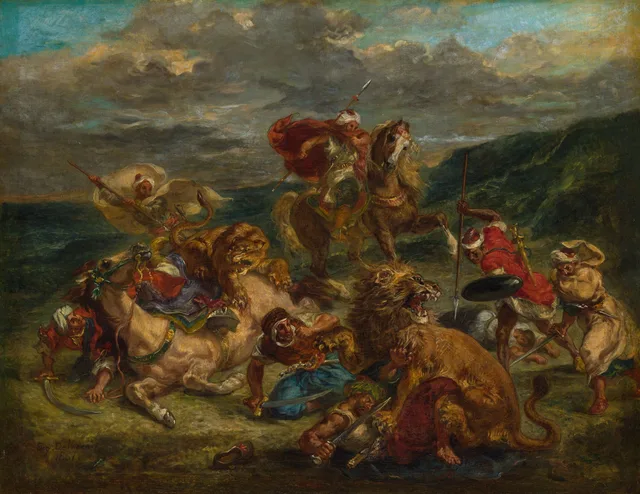
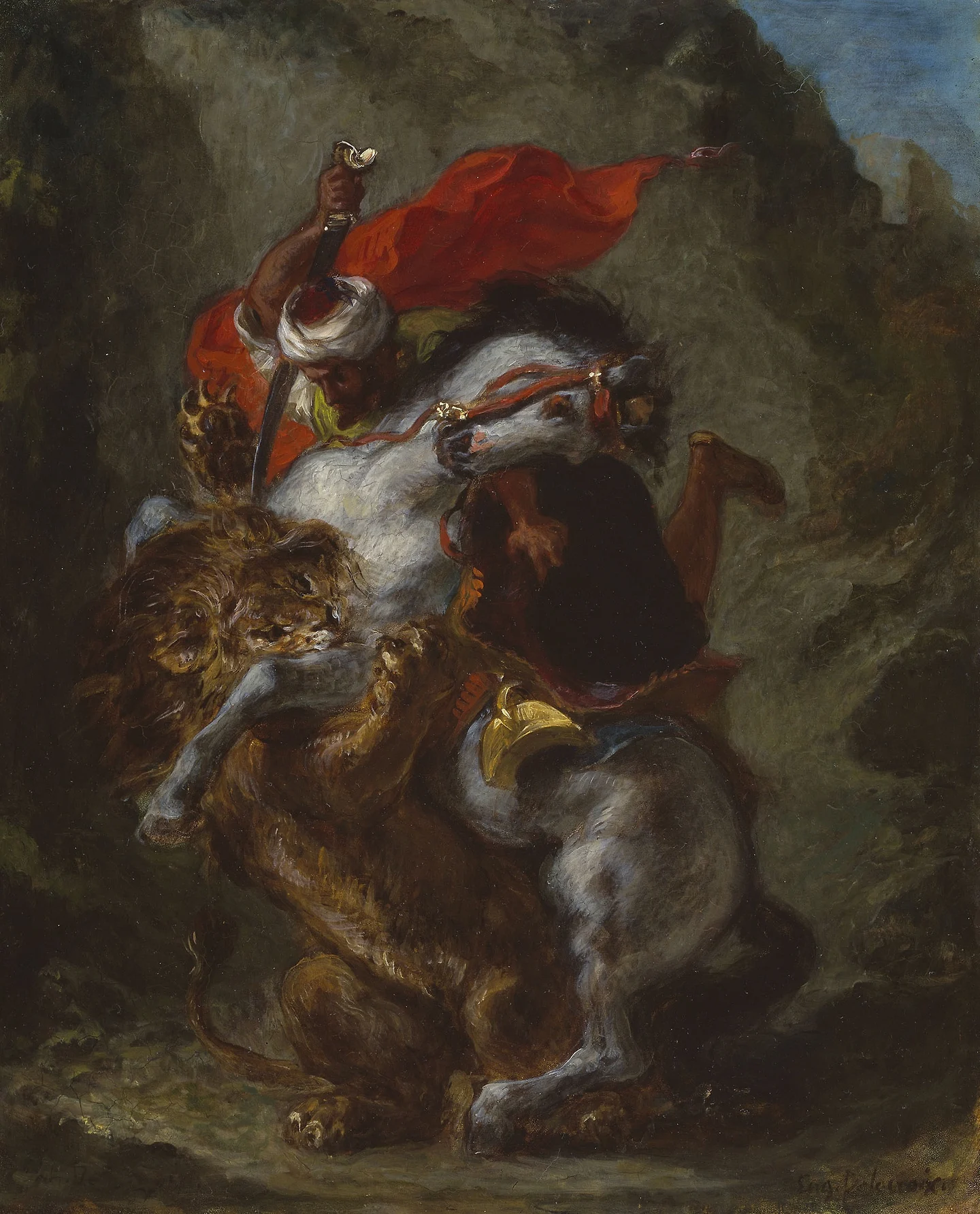
People, horses and lions converge in a crowded struggle. Delacroix painted this Lion Hunt in 1860–61, many years after travelling in North Africa. In 1832 he accompanied a diplomatic mission and gathered impressions, sketches and observations. He never witnessed a lion hunt, however. That distinction is fundamental to the picture. Details of clothing and animals could derive from studies, while the event as a whole was invented in the studio.
A mounted hunter rises above the other participants near the centre. Red clothing and the horse’s pale head stand out against darkness. His position gives the struggle a high point from which weapons and bodies extend diagonally. This organises complicated action without making it look diagrammatic. We recognise movement before identifying every participant. Delacroix depends on the eye’s emotional response as it gradually discovers order within a dense collision of forms.
The lion on the right opens its mouth, its body overlapping a fallen man. Dark and golden strokes build the mane, while light touches mark teeth and eyes. Delacroix studied animals, including in a menagerie, and transferred observations into an imagined scene. A convincing detail helps make the entire event believable. This mechanism is powerful, making it important to distinguish a study from testimony. A well-observed lion does not make the painter an eyewitness to a hunt.
On the left a horse has fallen, and a man struggles beside its body. Pale fur and red fabrics stand sharply against earth and shadow. Repeated colours connect different parts of the painting, carrying the eye between centres of action. In Romantic painting, colour could organise drama as actively as drawing. Here it conveys simultaneous events. Each participant faces a separate danger, yet all belong to one rapidly unfolding scene.
Fallen people and weapons fill the bottom. The edge cuts off space, making it difficult to locate a safe viewing position within the depicted world. Crowding intensifies the sense of collision. Our actual position remains entirely secure, however. The painting turns someone else’s danger into a spectacle available for leisurely inspection. That gap between threatened subjects and comfortable viewers helped make dramatic hunts attractive to the European art market.
An unsettled sky stretches above the struggle while slopes enclose it at either side. The terrain looks plausible without requiring a precise geographical address. It becomes a setting for imagining North Africa as a place of exceptional passions and dangers. During French colonial expansion, that image carried political weight. Delacroix’s personal admiration for Arab culture could coexist with paintings that sustained European expectations of a spectacular, violent and foreign East.
The painting allows us to examine both Delacroix’s skill and the circumstances in which it operated. Colour, rhythm and the handling of bodies make an invented event convincing. Artistic power helps such an image shape perceptions of other people. Critical attention therefore need not stop attending to painting. The more precisely we understand its construction, the clearer it becomes how an attractive spectacle can quietly present one culture’s imagination as another culture’s everyday reality.
More works by Eugène Delacroix
- Medium
- Oil on canvas
- Collection
- Art Institute of Chicago
- Accession number
- 1922.404
Sources
Wikimedia Commons reproduction. Public domain. Image licence