The Beach at Sainte-Adresse
Claude Monet · 1867
Explore the painting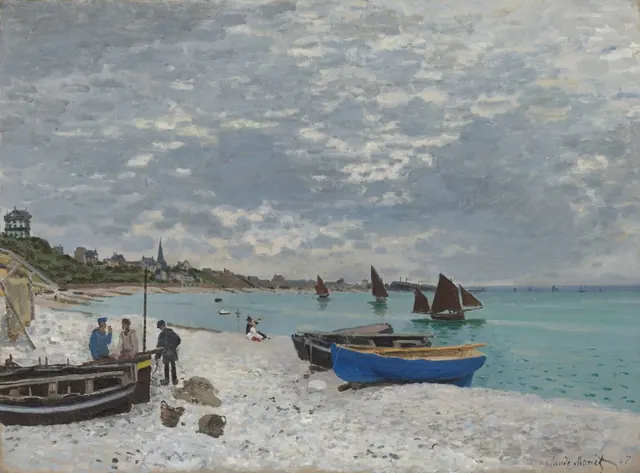
The painting’s story and details
Two ways of looking at the sea coexist on the beach at Sainte-Adresse. For fishermen it is a workplace; for visitors, a spectacle and a place of leisure. Monet painted here in summer 1867, near Le Havre, where he had grown up. Railways and tourist publications were turning Normandy’s fishing villages into resorts. Small figures on the shore make that change visible.
A blue boat rests on the shingle among other beached craft. Its vivid hull anchors attention in the foreground. Monet surrounds it with free, conspicuous brushwork. Saturated colour and open strokes show his early seascapes moving towards the approach later associated with Impressionism.
Boats occupy much of the left edge. Their hulls extend beyond the frame, with baskets and people nearby. The beach appears as a place for equipment and daily work. We enter at the level of a fishing community, even though bright water and expansive sky promise familiar seaside pleasure.
Three fishermen gather by the boats. Examination of the paint revealed that Monet added them later, over an already painted beach. This matters to the subject as a whole. Workers became more prominent in the final version while he covered some earlier holidaymakers.
Dark sails identify fishing vessels. X-rays and infrared images also revealed earlier white sails belonging to pleasure boats on the right. Monet removed these from the finished composition. The balance of labour and leisure developed during painting through decisions about whose life would dominate the landscape.
Houses on the slope recall the area’s transformation into a destination for visitors. Monet himself stayed here with his aunt. In summer 1867 he was working on numerous canvases, as he reported to Frédéric Bazille. The familiar coast supplied subjects ranging from gardens and holidaymakers to boats at low tide.
A couple sits between the boat groups. A man in a dark hat uses a telescope, accompanied by a woman in pale clothing and a ribboned hat. Their presence changes the whole shore. Even after revisions, the tourist’s gaze remains within the fishing community’s world. The same stretch of sea provides some people with a livelihood and others with an experience.
Monet exhibited the work at the second Impressionist exhibition in 1876, almost a decade after painting it. Both its handling and its contemporary subject remained relevant. It reveals the emergence of a landscape in which changing colour and weather are inseparable from changes in human life along the shore.
Featured in tours
Early Impressionism. Paris 1860–1879
The Salon, the first independent exhibition, railway stations, studios and leisure on the Seine.
More paintings to compare


Period, style and subject
- Movement
- Impressionism
- Genre
- Landscape
- Medium
- Oil on canvas
- Collection
- Art Institute of Chicago
- Dimensions
- 75.8 × 102.5 cm
- Accession number
- 1933.439
Sources
Image provided under CC0. Image licence
Adapted and translated from Art Institute of Chicago materials. · Text licence