Woman with a Parasol - Madame Monet and Her Son
Claude Monet · 1875
Explore the painting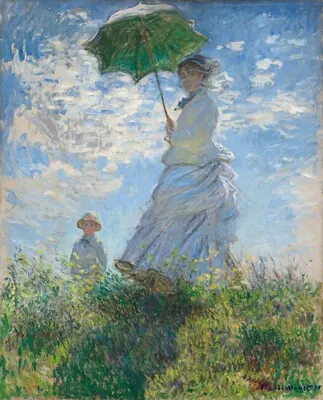
The painting’s story and details
In the summer of 1875 Monet painted his wife Camille and their son Jean on a walk. The family lived at Argenteuil, a suburb where Parisians arrived by train for leisure beside the Seine. Other leading Impressionists also worked there. Everyday life beside the rapidly growing city supplied new subjects. Monet gave this family encounter on a hillside a canvas almost a metre high.
The parasol opens towards us, revealing its green underside. Light filters through the fabric, divided into sections by the ribs. Its canopy almost touches the upper edge, increasing the figure’s height. It shades Camille’s face, leaving her features in shadow although the landscape is full of sunlight. Monet retains that difference in illumination.
White strokes of the veil cross her face. Wind turns its edge and draws the fabric behind her hat. Camille’s features are painted together with that movement, without a sharp separation from the surrounding air. A yellow tone appears on her sleeve, echoing the buttercups. Her white clothes gather coloured reflections from the field and sky.
Jean stands farther away, beyond the slope of the hill. Grass conceals his lower body, and a straw hat frames his small face. The difference in elevation makes Camille look particularly tall. Yet the boy remains an independent participant in the walk: there is space between the figures, and each has turned towards the painter from a different position.
The skirt fans out to the left. Blue, violet and grey mark its folds, while thick white paint picks out the sunlit edge. Long strokes follow the fabric’s movement; short touches describe the grass. Different brushwork distinguishes firm cloth from loose vegetation even where their colours come close together.
The shadow runs diagonally down the slope towards the lower edge. Green, blue and brown strokes continue within it, and individual flowers remain visible. The ground gains depth and direction beneath the figure. In the sky, by contrast, canvas remains exposed between rapid strokes. Its pale surface participates in the clouds alongside the paint.
The museum associates the work with a single outdoor session. Yet the impression of a chance encounter depends on the precise placement of figures, parasol and shadow. Family intimacy gave the painter freedom to work quickly, and visible strokes remained part of the completed canvas.
Featured in tours
Early Impressionism. Paris 1860–1879
The Salon, the first independent exhibition, railway stations, studios and leisure on the Seine.
More paintings to compare


Period, style and subject
- Movement
- Impressionism
- Genre
- Portrait
- Medium
- oil on canvas
- Collection
- National Gallery of Art, Washington
- Dimensions
- Overall, 100 × 81 cm
- Accession number
- 1983.1.29
Sources
Reproduction of a public-domain artwork. Image licence