Stacks of Wheat (End of Summer)
Claude Monet · 1890–91
Explore the painting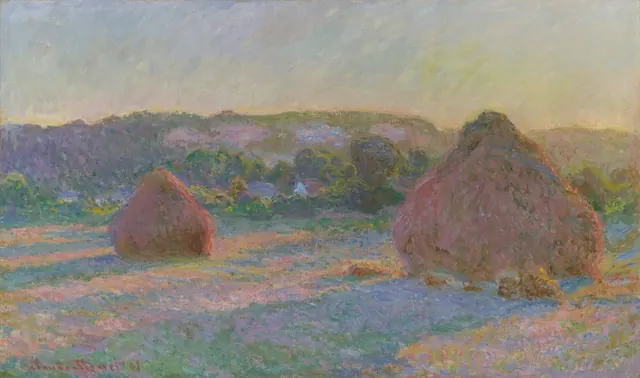
The painting’s story and details
Wheat stacks near Monet’s home at Giverny became the subject of a major series in 1890–91. He worked at several easels outdoors, then continued in the studio. A recurring object allowed comparisons of light, weather and season. Fifteen canvases hung together in a small room at Durand-Ruel’s Paris gallery in May 1891, bringing exceptional critical and financial success.
The large stack on the right rises above the distant ridge. These structures reached roughly five to six metres high. A massive conical form offered a stable subject under changing illumination. Warm and cool touches vary across its summit and slopes.
A smaller stack sits farther away on the left. Repetition establishes space and allows comparison of related volumes. Differences of colour and light remain. Even within one canvas, the series’ principle operates: similar forms reveal changes in their relations with surroundings.
A violet ridge crosses behind the field. Its colour connects with foreground shadow across a considerable distance. Shared relationships hold the landscape together. Studio work allowed Monet to refine this coherence after rapid outdoor observation.
Green trees fill the interval between stacks, with small pale buildings beyond. An agricultural structure belongs to inhabited ground beside the artist’s house. The museum connects stacks with sustenance and survival: harvest underlies these simple shapes.
Pale yellow and bluish strokes cross the sky. Visible marks combine into soft late-summer illumination. The large stack’s summit breaks the horizon. In most winter views, the museum notes, surrounding bands of field and hill enclose the stacks more fully within the landscape.
Green, pink and violet passages share the earth. Shadow becomes coloured and open areas answer the sky. Close viewing reveals a complicated surface instead of a uniform field colour. Many small comparisons sustain the whole impression.
The series changed the presentation of an ordinary rural subject. Exhibition visitors could compare paintings side by side, and their success strengthened Monet’s market position. Poplars, Rouen Cathedral and his garden followed. Stacks retained their connection with harvest while becoming instruments of pictorial research. Grain’s practical value and the new value of serial images belong to the same history.
More paintings to compare


Period, style and subject
- Movement
- Impressionism
- Genre
- Landscape
- Medium
- Oil on canvas
- Collection
- Art Institute of Chicago
- Dimensions
- 60 × 100.5 cm
- Accession number
- 1985.1103
Sources
Image provided under CC0. Image licence
Adapted and translated from Art Institute of Chicago materials. · Text licence