Arrival of the Normandy Train, Gare Saint-Lazare
Claude Monet · 1877
Explore the painting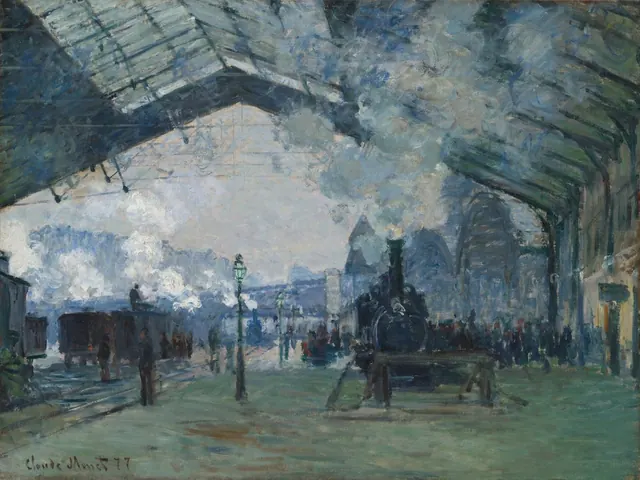
The painting’s story and details
Early in 1877, Monet obtained permission to paint inside the Gare Saint-Lazare. He knew the route well: trains connected his home in Argenteuil with Paris, where dealers and patrons conducted the business of art. His friend and fellow painter Gustave Caillebotte helped him rent a nearby studio. A place of regular travel became a major subject. This is one of twelve station views he painted that year, exploring how steam, light and movement transformed the industrial city.
The glass roof rests on metal beams. Their lines are clearest on the left; on the right, much of the structure disappears in steam. Examination revealed that Monet initially painted the grid on the right too, then covered it with pale strokes. The building’s visibility changed during work on the canvas. He decided how much structure to leave before our eyes and how much to dissolve into the air.
The cloud above the locomotive consists of white, blue and grey strokes. Some mix into wet paint; others lie over dried layers. Museum researchers conclude that the painting took several sessions and was probably continued in the studio. Its loose handling readily suggests an instantaneous record, yet the paint preserves repeated decisions. Describing rapidly vanishing steam required time.
The dark locomotive faces almost directly towards us. Its chimney and rounded front remain recognizable through the haze, with small human figures beside it establishing its scale. By 1870, Saint-Lazare handled around eleven million suburban passengers a year. Railways made frequent travel between Paris and its suburbs possible. Monet’s own way of life depended on those connections too.
Passengers stand on the platform, while railway workers are active on the left. Faces are mostly indistinct, though some poses and garments remain legible. Monet conveys a busy place without supplying each person’s story. This is an important limit of the painting. We see the station’s activity but learn little about working conditions or differences among passengers. Another painter could have built a very different account from the same setting.
The foreground tracks converge into the distance, while the green lamp rises towards the glass canopy’s apex. These guiding lines orient us among steam and loose strokes. Monet made pencil sketches of the station, an unusual practice for him. A noisy place in constant motion required thought about the placement of the principal forms. Carefully organized space remains beneath the impression of bustle.
Behind the train are the arched bays of the parcel depot. Monet chose the part of the station where trains from Normandy arrived, a detail preserved in the painting’s title. The station expanded as passenger traffic and Paris itself grew. Service buildings, glass canopies and new tracks offered artists an urban landscape changing alongside its inhabitants’ habits.
In April 1877, Monet exhibited this painting with six other Saint-Lazare views at the third Impressionist exhibition. Émile Zola praised their sense of moving trains and billowing smoke. The collector Ernest Hoschedé had bought this work before the exhibition opened. An image of an operating station found both an audience and a buyer. Showing several versions together invited comparisons of viewpoint, lighting and detail. Such a way of working and exhibiting would later become central to Monet’s series.
Featured in tours
For children. Everyday life before us
Homes, school, trains and games in twelve paintings. For ages 8–12 and adults.
Early Impressionism. Paris 1860–1879
The Salon, the first independent exhibition, railway stations, studios and leisure on the Seine.
More paintings to compare


Period, style and subject
- Movement
- Impressionism
- Genre
- Landscape
- Medium
- Oil on canvas
- Collection
- Art Institute of Chicago
- Accession number
- 1933.1158
Sources
Open-access Art Institute of Chicago reproduction, CC0. Image licence