The Japanese Footbridge
Claude Monet · 1899
Explore the painting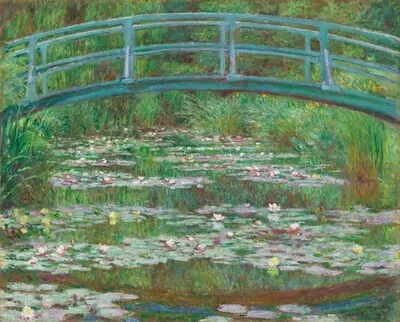
The painting’s story and details
This pond came into being partly for painting. Monet wanted a water garden that would please the eye and provide new subjects. In 1893 he bought land beside his home at Giverny and secured permission to divert water from a stream. He chose the plants, the pond’s shape and the bridge. Years of practical work on the property preceded this 1899 painting.
The bridge’s arc crosses almost the whole canvas. Blue-green railings provide a stable shape among the foliage’s small strokes. Monet collected Japanese prints, whose bridges helped inspire the garden structure. His interest in another artistic culture literally changed a French plot of land before entering European painting.
Beneath the bridge, water lilies lie in transverse bands. Farther away the bands draw closer together, leaving narrow gaps of dark water. The small pond gains depth without a distant horizon. Flowers stay on the surface while reflected greenery seems to descend below it; two different spatial arrangements occupy the same patch of canvas.
Pink and pale-yellow flowers rise above flat leaves. Monet planted cultivated water lilies selected from a catalogue. Their varied colours belong to both nature and horticulture. Cultivation, the plant trade and care for the water underlie this beauty. A gardener removed dead leaves, maintaining the view the painter returned to repeatedly.
Tall grass conceals the left bank. Behind the bridge, foliage fills the opening and leaves almost no sky. Monet cropped the garden tightly, making a small area feel enclosed by greenery on every side. Paths and property boundaries remain outside the image. Within it are water, plants and a single human-built arc.
At the bottom, the bridge’s reflection curves into a dark band. Leaves and pale patches interrupt its outline. The reflected object is much less stable than the actual bridge above. Monet would increasingly paint close views of such areas of water, later removing both bridge and banks from many compositions. Lilies and reflections would fill the canvas.
In 1899 Monet completed twelve views of the bridge; this painting was shown at Durand-Ruel’s in 1900. The series allowed comparison of one garden in different conditions. The painter had his own place of observation, arranged to his taste and sustained by daily work. Even this apparently immediate landscape depends on human choices made before the first brushstroke.
More paintings to compare


Period, style and subject
- Movement
- Impressionism
- Genre
- Landscape
- Medium
- oil on canvas
- Collection
- National Gallery of Art, Washington
- Dimensions
- Overall, 81.3 × 101.6 cm
- Accession number
- 1992.9.1
Sources
Reproduction of a public-domain artwork. Image licence