Young Woman Sewing
Pierre-Auguste Renoir · 1879
Explore the painting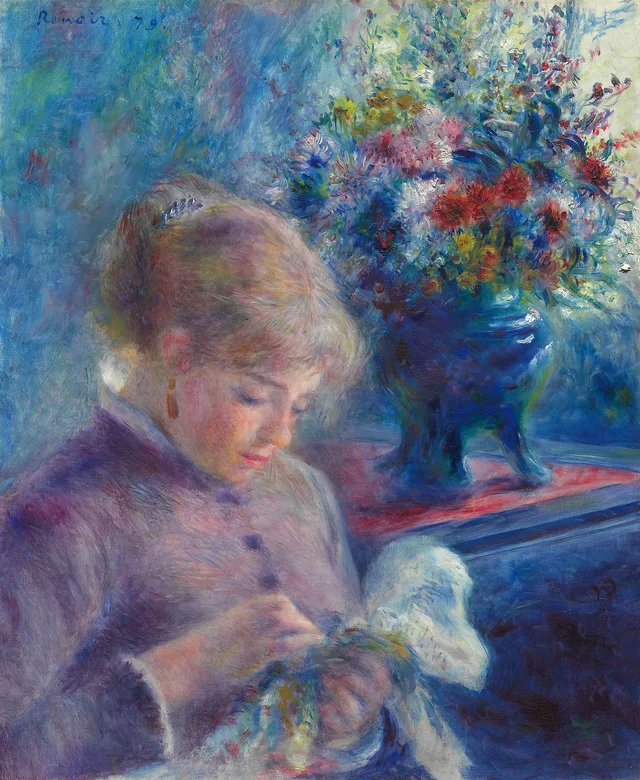
A young woman bends over needlework in a bright room. Renoir painted her in 1879, when scenes of everyday life were central to his art. The museum suggests that the model may have been Aline Charigot, his future wife, but the identification remains uncertain. The picture reveals much about the activity, colour and construction of a domestic image even without securely connecting the face to a particular biography.
Her eyes are lowered towards the fabric. Pink and golden tones make the face brighter than the lilac dress. Renoir avoids a hard boundary between hair and background. Blue and lilac tones pass from the room towards the head, joining the figure to the surrounding light. Concentration emerges through posture and gaze, without an emphatic gesture turning an ordinary activity into theatre.
A coloured pattern is visible on the fabric. An early label on the painting’s reverse described the woman as embroidering, and the museum study preserves that distinction. Mending clothing could be a necessity or paid employment. Decorative embroidery in a comfortable household carried a different social meaning. Similar movements of a needle belonged to different circumstances. The painting supplies no household accounts, but encourages closer attention to activities often grouped under the general term sewing.
The bouquet on the right is painted with noticeably thicker touches than the face. Red, yellow and white flowers gather around the blue that dominates the whole picture. Their proximity shows how primary colours can intensify one another. This domestic scene nevertheless approaches the chromatic energy of Renoir’s landscapes. He brings an investigation of light indoors, where even a still bouquet seems filled with small variations and reflections.
The blue vase stands on a reddish surface. A few highlights describe its rounded body, while dark feet lift it above the table. The furniture’s edge runs diagonally towards the woman. Objects serve both as spatial supports and independent areas of colour. Covering the figure would leave an almost complete still life. Renoir combines two familiar genres, allowing surrounding things to contribute to the portrait’s atmosphere without explanatory symbolism.
A lilac dress, white fabric and blue surroundings connect through numerous intermediate tones. Contours remain fluid, yet hands and face are legible. Such painting asks the viewer to vary the viewing distance. Close up, individual brushmarks appear; farther away, they combine into a recognisable activity. Apparent ease depends on deciding what to emphasise and what can remain indistinct. The movements of the hands are crucial, organising the model’s entire attention.
Renoir admired Dutch paintings of domestic activities, including Vermeer’s Lacemaker. Here that tradition continues through Impressionist colour. Yet a comforting image of women’s work merits attentive scrutiny. It can convey concentration and skill while also reinforcing an idea of the home as a woman’s natural place. The picture cannot be reduced to either judgement. Its specificity lets us consider both without losing sight of a person engaged in delicate work.
Featured in tours
Domestic life. Leisure and care
Sixteen paintings about reading, music, children and the work that makes domestic comfort possible.
More works by Pierre-Auguste Renoir
 Pierre-Auguste Renoir
Two Sisters (On the Terrace)
 Pierre-Auguste Renoir
Acrobats at the Cirque Fernando (Francisca and Angelina Wartenberg)
 Pierre-Auguste Renoir
By the Seashore
 Pierre-Auguste Renoir
Madame Charpentier and Her Children
 Pierre-Auguste Renoir
Dance at Le Moulin de la Galette
 Pierre-Auguste Renoir
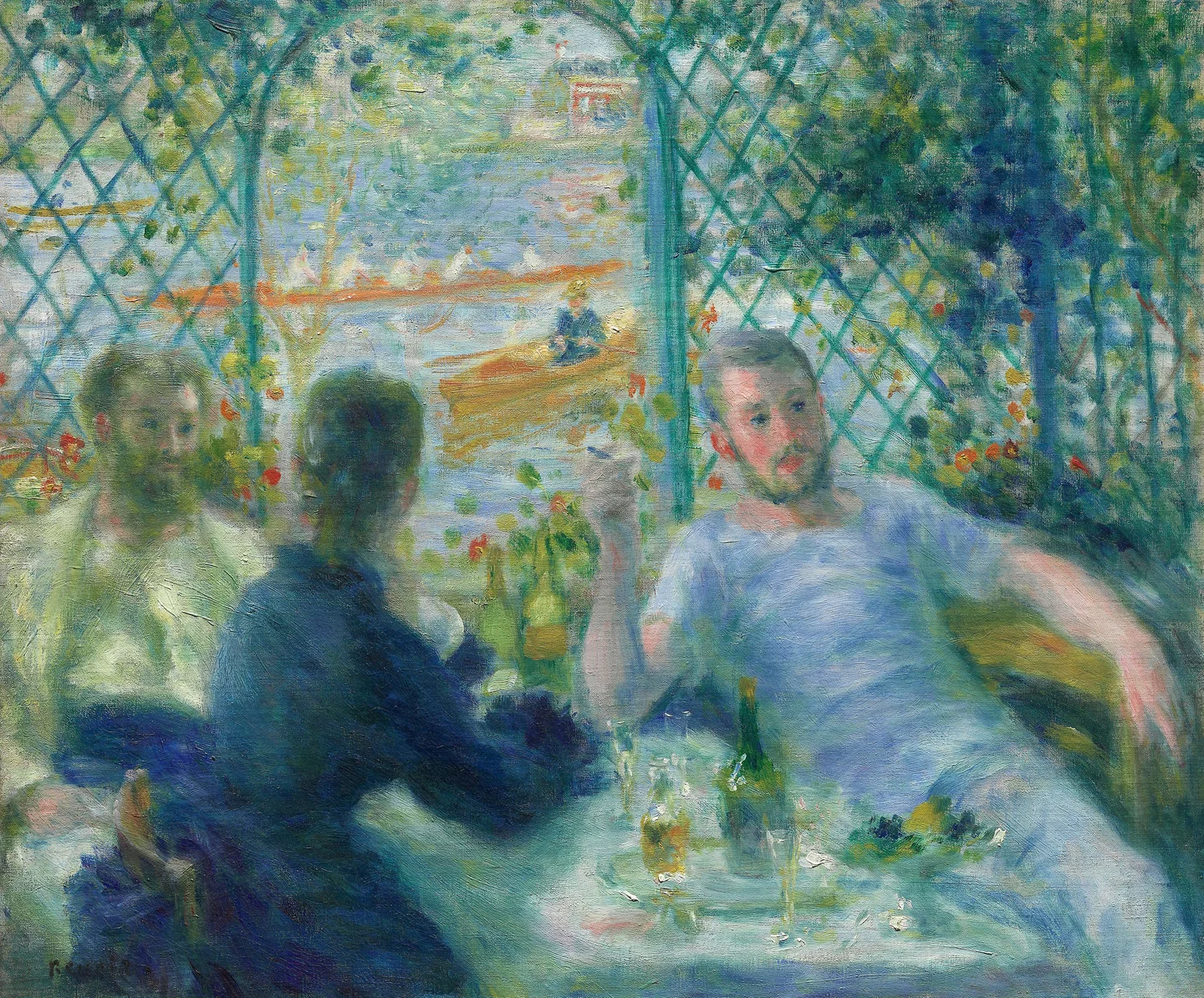
Lunch at the Restaurant Fournaise (The Rowers' Lunch)
- Medium
- Oil on canvas
- Collection
- Art Institute of Chicago
- Accession number
- 1933.452
Sources
Wikimedia Commons reproduction. Public domain. Image licence