Acrobats at the Cirque Fernando (Francisca and Angelina Wartenberg)
Pierre-Auguste Renoir · 1879
Explore the painting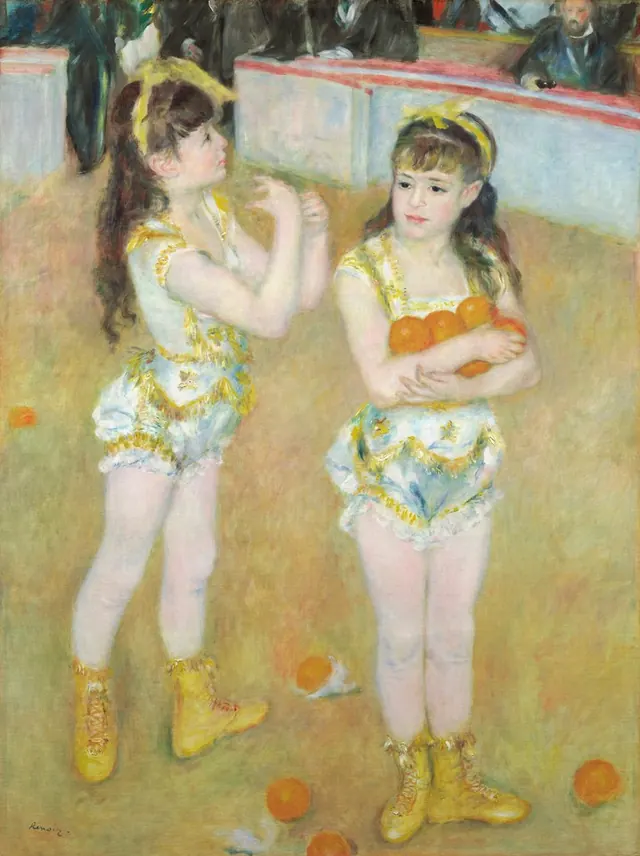
The painting’s story and details
The oranges in the younger girl’s arms long misled viewers. Renoir’s painting was described as a scene of jugglers. A participant’s own recollection eventually restored the event. Francisca and Angelina Wartenberg have finished performing at the Cirque Fernando, and the audience has thrown fruit in appreciation. Their history proved more accurate than the familiar museum title.
Francisca, on the left, acknowledges the spectators. With the museum’s accepted dating, she would have been about seventeen and Angelina about fourteen. Both look younger in the painting. Their family history helps reveal how Renoir altered their appearance. He gave experienced performers poses resembling ballet and surrounded them with warm, gentle colours.
Angelina holds the collected oranges against her body. In a 1938 letter she identified herself and her older sister and explained the fruit. This late testimony restored names to the figures and let one of them explain her own action. Before it became known, even Renoir’s biographer had described juggling.
The orange fruit repeats the colours of costumes, footwear and the illuminated ring. Renoir binds the figures through a warm palette. A reward significant to the performers also becomes material for painting. Social exchange and the organisation of colour operate together.
White stockings and golden shoes emphasise Francisca’s legs. The tall canvas gives the girls almost full-length representation. Its scale recalls a formal portrait, although no family commission is established. Circus performers receive attention often reserved for people of high status.
Angelina’s shoes stand out against the pale floor. Scholar Douglas Druick suggested that the girls posed in the studio by daylight. Renoir disliked circus gaslight because it distorted faces. This hypothesis helps explain their warm skin tones and composed poses. The picture may combine observation of the arena with separate work on the figures.
Oranges remain scattered across the floor after the ovation. They preserve a trace of the completed act, while its risks and physical demands remain unseen. The viewer receives a pleasant moment of recognition. The labour that made it possible falls outside the chosen scene.
Men along the upper edge are almost cropped away. The audience remains essential to the spectacle without receiving detailed portraits. The girls occupy most of the painting, yet their working lives depend on those who watch and pay. Soft colour and attractive costumes can make that dependence easy to overlook.
The work was exhibited in 1879 and later entered Bertha Palmer’s collection. Its history combines Parisian entertainment, pictorial experiment and collecting. Angelina’s letter added a performer’s voice. With it, the cheerful scene also became an account of two particular working girls.
Featured in tours
Early Impressionism. Paris 1860–1879
The Salon, the first independent exhibition, railway stations, studios and leisure on the Seine.
More paintings to compare
 Pierre-Auguste Renoir
Two Sisters (On the Terrace)
1881 Pierre-Auguste Renoir
By the Seashore
1883 Pierre-Auguste Renoir
Madame Charpentier and Her Children
1878 Pierre-Auguste Renoir
Dance at Le Moulin de la Galette
1876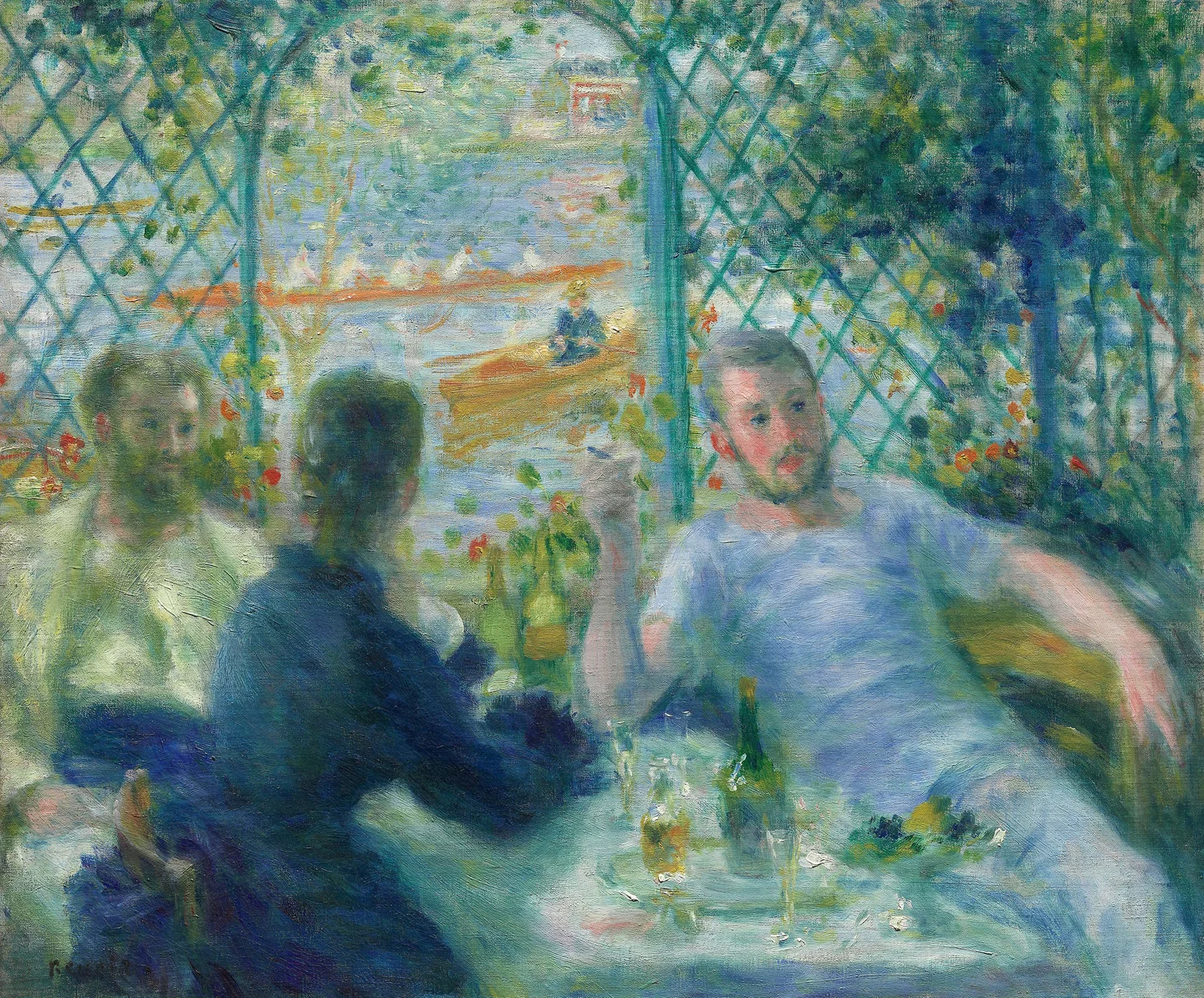 Pierre-Auguste Renoir
Lunch at the Restaurant Fournaise (The Rowers' Lunch)
1875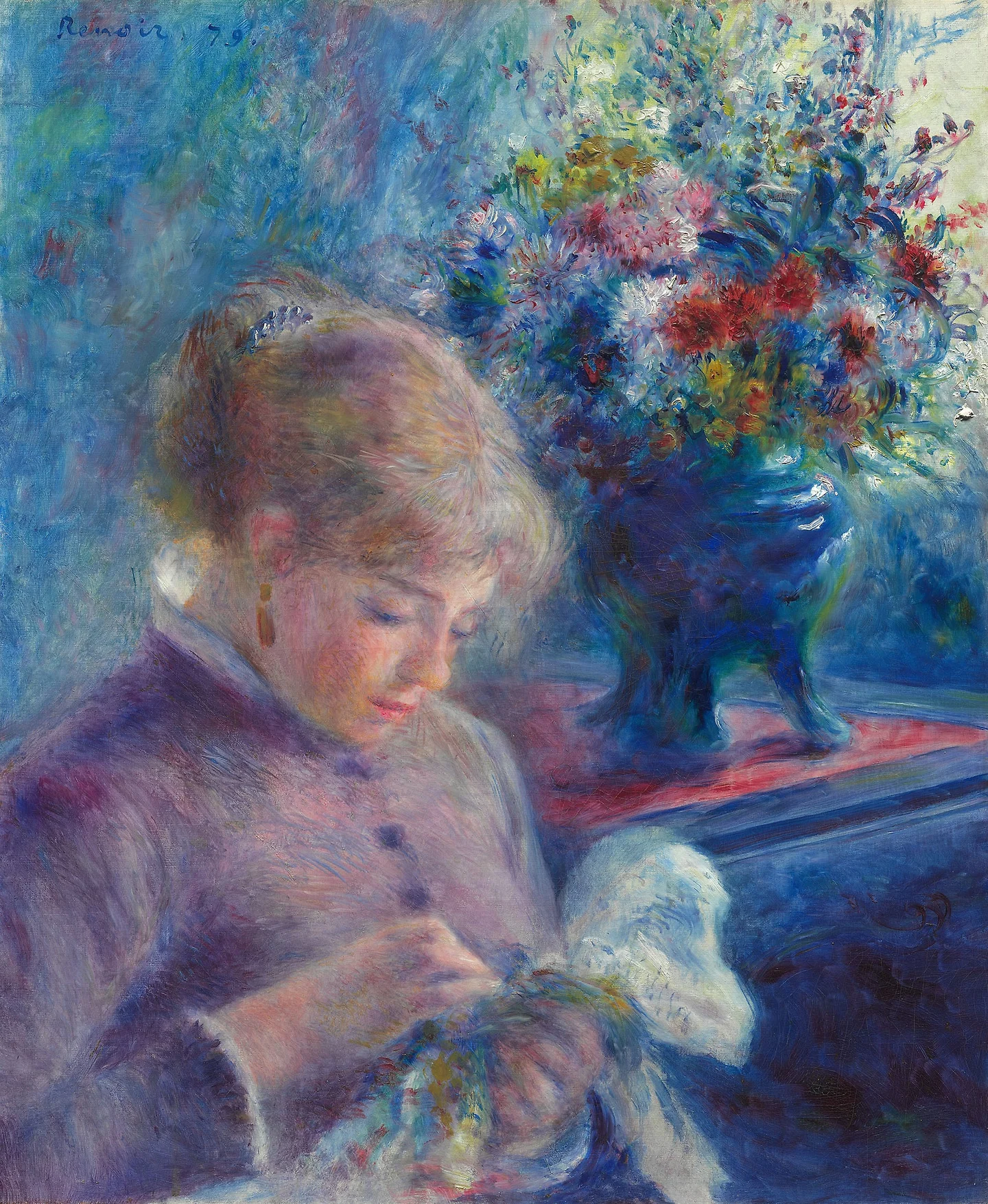 Pierre-Auguste Renoir
Young Woman Sewing
1879Period, style and subject
- Movement
- Impressionism
- Genre
- Everyday life
- Medium
- Oil on canvas
- Collection
- Art Institute of Chicago
- Dimensions
- 131.2 × 99.2 cm
- Accession number
- 1922.440
Sources
Image provided under CC0. Image licence
Adapted and translated from Art Institute of Chicago materials. · Text licence