Charing Cross Bridge, London
Claude Monet · 1901
Explore the painting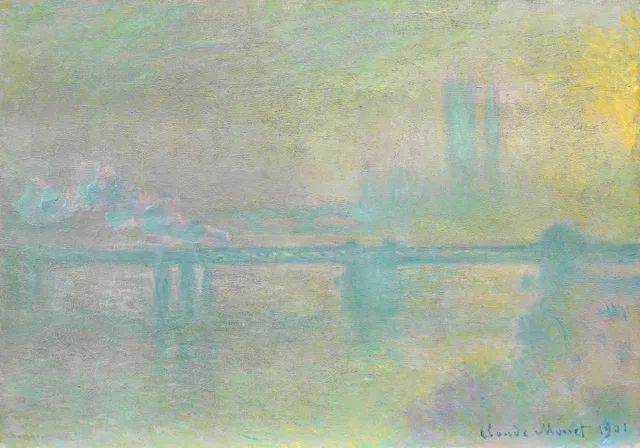
Monet looks across the Thames from the Savoy Hotel. Beginning in autumn 1899, he produced almost a hundred London paintings, repeatedly using three views: two bridges and the Houses of Parliament. This Charing Cross Bridge canvas is dated 1901. Repetition allowed him to observe how sunlight, fog, and industrial smoke altered the same structure.
The bridge crosses the canvas as a long blue-green band. Supports and openings above the water are faintly visible beneath it. This rectilinear structure organizes the space even as its edges dissolve. A few stable directions let us reconstruct the bridge, while the surrounding surface records the atmosphere through which it is seen.
At left, blue and pink puffs rise above the bridge. Steam and smoke belong to the working railway city. Within the painting, they receive as much attention as water or clouds. Industry physically transforms the landscape by filling the air through which light travels and familiar outlines disappear.
The towers of Parliament barely emerge beyond the bridge. They appear lighter and softer than the nearer structure despite their massive size. This contrast creates distance without a sharply drawn perspective. Allowing the silhouette to emerge gradually resembles looking toward a far bank through actual fog.
Yellow light spreads through the sky at right and reappears on the water without a firm boundary. Small passages of pink, blue, and green modify its warmth. Illumination connects different surfaces, and the bridge provides the principal distinction between the sky and river.
Short brushstrokes interrupt longer bands of color across the lower canvas. Their combinations create the water. Nearby, marks and canvas texture become prominent; at a distance, an unstable reflection appears. The paint remains materially visible while also suggesting light on a moving surface.
The beauty of this London depends partly on the industrial city’s atmosphere. Knowing where the haze came from introduces tension between the image’s appeal and the conditions that produced it. Monet investigated visual effects; his series also allows us to ask how a city’s history enters a landscape through color and visibility.
More works by Claude Monet


- Medium
- Oil on canvas
- Collection
- Art Institute of Chicago
- Accession number
- 1933.1150
Sources
Painting in the public domain. Digital reproduction CC BY-SA 4.0; resized and tiled. File uploaded to Wikimedia Commons by Maltaper. Image licence
Art Institute of Chicago / Wikimedia Commons. Uploaded by Maltaper. CC BY-SA 4.0. · Licence
