Madame Léon Clapisson
Pierre-Auguste Renoir · 1883
Explore the painting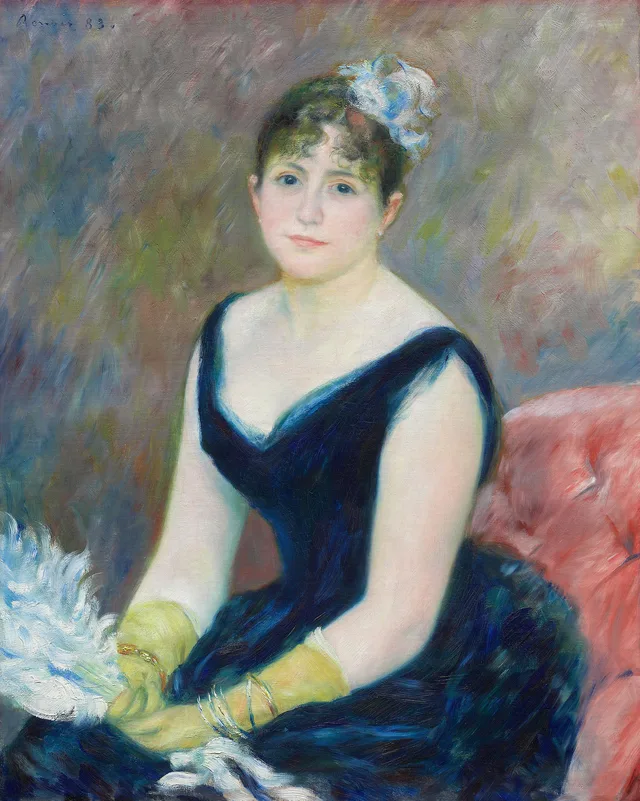
Renoir painted Marie-Henriette-Valentine Clapisson in 1883. She was thirty-three and dressed for a ball. Commissioned society portraits provided income and access to wealthy buyers. Here he carefully represents an expensive costume while retaining the loose brushwork that had previously provoked public criticism. This painting also has another history: its present colours differ considerably from those seen by its first viewers.
Her head turns towards us, with her gaze directed slightly aside. Small strokes around the eyes and lips define the face more clearly than the background. Yet the pale skin is not isolated by a rigid contour. Colour transitions remain visible near her hair and shoulders. Renoir preserves the sitter’s identity while allowing paint to remain evident on the portrait’s surface.
The deep blue of the dress echoes her eyes. Bare shoulders, a fitted bodice and an elongated silhouette belong to contemporary evening fashion. The gown forms a large dark area at the centre, making her skin appear particularly pale. The costume communicates her social position while helping the painter organise the major relationships of colour.
Yellow gloves gather near her knees. Their warm colour stands out against the cool dress, and brief pale touches mark the bracelets’ gleam. The hands appear naturally settled, but technical examination revealed that Renoir altered their position several times. The finished portrait’s ease emerged through revisions that researchers can now detect beneath the paint.
The fan’s feathers are painted with light strokes near the left edge. A related ornament appears in her hair. These accessories occupy considerable space while suggesting almost no weight. Their blurred edges soften the gown’s firm silhouette. A nineteenth-century viewer would recognise the fan as part of fashionable social behaviour, helping establish both the costume and the occasion it was designed for.
The grey-green background was once much more saturated. A red pigment derived from cochineal has faded. More vivid areas survive along edges protected by the frame. Museum specialists analysed the pigments and produced a digital reconstruction of the likely colour relationships. It reveals how differently the pale face may once have appeared against its red surroundings.
This portrait is worth remembering whenever we encounter older paintings. What we call an artist’s palette can include changes the artist never intended. Here the material history of paint affects even our impression of the sitter’s character. The museum preserves the surviving original, while research allows us to compare it mentally with an earlier state without repainting the canvas.
More works by Pierre-Auguste Renoir
 Pierre-Auguste Renoir
Two Sisters (On the Terrace)
 Pierre-Auguste Renoir
Acrobats at the Cirque Fernando (Francisca and Angelina Wartenberg)
 Pierre-Auguste Renoir
By the Seashore
 Pierre-Auguste Renoir
Madame Charpentier and Her Children
 Pierre-Auguste Renoir
Dance at Le Moulin de la Galette
 Pierre-Auguste Renoir
Lunch at the Restaurant Fournaise (The Rowers' Lunch)
- Medium
- Oil on canvas
- Collection
- Art Institute of Chicago
- Accession number
- 1933.1174
Sources
Wikimedia Commons reproduction. Public domain. Image licence