Woman at the Piano
Pierre-Auguste Renoir · 1875–76
Explore the painting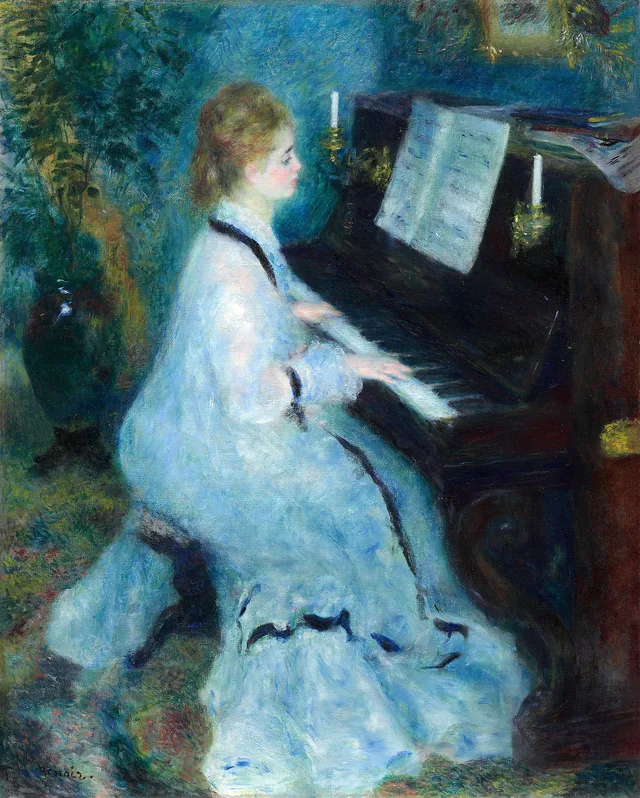
A woman plays an upright piano in a modest living room. Renoir painted this in 1875–76; it was probably shown at the second Impressionist exhibition. The sitter may be Nini Lopez, a frequent model. Musical training formed part of the upbringing of middle-class French girls. Contemporary viewers therefore recognised a familiar image of domestic culture, in which playing an instrument suggested both education and family standing.
The face appears in profile, eyes turned towards the score. Reddish hair stands out against blue surroundings, and a flush warms the pale skin. She does not pose directly for the viewer. Her activity lets the painter make another person’s presence in the room seem unobtrusive. We occupy a listener’s position, reconstructing absent music through the placement of head and hands.
Both hands rest on the keyboard, seen from slightly above. The viewpoint makes the activity unmistakable. A diagonal band of white keys crosses the dark case and connects the figure with the instrument. Renoir does not describe each finger equally. A few pale and pink strokes suffice to suggest hands engaged in movement rather than arranged motionlessly for a portrait.
The open score is brightly lit, although its notation is not meant to be read by us. It confirms that the performer follows written music. Additional sheets lie nearby. Domestic music required an instrument, teaching and practice time. Those conditions almost disappear behind the scene’s appeal, yet explain why the piano became so recognisable in nineteenth-century images of comfortable life.
Two candles are attached to the instrument. Their pale verticals echo the score and help articulate dark furniture. A vase, carpet and curtain complete the room without making it palatial. Museum research relates the setting to an ordinary bourgeois home. The objects suggest a comfort in which practising music appears a natural part of the day.
A pale peignoir fills much of the foreground. Blue and pink tones dominate its folds, while dark ribbons define the shape. Renoir makes the fabric brighter than the room’s general lighting might lead us to expect. This is a considered colour arrangement. The light figure becomes the main area against the piano, while blue reflections connect her with the interior.
Domestic music allowed a woman to demonstrate skill before family and guests. Social expectations also directed that skill into private space. The picture allows both aspects of such an education to be considered. Renoir presents an attentive performer, yet conventions of feminine domesticity surround her accomplishment. Colour and light make the scene appealing without removing the historical rules that made it legible to its first viewers.
Featured in tours
Domestic life. Leisure and care
Sixteen paintings about reading, music, children and the work that makes domestic comfort possible.
More works by Pierre-Auguste Renoir
 Pierre-Auguste Renoir
Two Sisters (On the Terrace)
 Pierre-Auguste Renoir
Acrobats at the Cirque Fernando (Francisca and Angelina Wartenberg)
 Pierre-Auguste Renoir
By the Seashore
 Pierre-Auguste Renoir
Madame Charpentier and Her Children
 Pierre-Auguste Renoir
Dance at Le Moulin de la Galette
 Pierre-Auguste Renoir
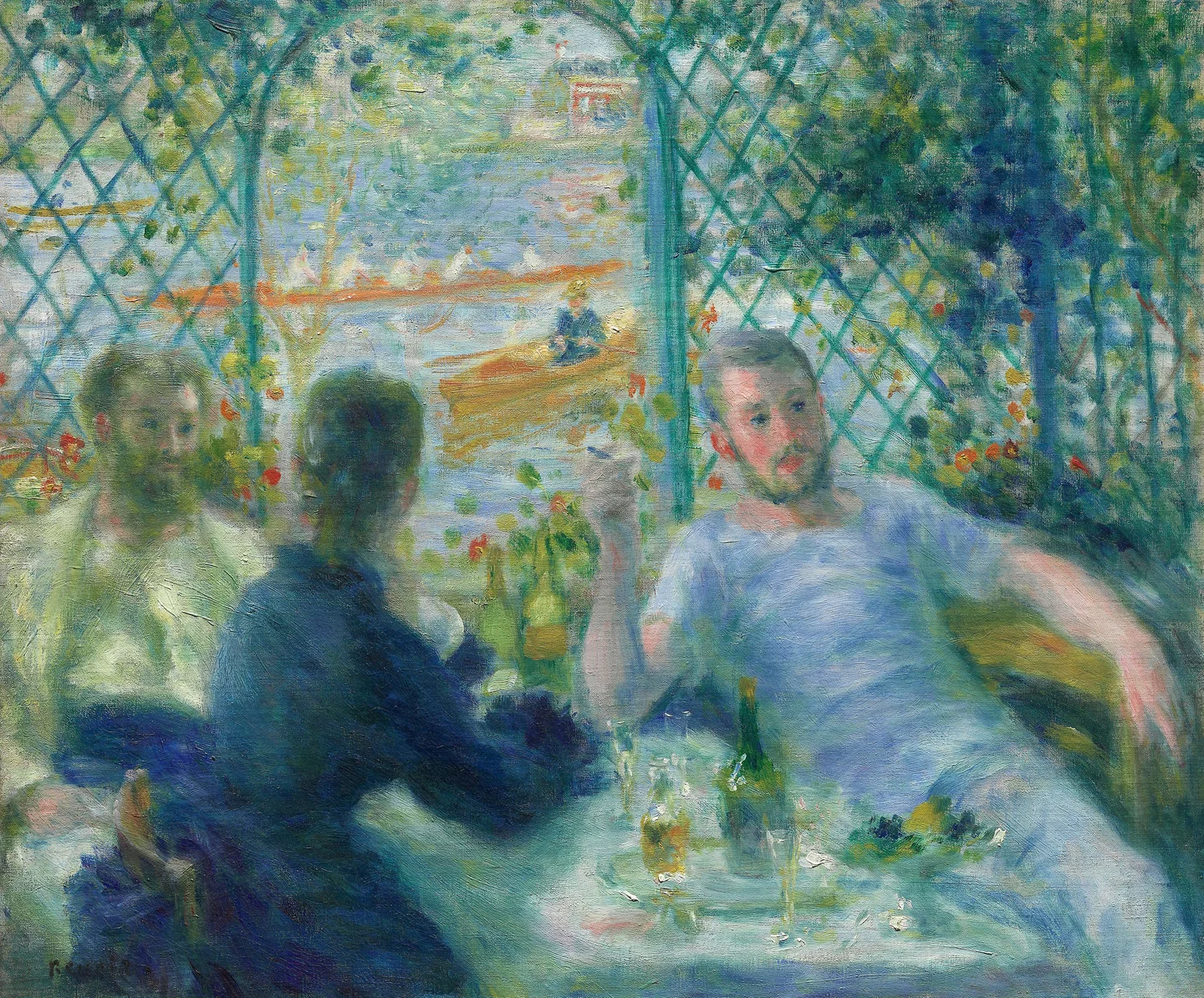
Lunch at the Restaurant Fournaise (The Rowers' Lunch)
- Medium
- Oil on canvas
- Collection
- Art Institute of Chicago
- Accession number
- 1937.1025
Sources
Wikimedia Commons reproduction. Public domain. Image licence