The Laundress
Pierre-Auguste Renoir · 1877–79
Explore the painting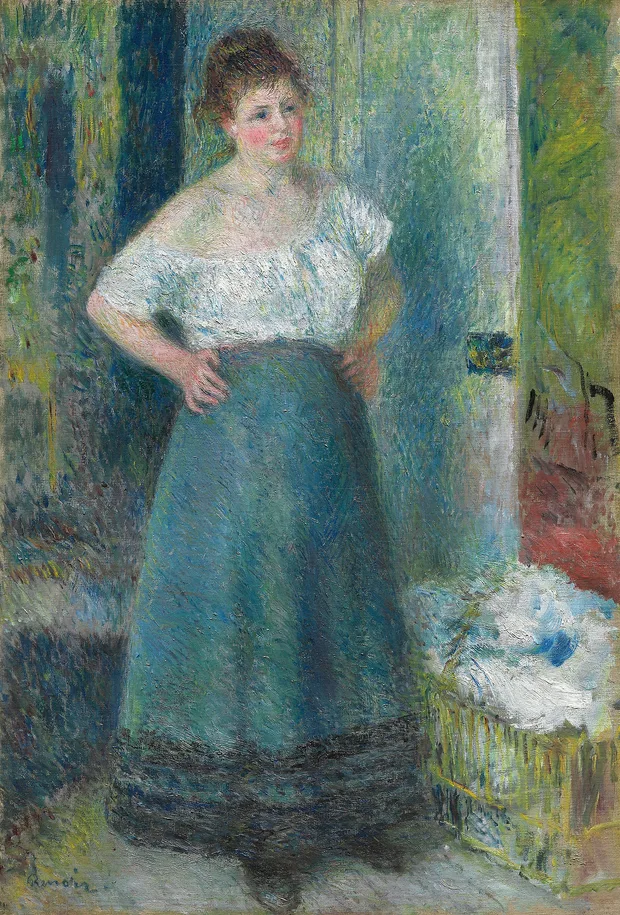
Nini Lopez, a frequent model between 1874 and 1880, posed for Renoir’s Laundress. He painted it shortly after illustrating Zola’s L’Assommoir, a novel about a Parisian laundress. Little strenuous labour is visible here. The woman has paused in a prosperous employer’s home, hands on her hips. Renoir chose a short break and made her figure the focus of attention.
Her face turns towards us, lips slightly parted. Flushed cheeks and loosely gathered hair suggest informality. Yet this is a professional model performing a role selected for a painting. The title Laundress cannot be transferred to Nini’s biography. Her work for the painter produced a convincing urban worker whom viewers could experience as a direct encounter with everyday life.
The blouse slips from one shoulder. The museum connects this motif with a nineteenth-century stereotype of laundresses as sexually available. Such a stereotype reveals much about audiences and proves little about actual women in the profession. Renoir employs a recognisable convention. The image’s appeal should therefore be considered alongside the way painting directs attention towards a working woman’s body.
A basket of laundry stands on the right. White and blue strokes suggest folded fabric without letting us count individual items. The basket provides the clearest evidence of the occupation. Without it, the title would be less obvious. This small object connects the figure with domestic service and recalls work continuing beyond the pause depicted.
Behind the basket is a stove used to heat irons. It recalls the heat and physical conditions of ironing, although nobody is ironing at this moment. That information alters the first impression created by the cool blue-green palette. Colour makes the room visually attractive, while its working equipment implies effort left outside the depicted action.
A long blue skirt occupies the centre. Short strokes in different directions connect it with curtains and wall. Its outline softens in places, while the hands and stable stance remain clear. Impressionist technique serves a figure in an interior. Light and colour extend throughout the room, linking body, clothing and objects without sharply separating important from secondary surfaces.
Comparison with the Zola illustrations clarifies Renoir’s choice. One occupation could become either social drama or an appealing everyday image. Here a few objects indicate labour, while attention concentrates on the model. We can value the painting’s freedom and also notice which parts of a worker’s life it makes visible and which it leaves outside the frame.
Featured in tours
Domestic life. Leisure and care
Sixteen paintings about reading, music, children and the work that makes domestic comfort possible.
More works by Pierre-Auguste Renoir
 Pierre-Auguste Renoir
Two Sisters (On the Terrace)
 Pierre-Auguste Renoir
Acrobats at the Cirque Fernando (Francisca and Angelina Wartenberg)
 Pierre-Auguste Renoir
By the Seashore
 Pierre-Auguste Renoir
Madame Charpentier and Her Children
 Pierre-Auguste Renoir
Dance at Le Moulin de la Galette
 Pierre-Auguste Renoir
Lunch at the Restaurant Fournaise (The Rowers' Lunch)
- Medium
- Oil on canvas
- Collection
- Art Institute of Chicago
- Accession number
- 1947.102
Sources
Wikimedia Commons reproduction. Public domain. Image licence