The Sacred Grove, Beloved of the Arts and the Muses
Pierre Puvis de Chavannes · 1884–89
Explore the painting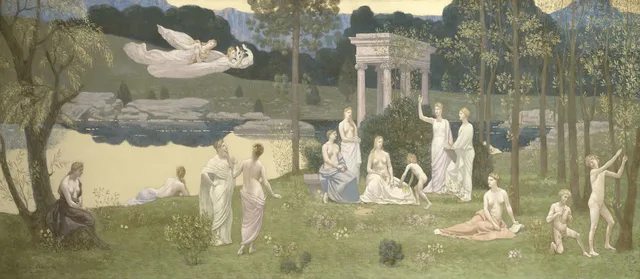
Muses and personifications of the arts gather beside the water. Painted in 1884–1889, this is a smaller version of Puvis de Chavannes’s mural for the staircase of Lyon’s Musée des Beaux-Arts. The classical grove offered museum visitors an image of a world devoted to art, giving the modern institution a symbolic ancestry in antiquity.
The central figures personify architecture, painting, and sculpture. A palette lies on the ground before them, giving an abstract concept a tangible attribute. Their different positions form a stable group. Puvis brings separate practices together as a shared culture, assigning them the composition’s central place of honor.
Two lightly draped figures float above the lake. Their horizontal movement reinforces the painting’s elongated format. Other figures stand, sit, or recline on the ground, making flight part of this world’s particular order. Bodily rest and imaginative freedom coexist without being subjected to the same rules of physical plausibility.
A small structure with columns establishes the classical setting. Its pale straight lines stand out among the slender trunks. The columns continue the rhythm of trees and figures, suggesting harmony between human culture and nature. The painter invented this ideal landscape for the wall of a public building.
Foreground figures appear in profile and from behind. One moves toward the center; another pauses near the water. Broad folds make their poses readable at a distance, an important quality for a mural viewed from a staircase at changing angles. This smaller version retains Puvis’s concern for architectural scale.
At right, figures occupy intervals between trees, with small flowers scattered through the grass. Muted greens, pinks, and blues keep individual details from projecting sharply forward. The shallow space recalls ancient wall painting. Figures and plants share a rhythm that encourages the eye to travel laterally and connect the separate groups.
The Lyon mural helped inspire Seurat’s A Sunday on La Grande Jatte. A modern riverside outing could adopt the monumental ordering of a classical scene. This connection places Puvis within the development of modern art: his stylization, measured intervals, and shallow space offered ways to reorganize even everyday subjects.
- Medium
- Oil on canvas
- Collection
- Art Institute of Chicago
- Accession number
- 1922.445
Sources
Wikimedia Commons reproduction. Public domain. Image licence