Sandvika, Norway
Claude Monet · 1895
Explore the painting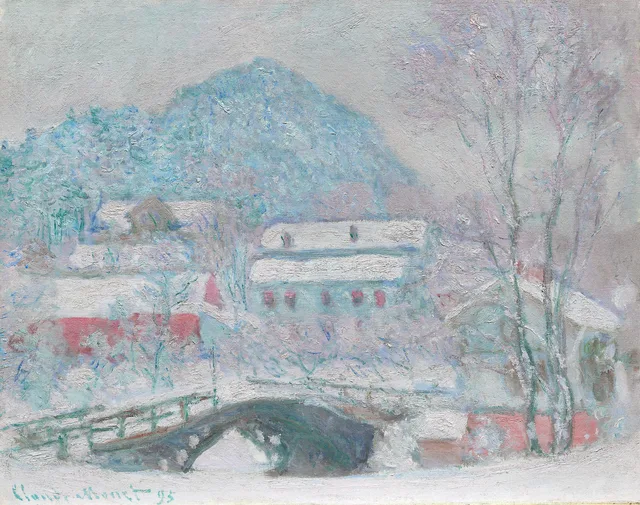
In 1895 Monet travelled to Norway to visit his stepson Jacques Hoschedé, who lived in Christiania, now Oslo. During two months he painted twenty-nine Norwegian landscapes, including at least six views of Sandvika. Working in the cold was demanding, and the initial search for suitable motifs proved frustrating. This canvas suggests what eventually engaged him. Familiar village buildings nearly dissolve into snow, while light transforms the customary colours of each object.
A dark bridge arch crosses the lower picture. Its contour provides the eye with a firm anchor while houses and hillside fade into pale air. The museum suggests that the local iron bridge may have reminded Monet of his Japanese bridge at Giverny. A similarity of form is more persuasive than treating the whole Norwegian view as an exotic fantasy. He found a familiar compositional problem in a new place and explored what a northern winter did to it.
Blue and pink strokes build the large house beyond the bridge. Its windows remain small dark marks, enough to identify a façade. Monet was not making an architectural record, yet he did not abandon the particular place. He selected features that survive snow and diffused light. The building consequently emerges gradually from the overall colour impression. This way of looking requires a pause, rather than immediately naming an object and moving on.
Reddish buildings on the left stand out among the cool tones. Their colour does not neatly fill geometric outlines, but is interrupted by white and blue touches. Snow works on several levels. It hides parts of objects, reflects surrounding colours and connects different surfaces. Up close, surprisingly little is pure white. Winter emerges from relationships among pink, greenish, lilac and blue tones, rather than a single colour conventionally assigned to snow.
The hill in the distance appears as a soft blue mass. A sharp boundary between it and the houses is difficult to draw, since the same colours pass from one distance to another. Yet its summit gives the view a stable silhouette. Monet preserves the landscape’s structure even where separate details nearly disappear. The tension between an identifiable place and unstable visibility became a central force in his mature painting, especially in series showing one motif under different conditions.
Bare branches on the right cut through the pale surface in fine lines. They establish a near foreground despite their light handling. Houses and snow remain visible through them, so the tree both divides and connects the space. No separate episode with people explains village life. Buildings, a road and the bridge preserve that human presence. This is an inhabited place temporarily transformed by weather until it seems almost deserted.
Monet arrived as a travelling painter able to turn difficult conditions into a chosen artistic challenge. For local inhabitants, the same winter was their everyday environment. The picture need not tell Sandvika’s entire history, but this distinction clarifies its viewpoint. We are drawn to the unfamiliar light encountered by a visitor. The series shows how a first impression develops into sustained investigation, and how acquaintance with a place continues through repeated observation of the same view.
More works by Claude Monet


- Medium
- Oil on canvas
- Collection
- Art Institute of Chicago
- Accession number
- 1961.790
Sources
Wikimedia Commons reproduction. Public domain. Image licence