The Song of the Lark
Jules Breton · 1884
Explore the painting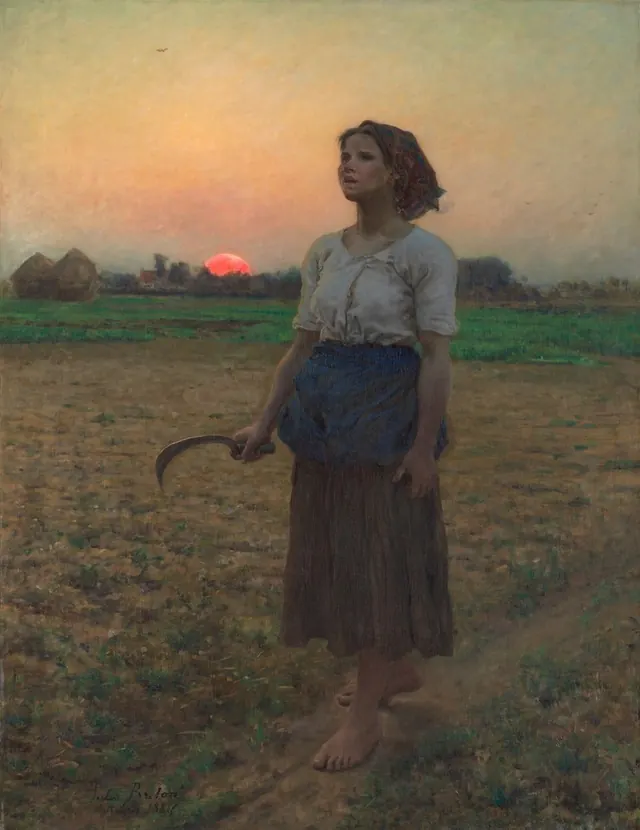
The painting’s story and details
A young woman has stopped in a field and raised her head. The museum identifies her as listening to a lark. Jules Breton painted the scene in 1884. Raised in Courrières in northern France, he repeatedly returned to rural life. A brief pause at the beginning of a working day fills a substantial canvas.
Her face turns upwards and her mouth is slightly open. The bird supplying the title does not become the principal visible subject. Breton paints a listener. Understanding the scene involves imagining a sound that painting cannot transmit. Her gaze connects the earth with the open sky.
A sickle remains in her lowered hand. It gives the pause a specific place within the day’s routine. This agricultural worker has brought her tool into the field. Work remains present while she listens and will have to resume afterwards.
Her pale blouse separates the figure from the soil. Described folds convey the fabric’s substance, while broad areas of colour keep the silhouette unified. Breton gives a peasant woman the scale and prominence often reserved in academic painting for historical and religious protagonists.
Bare feet rest on uneven ground. Rural life retains evidence of human labour. At the same time, her quiet pose and the gentle light make the countryside appealing. The museum explicitly identifies an idealization that contributed to the popularity of Breton’s rural pictures.
A red sun sits low above the horizon. Dawn explains both the lighting and her early arrival in the field. Warm light reaches her face and blouse while the earth remains dark. Breton organizes this brief morning condition around a stationary figure.
Her other hand rests against her skirt. She has no companion and displays her response to nobody. This independence matters in a picture about labour. For a moment, the worker is occupied by something she has heard herself, while the viewer observes her attention from outside.
Village buildings recede towards the left edge. They mark the world from which she has walked into the field. Breton brought rural existence into large-scale exhibition painting. Urban audiences could combine sympathy for the worker with an attractive idea of the countryside’s closeness to nature.
In 1934, Chicago Daily News readers voted The Song of the Lark America’s best-loved painting; it was celebrated at Chicago’s world’s fair. That reception belongs to another country and period. It reveals the lasting appeal of Breton’s image of labour interrupted by an individual experience.
More paintings to compare

Period, style and subject
- Movement
- Realism
- Genre
- Everyday life
- Medium
- Oil on canvas
- Collection
- Art Institute of Chicago
- Dimensions
- 110.6 × 85.8 cm
- Accession number
- 1894.1033
Sources
Image provided under CC0. Image licence
Adapted and translated from Art Institute of Chicago materials. · Text licence