Portrait of Dora Wheeler
William Merritt Chase · 1882–83
Explore the painting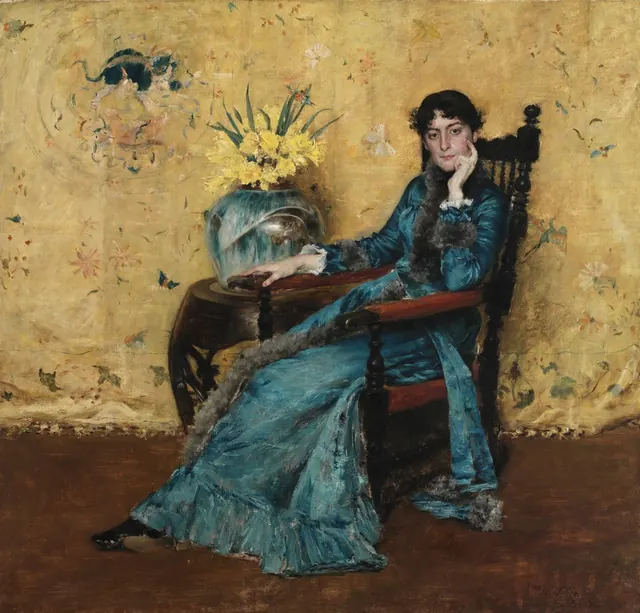
The painting’s story and details
Dora Wheeler sits among rich fabrics in a blue, fur-trimmed dress. She was an artist who also designed textiles. William Merritt Chase painted her in 1882–83, after she had become his first student in his New York studio. Few American artists then accepted women as private pupils. Behind the elegant portrait lies a story of access to professional training. The teacher presents a young artist surrounded by objects connected with her future work.
Dora rests her cheek against her fingers. Her pose is relaxed, but her well-lit face turns towards the viewer. Chase places it on the right, leaving ample space for the hanging and vase on the left. In this nearly square portrait, furnishings demand attention alongside the sitter. The arrangement shapes her presentation: Dora appears within an artistically composed interior, although no brush or drawing explicitly announces her profession.
The blue dress falls in broad folds to the floor. Pale strokes change direction with the fabric, while dark fur runs diagonally across it. Chase distinguishes surfaces through his handling of paint: the dress’s smooth sheen, soft fur and polished chair wood. Such skill was part of his professional reputation. The painting won a gold medal at an international exhibition in Munich in 1883 and was shown in Paris that same year. Through his pupil’s portrait, the teacher also demonstrated his own abilities to a European audience.
The yellow embroidered hanging relates to Dora’s occupation. In 1877 her mother, Candace Wheeler, founded a society where women could train in the applied arts and gain professional skills. In 1883 she established her own firm, Associated Artists, with Dora among its designers. The firm made both commissioned embroideries for wealthy clients and fabrics for a wider market. Familiar women’s needlework became paid work involving design, production and customers.
A large vase of yellow flowers stands to Dora’s left. Its blue-green glaze relates to the dress, while the flowers repeat the yellow background. Chase connects the objects through a few colours and contrasting textures. The vase is so large that it almost rivals the face for attention. The portrait may first appear to display luxury; only later do we learn the sitter’s profession. That delay matters: the same objects can suggest a customer or someone capable of designing them.
Dora’s right hand rests loosely on the wooden armrest. She rests in the portrait, but beyond the image she took part in public artistic life. With Chase, she helped raise money for the Statue of Liberty’s pedestal. She later acquired this portrait and gave it to the Cleveland Museum. The sitter thus became the painting’s owner and then its donor. Her part in its history continued after her teacher had put down his brush.
The artist’s profession is represented through furnishings, while the process of work stays outside the painting. This reveals how strongly the representation of a woman depended on familiar portrait conventions. A fine dress, chair and decorative textile were all appropriate to an impressive portrait. Chase used them for someone developing professional independence. With Dora’s history in mind, we can see the fabrics as products of labour and part of a business.
More paintings to compare
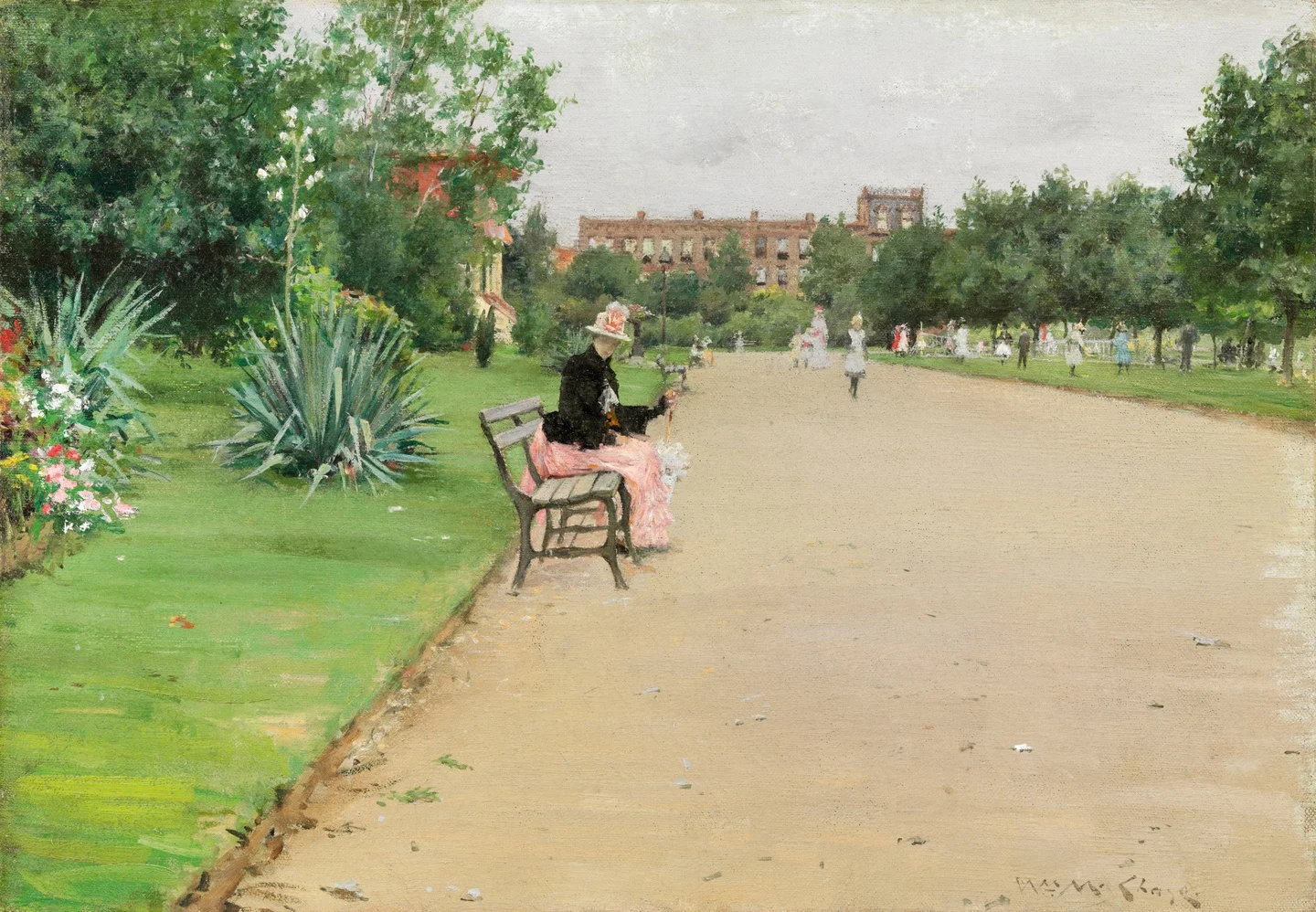 William Merritt Chase
A City Park
c. 1887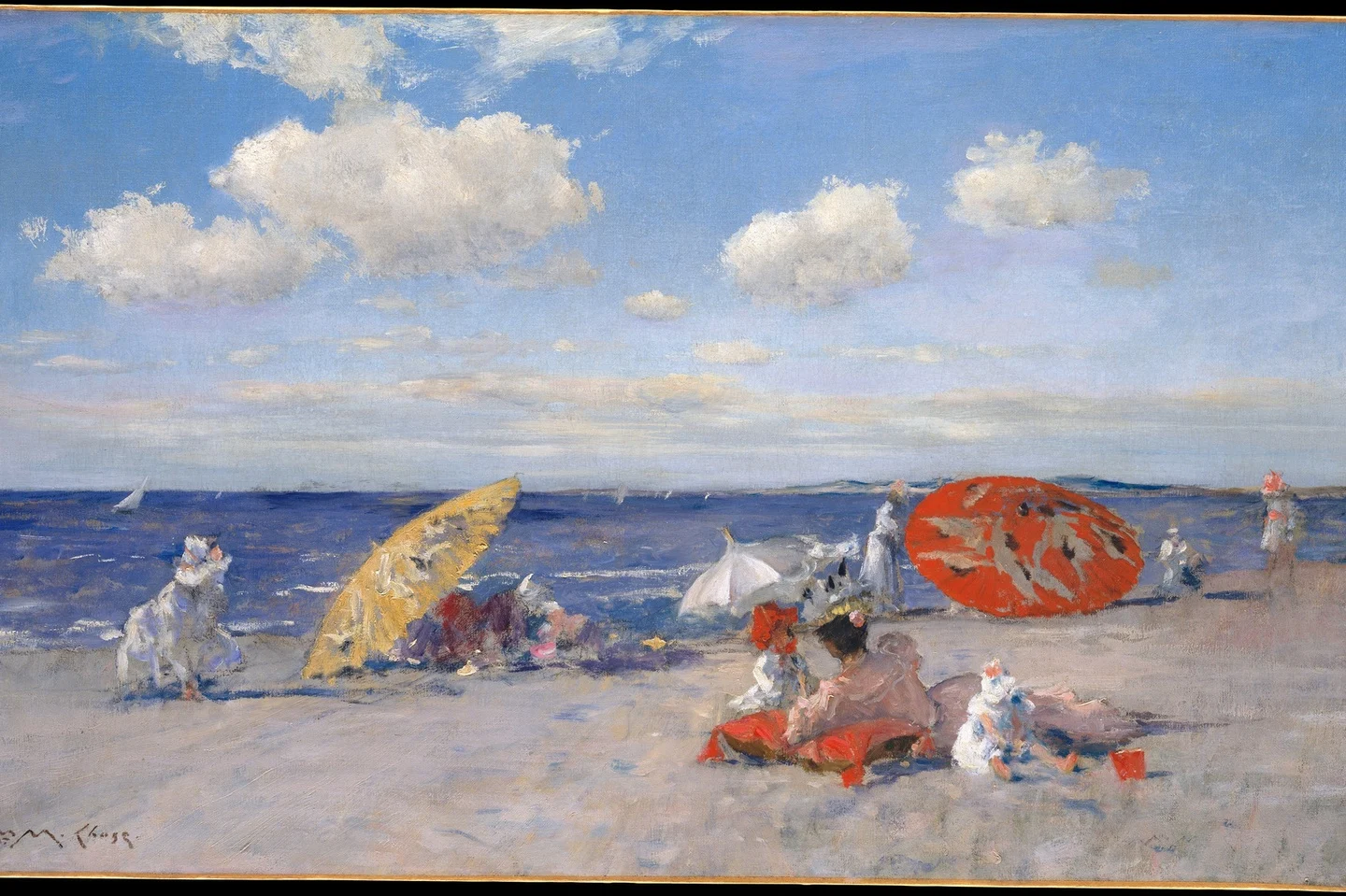 William Merritt Chase
At the Seaside
ca. 1892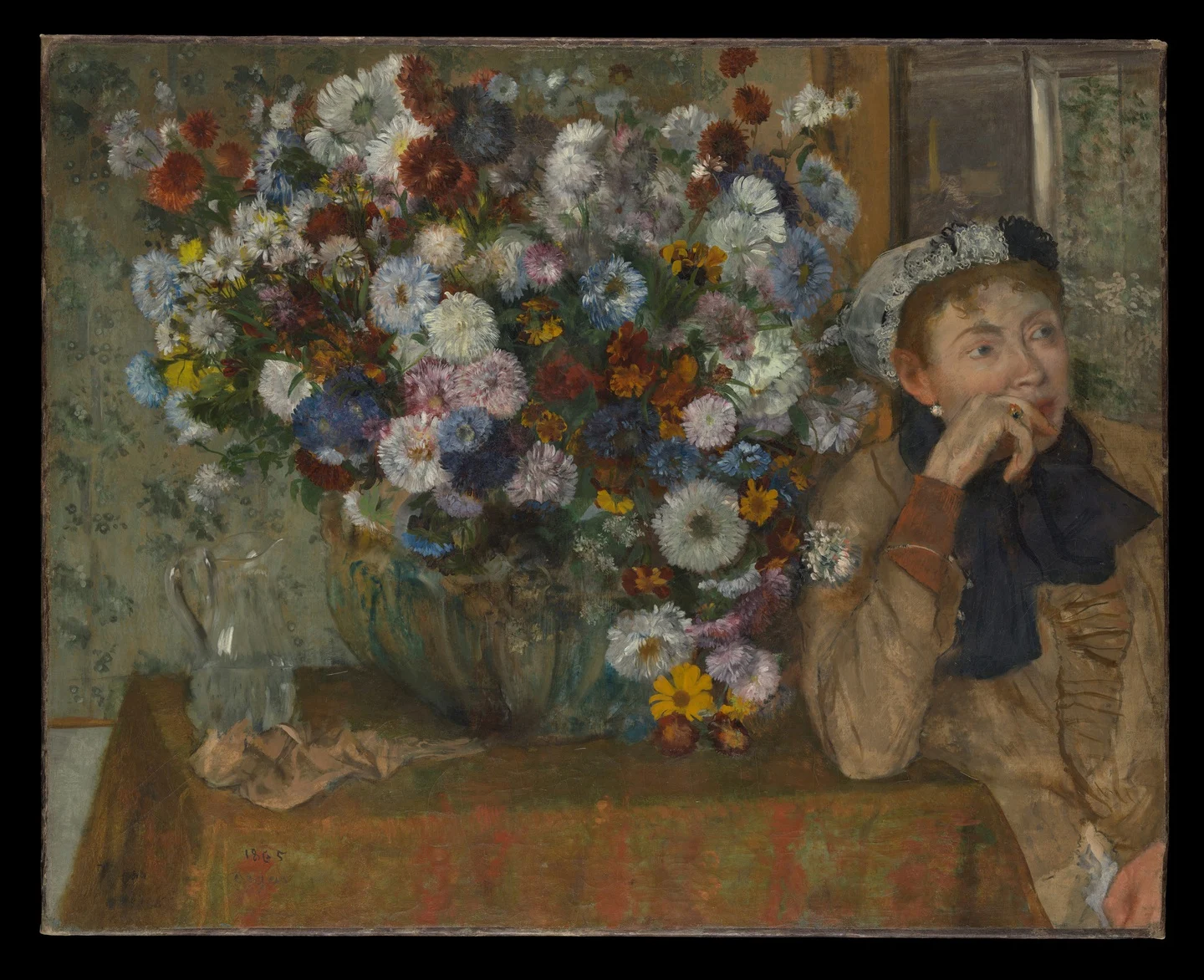 Hilaire Germain Edgar Degas
A Woman Seated beside a Vase of Flowers (Madame Paul Valpinçon?)
1865 Édouard Manet
Berthe Morisot with a Muff
c. 1871–72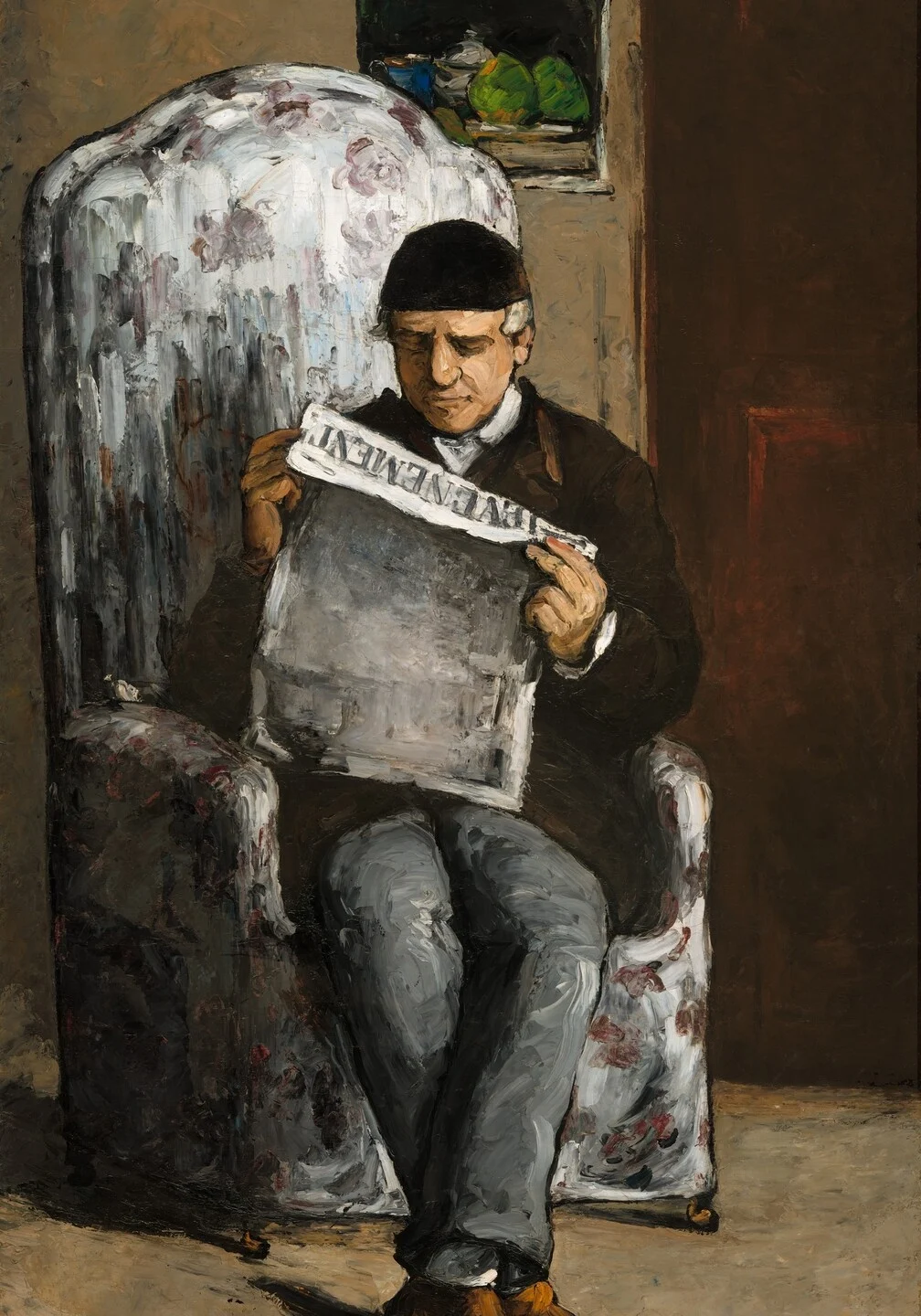 Paul Cezanne
The Artist's Father, Reading "L'Événement"
1866 Ilya Repin
Portrait of Modest Mussorgsky
1881Period, style and subject
- Movement
- Realism
- Genre
- Portrait
- Medium
- oil on canvas
- Collection
- Cleveland Museum of Art
- Dimensions
- Unframed, 159.8 × 166.4 cm
- Accession number
- 1921.1239
Sources
Image provided under CC0. Image licence