Berthe Morisot with a Muff
Édouard Manet · c. 1871–72
Explore the painting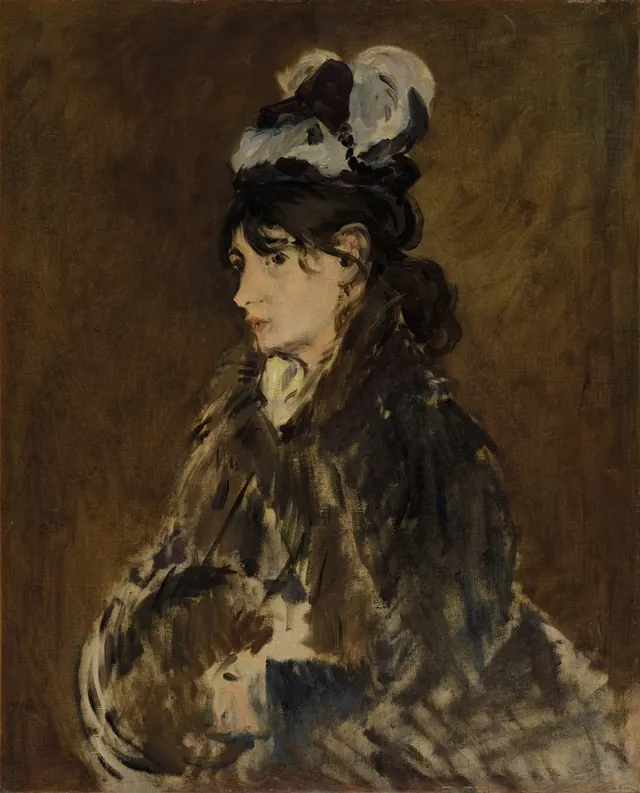
The painting’s story and details
Édouard Manet painted Berthe Morisot in winter clothes around 1871–72. She had already exhibited at the Paris Salon for several years. They met through Henri Fantin-Latour in 1868, and Manet subsequently asked her to pose on several occasions. This portrait belongs to an exchange between two practising painters. He kept this particular canvas until his death; it appears in the inventory of his studio. Its loose handling lets us see a face emerge among rapid brushstrokes.
Her head turns to the left, her eyes towards us, and her lips are slightly parted. Pale areas of forehead, nose and cheek sit beside a few dark touches. The face is painted more densely than the coat, making the features immediately recognizable. Manet chooses where to concentrate detail. We feel that we have met a living person’s gaze even though most of the surrounding form remains only suggested.
White feathers on the hat are painted with broad curves of the brush. Their edges sometimes merge with the background, while dark ornaments join the hair. A fashionable object also becomes a demonstration of painterly technique. Manet conveys a feather through the movement of a stroke without describing every barb. Compared with the face, this passage shows him moving within a few centimetres from a precise identifying feature to an almost free play of paint.
The muff at the bottom conceals her hands. A long dark outline establishes its rounded shape, with pale areas of the ground left inside. We complete its soft volume from a few clues: edge, shadow and position in front of the body. The viewer’s ability to participate lets the painter stop before the traces of work disappear. The portrait shows both winter clothing and the process of its emergence on canvas.
Broad strokes cross over the coat. The Cleveland Museum suggests that their freedom may echo Morisot’s own handling and thereby refer to her profession. On that reading, the broad strokes become part of an exchange between two painters. A fellow painter can be represented through the treatment of paint without including a palette or easel.
The brown background is almost empty of objects. Its colours are close to the coat, and parts of the silhouette disappear. This makes the pale head and elaborate hat still more noticeable. Such selection makes the encounter immediate but tells us little about the woman’s profession. Her name restores that history. This is Berthe Morisot, herself a painter of portraits and family scenes, soon to become a central participant in Impressionism.
In 1874 Morisot accepted Degas’s invitation to the independent exhibition despite Manet’s objections. She went on to participate in almost all the Impressionists’ group exhibitions. The two painters’ closeness allowed different professional decisions. This portrait can be understood as part of an exchange with two participants. Morisot offered Manet her face as a subject while pursuing a career whose direction she chose herself.
Featured in tours
Early Impressionism. Paris 1860–1879
The Salon, the first independent exhibition, railway stations, studios and leisure on the Seine.
More paintings to compare


Period, style and subject
- Movement
- Realism
- Genre
- Portrait
- Medium
- oil on canvas
- Collection
- Cleveland Museum of Art
- Dimensions
- Unframed, 74 × 60 cm
- Accession number
- 1958.34
Sources
Image provided under CC0. Image licence