The Artist's Father, Reading "L'Événement"
Paul Cezanne · 1866
Explore the painting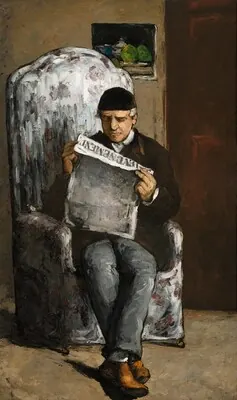
The painting’s story and details
In 1866 Cezanne painted his father almost life-size on a canvas around two metres high. Louis-Auguste was a banker and wanted his son to pursue something more secure than painting. Their relationship was difficult. Yet sitting for such a large portrait shows that family history involved more than prohibition. The young painter had the opportunity to make his father his principal model.
The face inclines towards the newspaper. A black indoor cap covers most of the hair, with grey strands visible beneath it. Forehead, nose and cheeks are built from thick light and dark areas. Cezanne preserves the head’s weight and the reader’s concentration while scarcely smoothing his brushwork.
The folded newspaper edge reads L’Événement. Cezanne’s friend Émile Zola wrote for this Parisian paper in defence of new painting. The museum notes that the artist substituted it for his father’s usual provincial reading. The banker’s hands hold a publication supporting his son’s world. That small substitution turns an ordinary domestic pose into a personal statement.
Indoor shoes and white socks appear at the lower edge. One foot comes forward, and the trousers gather in irregular folds. Comfortable clothing reduces the large portrait’s formality. Yet substantial footwear, a long shadow and the broad chair anchor the figure firmly to the floor. Domestic rest retains the weight and imposing presence of the householder.
The chair’s pale upholstery surrounds the dark clothes. Its flowers are painted in broad masses, and parts of the backrest are outlined in black. The young Cezanne developed this thick handling under Courbet’s influence. He applies it to both skin and furniture. The objects remain distinct, but all carry the same energetic handling of the paint layer.
An early still life by Cezanne hangs above his father’s head. Green fruit and vessels appear against a dark background. The son’s painting has already found a place in the home, though his professional future still caused disagreement. A small display of his own work enters the family portrait. Newspaper and still life introduce the artist without his physical presence.
The portrait brings together paternal authority, the family’s material support and the son’s ambitions. Louis-Auguste sits at the centre of his home; Cezanne chooses which newspaper he reads and which painting hangs above him. Family dependence becomes a condition of artistic experiment. Even while retaining his father’s imposing image, the son has the final say in the organisation of the canvas.
Featured in tours
Early Impressionism. Paris 1860–1879
The Salon, the first independent exhibition, railway stations, studios and leisure on the Seine.
More paintings to compare


Period, style and subject
- Movement
- Realism
- Genre
- Portrait
- Medium
- oil on canvas
- Collection
- National Gallery of Art, Washington
- Dimensions
- Overall, 198.5 × 119.3 cm
- Accession number
- 1970.5.1
Sources
Reproduction of a public-domain artwork. Image licence