The Large Plane Trees (Road Menders at Saint-Rémy)
Vincent van Gogh · 1889
Explore the painting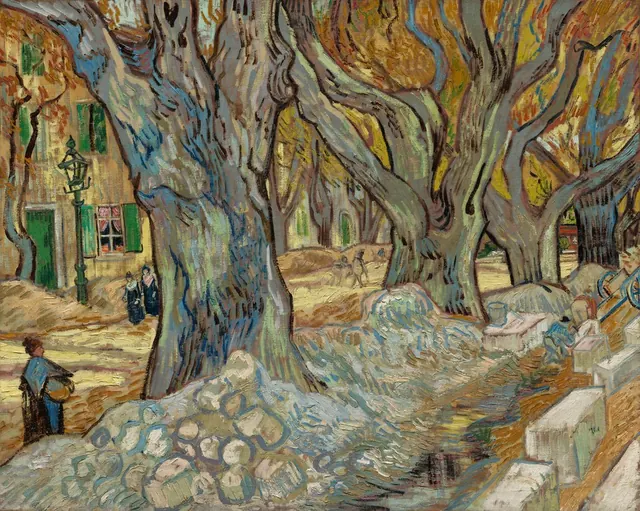
The painting’s story and details
Road workers labour beneath enormous plane trees in Saint-Rémy. Van Gogh painted this view in 1889 while receiving treatment at the local hospital and obtaining permission to work outside its grounds. He chose an ordinary street with trees, passersby and pavement repairs. The town continues its daily routine as the artist gathers it into dense movements of colour and brushwork.
Trunks occupy almost the painting’s full height. Blue-violet bands branch and bend with the trees’ growth. Shadow gains a saturated colour of its own. The plane trees consequently retain weight and volume while joining the canvas surface’s overall rhythm.
Short, separate touches describe yellow foliage. Branches and patches of cool sky appear between them. Colour density varies, making the canopy feel both continuous and permeable. Autumn emerges through bright remaining leaves and the increasingly exposed structure of the tree.
At the right, a worker bends over the pavement. His blue clothing connects with the cool bands on the trunks. His bodily angle conveys the task without an extended anecdote. Human labour becomes another movement within the street, alongside trees’ vertical growth and passing footsteps.
Women pass at the left, alternately revealed and obscured by the trees. Their familiar human scale makes the plane trees appear especially large. The eye must move around trunks to reach people and houses. We experience the street through obstacles, as during an actual walk.
Directional strokes describe stones and pale ground below. Examination of the two versions established that the Cleveland painting came first, painted from life; Van Gogh then made the repetition now in the Phillips Collection. In that second version he deliberately revised an arrangement already discovered.
The history of the two paintings adds to the impression of swift execution. Van Gogh returned to the view, compared solutions and continued constructing it in the studio. Street workers transform a place; the artist transforms what he sees into paint. Both processes involve duration and repetition, aspects easily missed behind the painting’s immediate force.
Featured in tours
After Impressionism. Four different answers
Seurat, Cézanne, Van Gogh and Gauguin changed painting for different reasons.
More paintings to compare
 Vincent van Gogh
The Bedroom. Second version
September 1889 Vincent van Gogh
Self-Portrait
1887 Vincent van Gogh
Madame Roulin Rocking the Cradle (La berceuse)
1889 Vincent van Gogh
Irises
1890 Vincent van Gogh
Self-Portrait with a Straw Hat (obverse: The Potato Peeler)
1887 Vincent van Gogh
Wheat Field with Cypresses
1889Period, style and subject
- Movement
- Post-Impressionism
- Genre
- Landscape
- Medium
- oil on fabric
- Collection
- Cleveland Museum of Art
- Dimensions
- Unframed, 73.4 × 91.8 cm
- Accession number
- 1947.209
Sources
Image provided under CC0. Image licence