Fight Between a Tiger and a Buffalo
Henri Rousseau · 1908
Explore the painting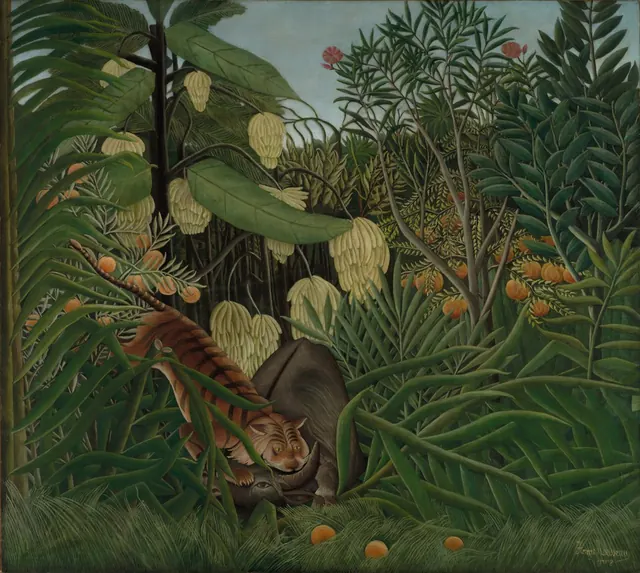
The painting’s story and details
A tiger attacks a buffalo in a forest that almost completely conceals the animals. Henri Rousseau completed this large canvas in 1908. He had never travelled outside France. Travel books and the Paris botanical garden gave him access to the tropics. From this urban experience he developed an imagined place of danger. The painting confronts us with a dense wall of plants through which we first have to locate the action.
The tiger’s face is low down, almost at the front edge. Its eyes look outwards, with stripes spreading over forehead and cheeks. Its body runs left behind the leaves. Rousseau leaves the head exposed and conceals much of the back, so the animal emerges gradually. Its gaze seems to meet ours even during the attack. We feel close to danger, viewing the scene from a distance we would scarcely choose in an actual forest.
The buffalo’s head is pressed down, with one horn passing in front of the tiger’s muzzle. Its grey back rises above them, and an open eye remains visible among the leaves. The animals’ positions make the predator’s advantage clear. Yet sharp outlines almost arrest the struggle. We have time to follow paw, horn, stripes and the curves of plants. Rousseau combines a violent event with the slow looking normally invited by a calm decorative pattern.
Huge leaves and pale bunches of bananas hang above the animals. Each shape has a distinct edge, and plants overlap in successive rows. Botanical accuracy yields to the construction of a fantastic forest; the museum even points out the upside-down bunches. Enlarged hothouse plants become an almost impenetrable barrier. A Parisian viewer might recognize separate elements while confronting an environment entirely assembled by the painter.
On the right, thin stems and narrow leaves form rows. Pink flowers and orange fruit recur among the green. The dangerous forest looks orderly and ornamental at the same time. The tiger’s stripes join the repetitions. Our attention alternates between the struggle and the arrangement of foliage. The unease lies in that coexistence: the beauty of the image does not make the encounter it depicts safe.
Fruit lies along the lower edge, with grass behind it blocking our approach to the animals. The canvas was intended for public exhibition and appeared at the Salon des Indépendants in March 1908. Its preparation was interrupted by Rousseau’s imprisonment in a fraud case in December 1907. According to the Cleveland Museum, he received early release so he could finish the work. Rousseau intended to present the canvas to an audience by a particular deadline. Behind the imagined forest lay the practical concerns of a working artist.
Rousseau was self-taught and, before retiring, worked at a Paris municipal toll station. His nickname, the Customs Officer, misdescribes that job. Independent exhibitions allowed him to show paintings outside academic selection, while Picasso and other younger artists valued their originality. Calling the work “naive” can obscure the planning within this scene. Rousseau carefully distributes exposed and concealed areas so that we examine the forest at length and repeatedly return to the struggle below.
More paintings to compare
Period, style and subject
- Movement
- Naive art
- Genre
- Animals
- Medium
- oil on fabric
- Collection
- Cleveland Museum of Art
- Dimensions
- Unframed, 170 × 189.5 cm
- Accession number
- 1949.186
Sources
Image provided under CC0. Image licence