The Sleeping Gypsy
Henri Rousseau · 1897
Explore the painting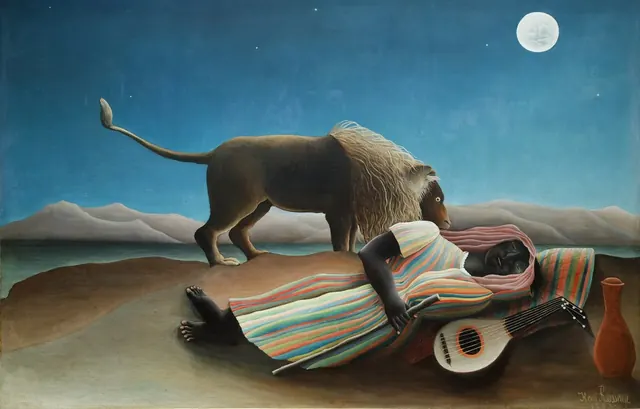
The painting’s story and details
A traveller sleeps beside a mandolin and a jar as a lion sniffs her hair. Rousseau exhibited the picture at the Salon des Indépendants in 1897. A year later he offered it to the mayor of his hometown, Laval, explaining the encounter in a letter. The passing beast catches the sleeper’s scent but leaves her unharmed. The picture’s most alarming moment thus also contains a promise of safety. Our attention stays between anticipated attack and the calm of sleep.
The lion’s muzzle almost touches the woman’s head. Numerous long pale lines form its mane, while broad dark areas describe its immense body. The raised tail and open eye maintain the animal’s alertness. Its capacity to harm gives significance to its pause. Peaceful coexistence arises without a fence, a trainer or any visible means of protection.
Stripes run along the dress and around the bent arm. Pink, blue, yellow and green retain their brightness in the night. Her head rests on a coloured cushion, with bare feet extending below the fabric. Clear outlines make each part almost motionless. The stable bodily arrangement makes sleep tangible, while colour connects the figure to the painting’s decorative pattern.
The mandolin lies beside the traveller’s hand, its strings and tuning pegs carefully distinguished. Rousseau identified her as a musician in his letter. The instrument gives her an occupation and suggests a life beyond this rest: performances, journeys and listeners. Now sound is absent. A silent instrument beside a sleeping person deepens the pause in which the animal encounter occurs.
The reddish jar stands at the edge. Rousseau explained that it holds drinking water. With the staff and musical instrument it forms a small set of travelling possessions. Few in number, they are painted as distinctly as the figures. The upright vessel anchors the right edge, while the long staff returns our gaze to the extended body. Practical belongings also organise the composition.
The moon hangs above a level band of distant mountains. Land, water and sky lie almost parallel, in quiet layers. Distance does not dissolve objects into mist. Everything remains sharply defined while forming an improbable nocturnal encounter. The self-taught Rousseau builds conviction through combinations of simple shapes. His imagined space accommodates an event that would seem extraordinary in everyday life.
The title and artist’s letter combine a travelling musician, African appearance and “Oriental” clothing into a European image of a distant world. This is an invented character whose safety depends on the organisation of the artist’s fantasy. The peaceful outcome can console while also revealing an outsider’s view of the represented woman. The canvas later passed through private collections to MoMA in 1939. An artist who unsuccessfully offered his work to his hometown became part of the international history of modernism.
More paintings to compare
Period, style and subject
- Movement
- Naive art
- Genre
- Imagined worlds
- Medium
- Oil on canvas
- Collection
- Museum of Modern Art, New York
- Dimensions
- 129.5 × 200.7 cm
- Accession number
- 646.1939
Sources
Reproduction of a public-domain artwork. Image licence