Tropical Forest with Monkeys
Henri Rousseau · 1910
Explore the painting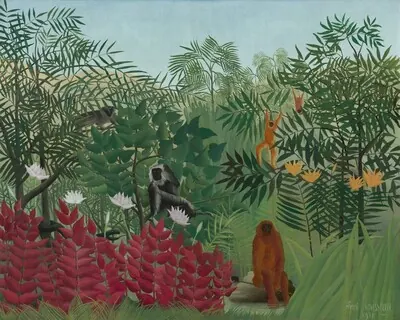
The painting’s story and details
Rousseau painted this forest in the final months of his life, in 1910. He had never visited the tropics or left France. His jungle material came from Paris: botanical gardens, the zoo, illustrated publications and colonial exhibitions. A former municipal customs employee, he transformed images of distant countries available to a city resident into elaborate landscapes of his own.
Near the centre left, a monkey holds a green stick with a thin dangling thread. It resembles a fishing rod, as the museum cautiously identifies it. An activity familiar from human leisure appears in the dense forest. Rousseau combines animals with an invented scene of recreation, so inspecting the foliage gradually becomes a search for small actions and participants.
Large red leaves and white flowers advance towards the front edge. Their outlines are sharply separated from neighbouring plants, as though each leaf had been cut out individually. Rousseau alters scale and assembles vegetation in dense groups. The painting cannot identify a particular stretch of tropical forest. Its botany follows the way forms fill the surface and overlap.
The orange monkey below sits facing us, separated from its green surroundings by a pale rock. Its body forms a large warm patch. Nearby leaves build an almost continuous wall. This arrangement makes the animal conspicuous and, at the same time, small among the oversized vegetation.
Higher on the right, two more orange figures intertwine with branches, one hanging upside down. Their colour returns in the yellow-orange flowers. The animals appear at different heights, leading the eye from one opening to another. Despite the density, outlines remain legible: branches, tails and leaves rarely dissolve into a shared shadow.
A narrow band of blue sky remains above. Leaves stand sharply against it, as if the forest were assembled from overlapping planes. There is little visible air between trees. Such clarity of outline differs from familiar European landscapes with gradually softened distances. Independent solutions like these attracted a younger generation of artists to Rousseau, including Picasso.
Rousseau’s studio contained an album of wild animals issued by the Galeries Lafayette department store. That source reveals much about his period. Plants, animals and colonial imagery reached the European capital through commerce, museum collections and mass printing. Even this highly fantastic forest connects with the workings of a real city that gathered and circulated images of other lands.
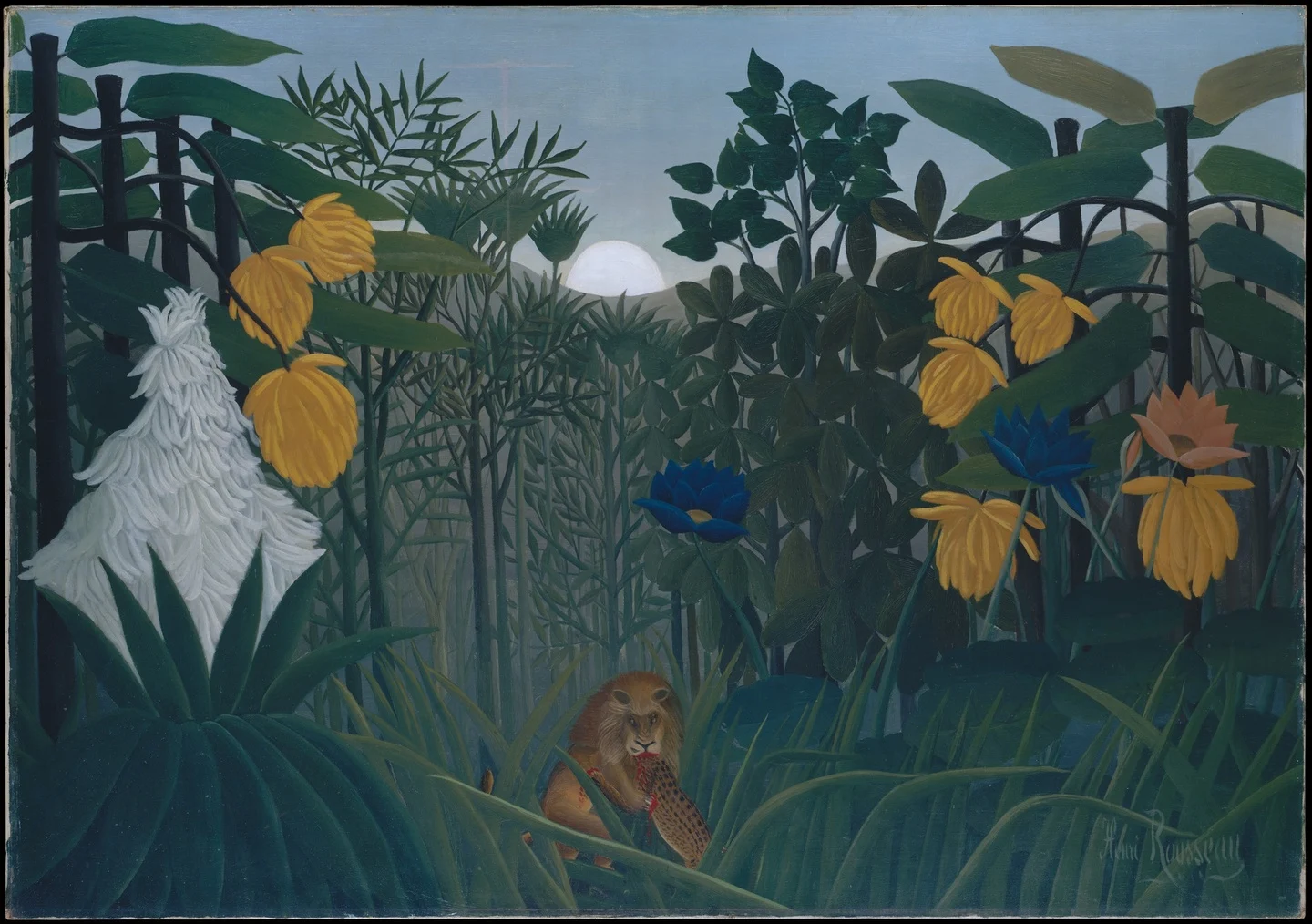
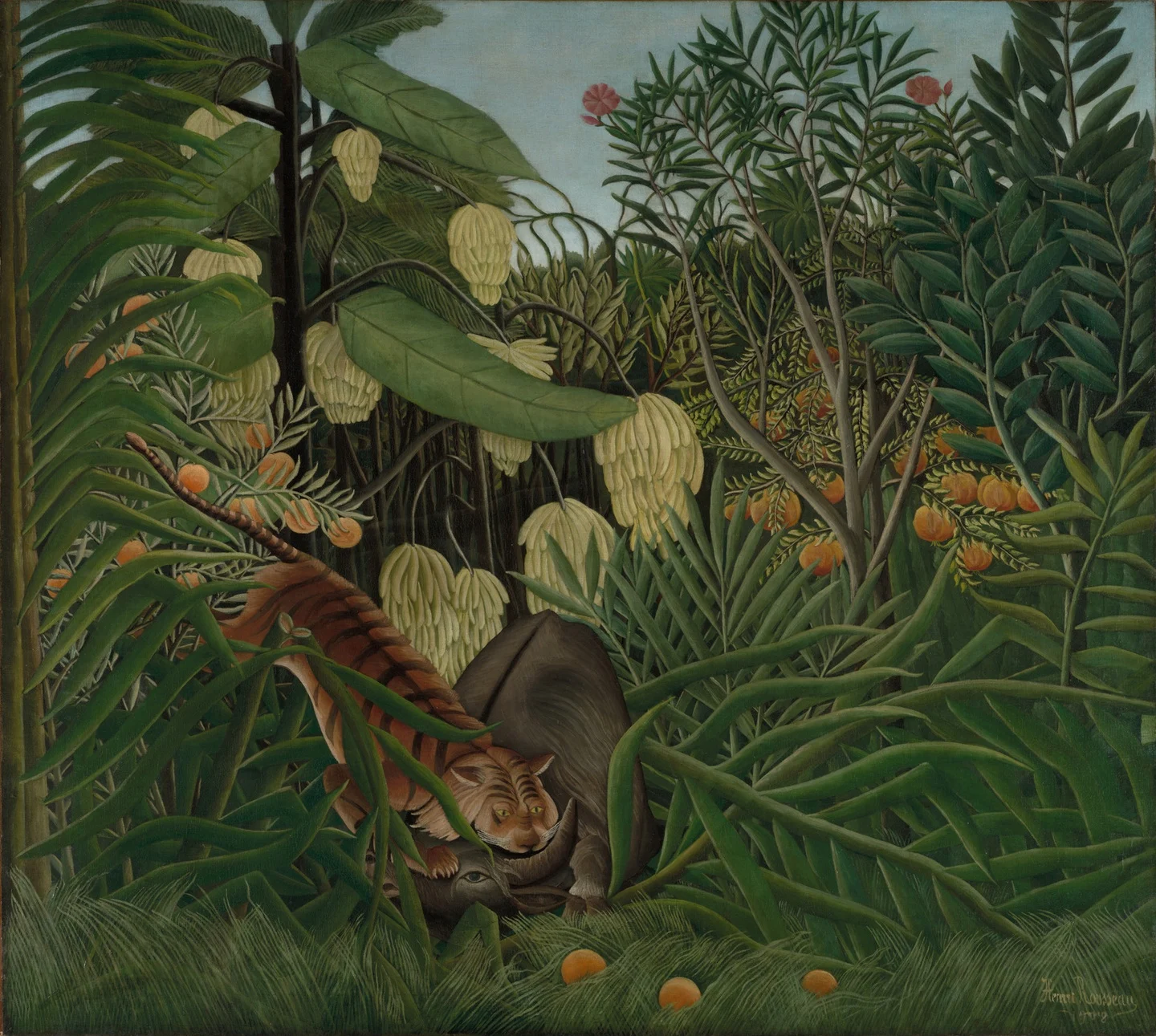
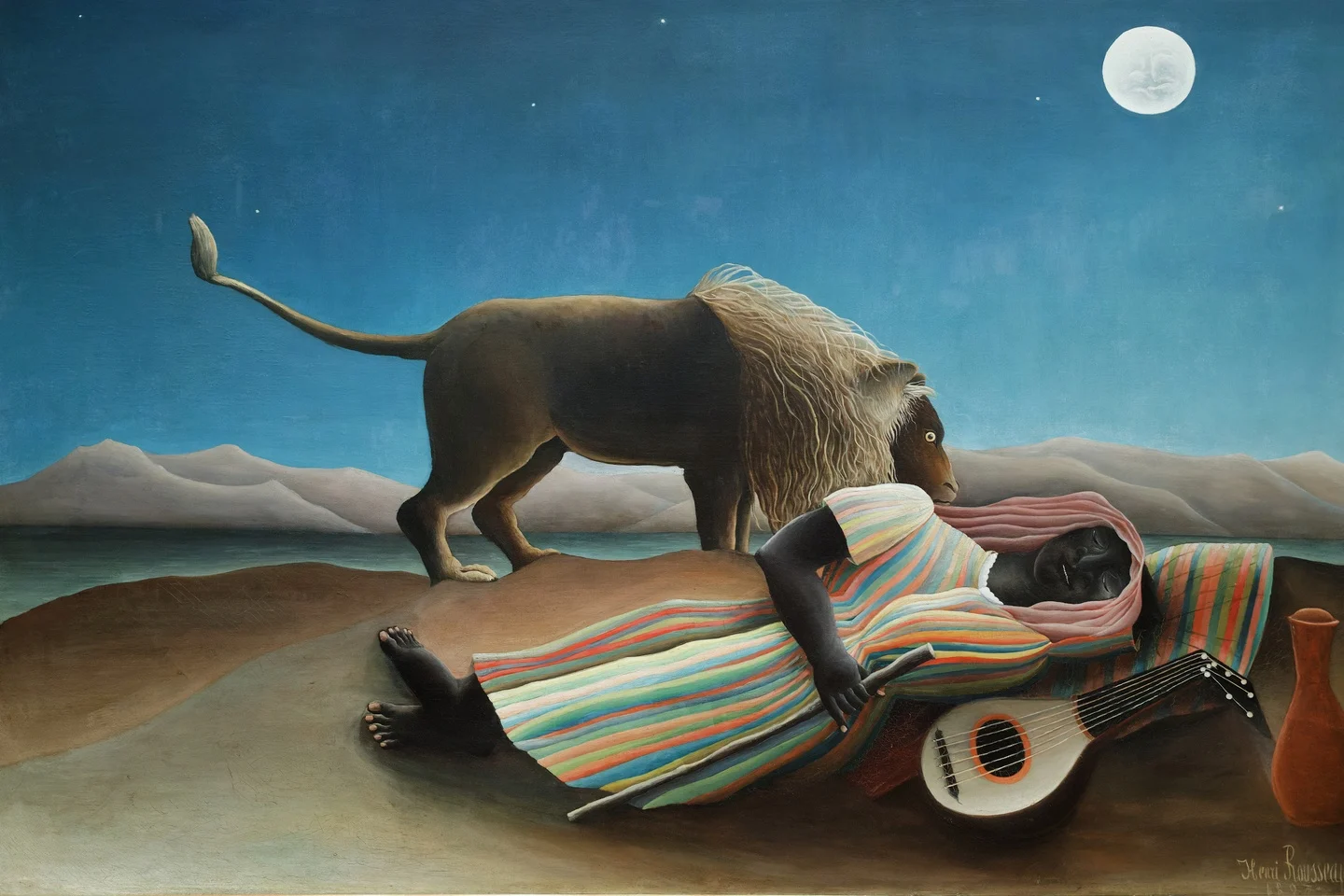
More paintings to compare
Period, style and subject
- Movement
- Naive art
- Genre
- Animals
- Medium
- oil on canvas
- Collection
- National Gallery of Art, Washington
- Dimensions
- Overall, 129.5 × 162.5 cm
- Accession number
- 1982.76.7
Sources
Reproduction of a public-domain artwork. Image licence