The Repast of the Lion
Henri Rousseau · ca. 1907
Explore the painting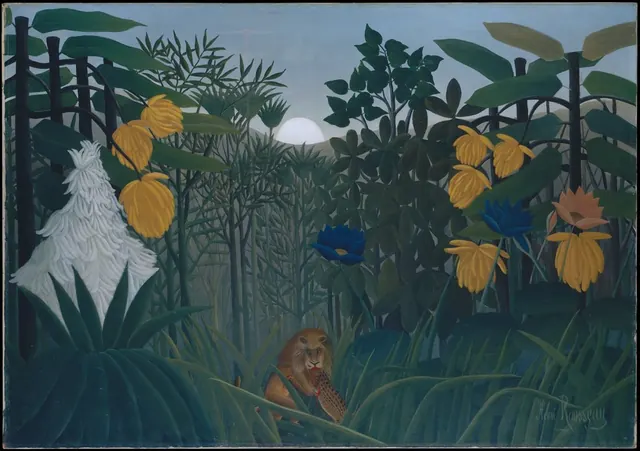
The painting’s story and details
Henri Rousseau painted jungles without leaving France. He studied plants in Paris’s botanical gardens and found animals in periodicals and illustrated books. Around 1907 these sources, available to a city dweller, produced The Repast of the Lion. The arrangement lets the enormous flowers register before the predator and its prey.
The lion sits low, close to the center. Leaves conceal most of its body, while its face turns toward the viewer. Spotted prey and a few red marks appear at its mouth. Rousseau confines the violence to a small area within lush vegetation. It emerges unexpectedly after the first impression of the beautiful surface.
The yellow flowers on the right are almost comparable in size to the lion’s head. They hang in repeated heavy clusters beside open blue blossoms. Rousseau enlarges and rearranges plant forms to establish his own proportions. A flower can command more space and attention than the animal that gives the painting its title.
A white inflorescence stands out on the left. Its petals recur in long rows, each painted separately. The petals curve differently from row to row, following the flower’s overall shape. Rousseau was self-taught but built his surfaces methodically. The forest consists of many finished fragments assembled into a dense, almost impenetrable wall.
Slender stems in the middle form a close mesh. A paler distance lies beyond, but the eye has difficulty reaching it. Near and far leaves keep firm outlines. Overlapping forms create depth without the usual gradual dissolution of detail. The forest consequently feels both flat and intensely dense.
A pale disk barely emerges above the foliage at the horizon. It does not flood the forest with directional light or produce long, consistent shadows. Individual leaves remain clearly legible. Rousseau combines celestial light with the even clarity of a botanical image, where the shape of each plant matters.
Parisian gardens and zoological collections offered encounters with tropical plants and animals without distant travel. Rousseau used them alongside magazine pictures. His enormous foreground leaves, overlapping the lion, turn separate observations into an invented environment. Studying specimens and creating an entire forest were distinct stages of the work.
Painting like this attracted Picasso and his circle, although Rousseau had previously faced considerable ridicule. In 1908 Picasso held a party in his honor. Younger artists valued solutions independent of academic training. In The Repast of the Lion, that independence appears in oversized flowers, sharp outlines, and space constructed according to Rousseau’s own rules.
More paintings to compare
Period, style and subject
- Movement
- Naive art
- Genre
- Animals
- Medium
- Oil on canvas
- Collection
- The Metropolitan Museum of Art
- Dimensions
- 113.7 × 160 cm
- Accession number
- 51.112.5
Sources
Image provided under CC0. Image licence