The Power of Music
William Sidney Mount · 1847
Explore the painting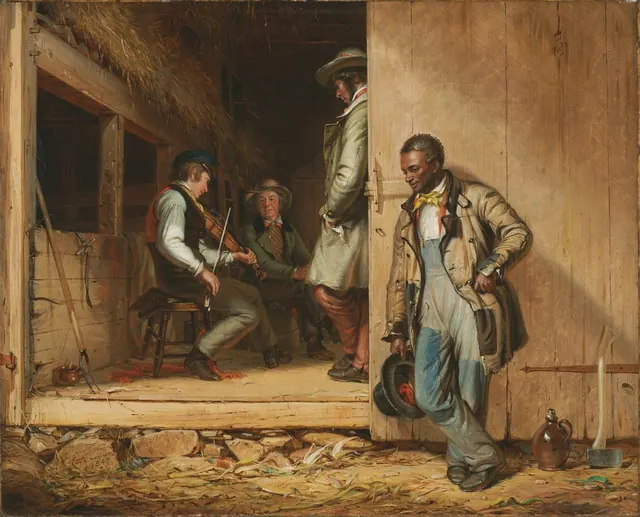
The painting’s story and details
In a barn on Long Island, a man plays the fiddle for three listeners. The tools around them suggest a break from work. Three gather inside a barn; a Black worker stays outside, beside the open door. William Sidney Mount painted The Power of Music in 1847, fourteen years before the American Civil War. The title promises shared enjoyment, and the faces do respond to the playing. Yet the painter places the listeners on opposite sides of a threshold. That division remains part of the scene even when it appears tranquil.
The fiddler sits on the left, his head turned towards the instrument. Mount knew this music at first hand. He played for country dances, collected folk tunes and grew up in a musical family. His brother Robert was a fiddler and travelling dance master. The painter later developed a violin intended to project its sound more strongly and received a patent in 1852. The barn was a fitting place for this music, played in familiar surroundings without a stage or concert hall.
The two white listeners turn towards the fiddler. One sits behind him; the other stands by the door. They can see the player’s face and the movement of his bow. For the worker outside, the door blocks that view. The three men inside share a face-to-face encounter; the fourth has the sound. The difference is built into the space without a scene of open hostility. It is easy to miss if we attend only to the contented expressions.
The Black listener holds his hat, crosses his legs and smiles slightly. His coat is worn and torn. Mount brings him close to us and into the light, while leaving the player in shadow. As a result, the man outside receives particularly close attention. His enjoyment deserves as much notice as the performance itself, although he remains apart from the group.
The open door separates two standing men who are physically very close. The Cleveland Museum reads it as a sign of racial division. New York State abolished slavery in 1827, twenty years before the painting was made. Freedom from slavery did not bring equality in daily life. Mount depicts no explicit refusal of entry; the listeners’ separate positions appear ordinary to everyone in the scene.
An axe stands by the door on the right, with a jug beside it. Wood chips and cut pieces connect the listener’s position with recent work. Tools, boards and hay remain visible inside as well. The musical break takes place amid labour, with everything left where it belongs. Mount carefully describes rough timber and clothing. These details place racial division within a particular setting, among people who work and rest alongside one another.
Sympathy for a person and an equal place in society are different things here. Mount makes the Black listener’s pleasure accessible to us while keeping the door between him and the others. The Power of Music can therefore suggest both a hope for human affinity and the limits of that affinity. A pleasant tune briefly unites people’s attention. Their positions on opposite sides of the threshold remain unchanged.
More paintings to compare

Period, style and subject
- Movement
- Realism
- Genre
- Everyday life
- Medium
- oil on canvas
- Collection
- Cleveland Museum of Art
- Dimensions
- Unframed, 43.4 × 53.5 cm
- Accession number
- 1991.110
Sources
Image provided under CC0. Image licence