The Thaw
Fyodor Vasilyev · 1871
Explore the painting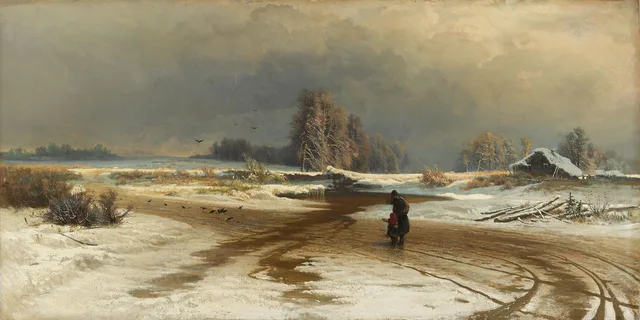
Fyodor Vasilyev was about twenty when he painted The Thaw in the winter of 1870–71. A journey along the Volga had helped him study wide-open spaces. Here he chose an awkward season, with snow still lying while the road had already turned to mud. An ordinary obstacle to travel became a picture that brought the young painter recognition.
Two figures have stopped on the wet road, an adult and a child. Their small scale enlarges the surrounding plain. They make the weather physically imaginable through dampness, cold and difficult movement. They have paused where meltwater crosses their route. Their halted movement draws attention to an obstacle that might otherwise appear merely a puddle.
Wheel marks curve across the foreground and converge into a shared route. Mud receives the attention an academic landscapist might give ancient ruins. The choice changes what we expect from a beautiful view. The road matters through texture, direction and its connection to people who must actually use it.
A cluster of trees stands beyond the water, its verticals anchoring a composition dominated by horizontal distances. Individual trunks and branches brighten against the clouds. Small changes of illumination prevent the landscape from becoming a static diagram. A shift of cloud seems capable of transforming this whole stretch of plain.
A low building nearly disappears beneath its snowy roof. The land is inhabited despite the scarcity of people. The dwelling occupies a modest place beside trees and road, suggesting the dependence of rural life on the season. Architecture almost continues the ground surface beneath the same melting snow.
Clouds part to admit light. The restrained palette contains many variations within grey and brown. The brighter area makes changing weather visible, suggesting how quickly illumination across the plain may shift. The painting’s emotional effect develops from combining that observation with the difficult road below.
The Thaw won first prize from the Society for the Encouragement of Artists and was acquired by Pavel Tretyakov. Its success reveals changing ideas of a worthy landscape subject. An uninviting season and a muddy road could persuade contemporaries through close observation. Painting asks us to dwell on a place a traveller might prefer to leave behind.
Featured in tours
Russian landscape. From study to painting
Twelve works about observation, travel and artistic choices, from Savrasov and Shishkin to Levitan and Nesterov.
- Medium
- Oil on canvas
- Collection
- State Tretyakov Gallery
- Dimensions
- 53.5 × 107 cm
- Accession number
- Инв.904
Sources
Public-domain artwork. Digital reproduction from the State Tretyakov Gallery. Image licence