The Vanquished. A Requiem
Vasily Vereshchagin · 1878–1879
Explore the painting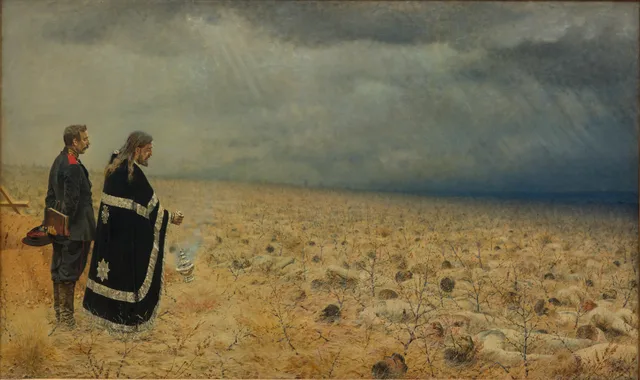
Vereshchagin took part in the Russo-Turkish War of 1877–78, suffered a serious wound and lost his brother Sergei. At Telish in Bulgaria he saw the bodies of fallen Russian soldiers. Those experiences informed The Vanquished, painted in 1878–79. Attention moves from the battle’s course to those left in the field and the need to mourn them.
A priest conducts the memorial service outdoors. Black vestments with pale trim stand sharply against yellow earth. Ritual introduces human order into the aftermath of violence. Vereshchagin worried about his own brother’s burial, giving the subject personal weight. The funeral image connects public remembrance with family loss.
A soldier stands beside the priest with his head uncovered. His upright posture retains military discipline while he participates in mourning. The living occupy one edge, leaving almost the entire canvas to the dead. The disproportion between the small standing group and the vast field makes the loss palpable.
Bodies nearly share the colour of dry earth and vegetation. At first the field can seem an ordinary landscape. Human forms then become distinguishable and alter that impression. Vereshchagin makes recognition gradual, requiring attention to what a quick glance across the large canvas might miss.
Individual bodies become clearer in the foreground. Vereshchagin witnessed evidence of abuse of the dead and described it in his exhibition catalogue. The picture prevents casualties from remaining an abstract total. The passage from the distant field to the nearest person makes a mass event physically immediate.
Dark sky occupies almost half the composition. Breaks in the clouds distribute light across the field without giving it ceremonial splendour. Weather and earth continue around the traces of human violence. Their scale intensifies the isolation of those conducting the service and changes the meaning of an open landscape.
For contemporary audiences the picture stood in relation to battle painting organised around combat and commanders’ success. Vereshchagin chose a moment when the outcome could change nothing for the dead. Personal witness becomes a public image of war’s cost. Even without knowing the Balkan campaign, viewers encounter consequences borne by participants and families.
More works by Vasily Vereshchagin


- Medium
- Oil on canvas
- Collection
- State Tretyakov Gallery
- Dimensions
- 179.7 × 300.4 cm
- Accession number
- Инв.2103
Sources
Public-domain artwork. Digital reproduction from the State Tretyakov Gallery. Image licence