Peter I Interrogating Tsarevich Alexei at Peterhof
Nikolai Ge · 1871
Explore the painting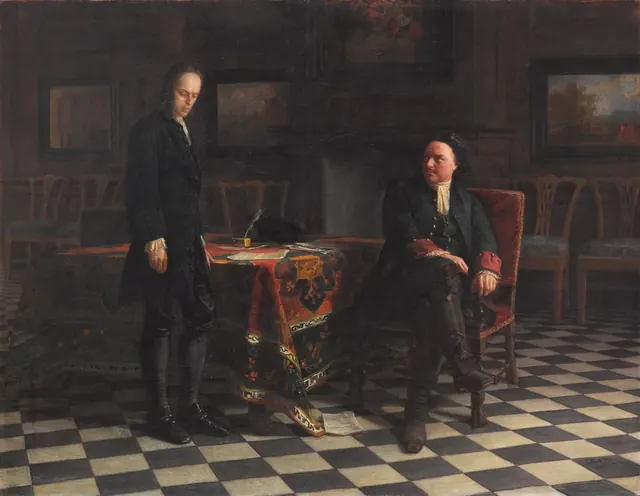
The painting’s story and details
Peter turns towards his son, who stands before him with his eyes lowered. Ge painted this encounter in 1871, on the eve of the tsar’s bicentenary. The anniversary renewed debate about Peter’s reforms. Recently returned from Italy, the artist himself had become enthusiastic about Peter. Working on the historical subject, however, led him to reconsider that initial admiration.
The meeting concerned the heir to the throne as well as a father and son. Alexei opposed Peter’s reforms. In 1716 he secretly sought the protection of Emperor Charles VI, returning to Russia in 1718 after negotiations with the tsar’s envoys. Arrest and investigation followed. A court condemned him to death, and he died in the Peter and Paul Fortress that year.
Peter is seated, yet his turn and his gaze towards his son govern the scene. Light catches his face, white neckcloth and hand on the armrest. Red cuffs distinguish his hands from the dark clothing. Bodily position and attention directed towards another person make authority visible. A chair, a few lit passages and a turn of the head carry much of the effect.
Alexei stands higher than his father, almost upright. His face is paler and his eyes point downwards. The pose allows several readings: submission, fear or evasion. A painting made a century and a half later cannot establish any of these as the historical Alexei’s feeling. Its uncertainty leaves the viewer to judge his position within the conflict.
The tsarevich’s hand hangs beside his clothing, its fingers slightly bent. Peter’s hands rest on the chair and his knee. Neither man reaches out to touch the other or extends an answering palm. Their gestures show different ways of occupying the room. The seated Peter has several supports; Alexei’s elongated figure stands apart at the edge of the table.
Papers lie on the table beside an inkwell and quill. One sheet has fallen to the floor. They evoke an investigation in which spoken words became written testimony. The writing remains illegible when enlarged. Ge shows the setting of an interrogation without supplying a document from which the viewer could independently test the accusation.
Black and white tiles lead from the foreground towards the wall. Their rows make the distance between the figures measurable. Ge studied the interior at Monplaisir and then selected details for his scene. The floor and furniture create a convincing room. The credibility of a setting and the historical accuracy of the conversation represented in it are separate matters.
In a recollection reported by Stasov, Ge admitted that he had tried to justify Peter’s cruelty through the interests of the state. The documents he studied undermined that justification. The painting can therefore open a discussion of political achievement and its moral cost. A ruler’s accomplishments do not by themselves settle the judgement of his conduct towards an individual, even when that individual is the heir to the throne.
Tretyakov acquired the painting before the first Peredvizhniki exhibition opened in 1871. It became one of Ge’s most discussed works. Viewers encountered a historical scene while judging it from their own time, when Peter’s legacy was again being debated. The painting preserves both distances: it represents the eighteenth century and reveals a nineteenth-century painter’s attempt to judge it.
Featured in tours
Russian life. Estate, city and village
How nineteenth-century painters depicted work, wealth, education and changes in everyday life.
History in painting. Events and memory
Who painted war, revolution and state power, and how long after the event.
More paintings to compare

Period, style and subject
- Movement
- Realism
- Genre
- History painting
- Medium
- Oil on canvas
- Collection
- State Tretyakov Gallery
- Accession number
- 2630
Sources
Reproduction: Wikimedia Commons · Public Domain