Prisoners from the Front
Winslow Homer · 1866
Explore the painting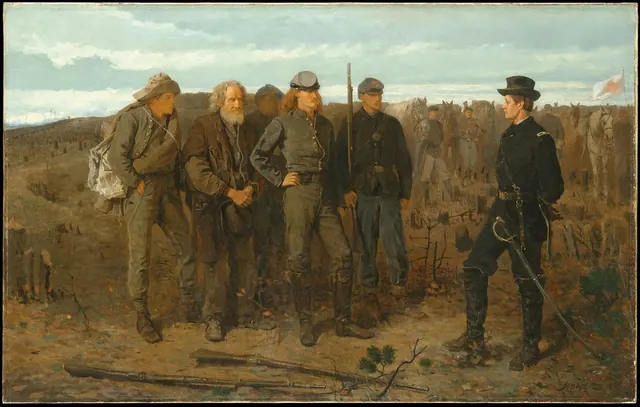
The painting’s story and details
Three Confederate prisoners stand before Union general Francis Barlow. Homer painted this in New York in 1866, after the Civil War had ended. The military achievements of Barlow, whom the artist knew, provided its basis. The encounter places the victor face to face with people now under his authority.
Barlow stands apart on the right with his hands behind his back. His dark uniform is neat, and he retains his sword. Open ground separates him from the prisoners, making the confrontation visible without an attacking gesture. Distance, weapons and a composed stance establish authority.
The young Confederate at the centre stands upright with one hand on his hip. His grey jacket is buttoned, his boots are high and his hair reaches his shoulders. He looks directly at Barlow. Captivity has not led the painter to give every defeated figure the same bowed posture.
Beside him stands an older man with a grey beard, holding his hat in both hands. The prisoner at the far left leans forward with a sack behind his shoulder. Age, clothing and the positions of hands and feet differ. The group shows how varied the people serving on one side could be.
Rifles lie in the foreground, their long barrels crossing the ground between us and the prisoners. The soldier standing beside them still holds his weapon. The difference immediately distinguishes those permitted to act under arms from those who have been disarmed.
A field of stumps and broken branches extends behind the figures, with horses and attendants farther back. Destroyed vegetation makes the war’s consequences part of the entire scene. Even where nobody is shooting, the ground carries traces of devastation.
During the war, Homer worked as an artist-correspondent for Harper’s Weekly and visited the Virginia front. His observations subsequently entered his paintings. Contemporaries already saw Prisoners from the Front as a broader account of the conflict. In 1869 critic Eugene Benson read the prisoners as different elements of Southern society that had supported the rebellion.
Featured in tours
History in painting. Events and memory
Who painted war, revolution and state power, and how long after the event.
More paintings to compare
Period, style and subject
- Movement
- Realism
- Genre
- History painting
- Medium
- Oil on canvas
- Collection
- The Metropolitan Museum of Art
- Dimensions
- 61 × 96.5 cm
- Accession number
- 22.207
Sources
Image provided under CC0. Image licence