Venus and Cupid
Lorenzo Lotto · 1520s
Explore the painting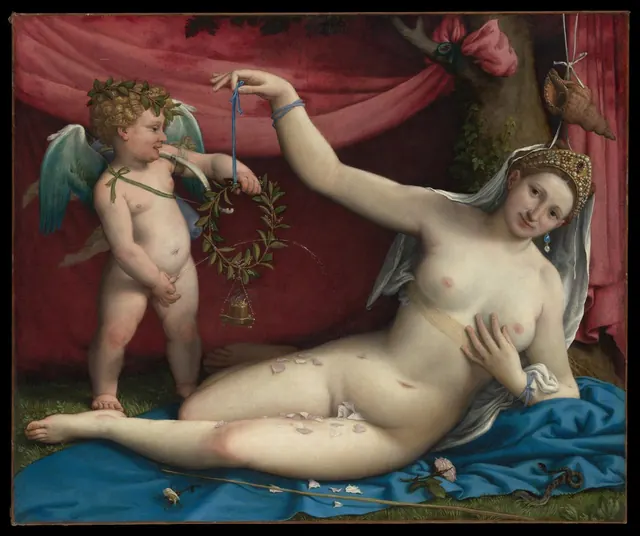
The painting’s story and details
Cupid urinates through a wreath held by Venus. Lorenzo Lotto painted the scene in the 1520s, probably to celebrate a marriage. The gesture may surprise a modern viewer, but Renaissance images of urinating boys were associated with fertility and well-being. A classical subject allowed a wish for children to accompany an earthy joke. Learned culture and a festive household wish share the same pictorial language.
Venus reclines with her face turned toward the viewer. Her bridal ornaments include a crown, veil, and pearl earring familiar from sixteenth-century Venetian dress. Individual facial features have led scholars to suggest a portrait of the bride, although no sitter has been identified. Even without that hypothesis, contemporary ornaments on a nude body connect marriage with the classical goddess of love.
Her raised hand holds the ribbon carrying the wreath. Cupid directs his stream through the opening, with Venus participating in the game. Roman wedding poetry, revived by Renaissance humanists, described Cupid waking Venus to preside over a marriage. Lotto transforms that imagery into visible action. A symbolic wish becomes an event between mother and son.
Rose petals lie on the cloth and near the goddess’s body. Flowers and soft folds continue the theme of sensual pleasure. A wedding setting also connects pleasure with the expectation of children. Patrons could receive this as a joyful wish, while a present-day viewer may also question the bride’s assigned role. Beauty and the capacity to produce descendants become central to the festive image.
A snake moves along the lower edge, with a long rod nearby. They introduce sharper associations around Venus. The Met’s study connects these details with love’s dangers and punishments. The possibility of pain remains around the carefree play. This image of marriage accommodates both pleasure and warning, resisting a uniformly celebratory account of married life.
A shell hangs above Venus’s head, referring to the goddess’s marine origins. Together with the ornaments, it distinguishes her from an ordinary reclining woman. Mythological surroundings allowed patrons to represent human life through divine characters. This transformation expanded the possibilities of private painting, from a bridal portrait to an open play with the body and desire.
A later restoration covered Cupid’s stream and idealized Venus’s features. Conservation in 1986 recovered the original details. The image’s history includes changing standards of propriety. The later alteration removed a gesture that could promise fertility in Renaissance wedding culture. The recovered surface again joins bodily humor with consequential social expectations.
Featured in tours
Love, marriage and encounters
Gods, lovers, spouses and people whose relationships remain unknown.
More paintings to compare



Period, style and subject
- Movement
- Renaissance
- Genre
- Myths & allegories
- Medium
- Oil on canvas
- Collection
- The Metropolitan Museum of Art
- Dimensions
- 92.4 × 111.4 cm
- Accession number
- 1986.138
Sources
Image provided under CC0. Image licence