A Hunting Scene
Piero di Cosimo · ca. 1494–1500
Explore the painting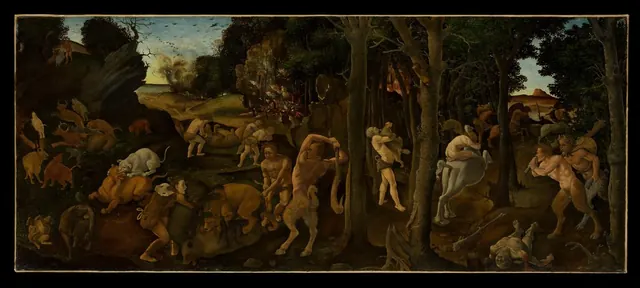
The painting’s story and details
The forest is burning. Animals flee the fire, while humans and mythological creatures take advantage of their flight to hunt. Piero di Cosimo painted this panel in Florence around 1494–1500. He imagines a distant past when people still obtained food by brute force and were learning to act together. The Met connects the conception with Lucretius’s poem On the Nature of Things. The Roman author explained the world through natural causes; his account of society’s origins offered learned Renaissance readers another view of human history.
Flames appear between the trunks, and smoke rises above a more distant wood. No one is putting out the fire or tending a hearth. The hunters exploit the movement of the animals it causes. A natural danger becomes a condition of the hunt. Piero connects several causes within one landscape, from distant fire to struggles at our feet. Understanding the scene involves tracing how the creatures’ actions change towards the foreground.
The central figure raising a club is a satyr, with a human torso and furry goat’s legs. Beside him a man carrying a shorter weapon bends over the animals. Both take part in the same struggle. Their proximity belongs to Piero’s imagined antiquity. He populates it with creatures from classical myth, so the scene cannot serve as a reconstruction of prehistoric life. Satyrs familiar to learned viewers help evoke a world in which ordinary boundaries between human and animal seem unsettled.
On the right humans and goat-legged creatures grasp one another, carrying or restraining other bodies. Their movements have to be followed through individual arms and legs because the figures overlap so closely. It is not immediately possible to identify every pair as allies or opponents. The composition preserves that difficulty. The same physical strength can support another creature or overpower it. Amid the disorder, the two actions become uncomfortably close.
At the left edge some animals scramble upwards while others attack their neighbours. A white animal bears down on a lion, and reddish bodies cluster below the rock. There is no safe position from which humanity simply observes nature. People take part in the same collisions. Piero fills the long strip of the painting with numerous small episodes. The eye moves between them, repeatedly finding another attempt to escape or seize prey.
At the lower right a dead person lies in pronounced foreshortening. The head is close to us and the feet recede. Against the raised arms and straining bodies around it, this figure is still. William Griswold, director of the Cleveland Museum of Art, identifies it as a reminder that the struggle is mortal. Humans too can become its victims. Food obtained through hunting and the death of a hunter belong to the same picture.
The panel, nearly 170 centimetres wide, probably formed part of a private room’s decoration. The exact room and patron have not been established. Its learned subject could invite discussion of an ancient poem and competing accounts of the past. Piero also painted devotional images and altarpieces for Florentine churches. Engagement with Lucretius belonged to the same artistic life as ecclesiastical commissions. This painting reveals the range of patrons’ interests without establishing a break with their faith.
The companion panel, The Return from the Hunt, continues the story as the spoils are brought ashore. Together the paintings allow conflict and cooperation to be compared. People learn to obtain more food by acting together, yet their advantage here depends on violence against other creatures. That raises a question about which changes should count as improvements in life. Piero gives it concrete substance in fire, weapons, a dead body and prey still to be shared.
More paintings to compare



Period, style and subject
- Movement
- Renaissance
- Genre
- Myths & allegories
- Medium
- Tempera and oil transferred to Masonite
- Collection
- The Metropolitan Museum of Art
- Dimensions
- 70.5 × 169.5 cm
- Accession number
- 75.7.2
Sources
Image provided under CC0. Image licence