Mars and Venus United by Love
Paolo Veronese · 1570s
Explore the painting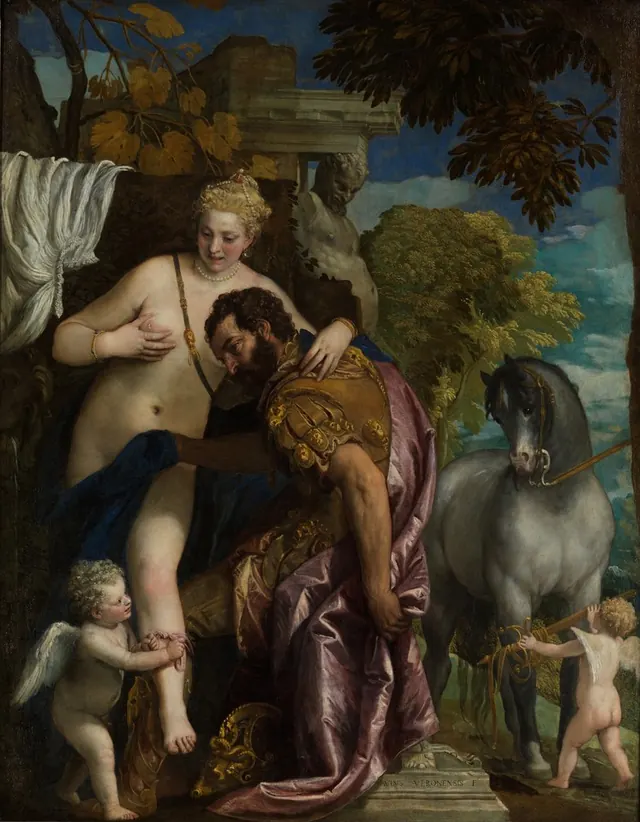
The painting’s story and details
Mars sits beside Venus while two winged children intervene in their relationship. One binds the couple together; the other restrains the horse. Veronese painted this allegory in the 1570s. Love gains power over military force through tangible actions: a hand on a shoulder, a knot being tied and an animal brought to a halt.
Venus rests one hand on Mars’s shoulder and touches her breast with the other; milk emerges from it. This detail adds nourishment and the continuation of life to erotic attraction. Her jewellery, pale skin and blue fabric make the scene sensuous. Its allegorical meaning develops through bodily beauty.
Mars still wears richly ornamented golden armour. His head inclines, his free arm hangs down and his body turns towards Venus. Nothing in the pose prepares a blow. The equipment retains its brilliance and weight, while its wearer is otherwise occupied. His armour identifies the god of war even as his behaviour ceases to be martial.
At the lower left, a cupid ties a pink ribbon around Venus’s leg, beside Mars’s. The small knot turns intimacy into a literal bond. The child concentrates on his task while the adult gods accept their new position. Power is distributed unexpectedly: an armed man is held by light fabric and the effort of a small figure.
The other cupid stands before the grey horse, holding a sword across its path. The weapon helps arrest the war animal’s movement. The horse dwarfs the child, yet stays behind the principal couple. Together the two episodes disarm Mars, restricting both his own freedom and his means of riding into battle.
Behind the couple, a stone male figure supports heavy masonry. Its immobility contrasts with soft bodies and falling cloth. White drapery on the left, blue around Venus and pinkish violet around Mars divide the large areas of colour. Veronese made monumental scenes for Venetian palaces and churches. Even an intimate mythological encounter takes on an architectural scale.
The painting is associated with Rudolf II’s imperial collection in Prague. A proposed original commission from Maximilian II remains unproven. For a courtly audience, war subjected to love could carry political implications. Yet an image of concord tells us little about its owner’s peacefulness. The sumptuous allegory offered a desirable order in which force is restrained and life can continue.
Featured in tours
Love, marriage and encounters
Gods, lovers, spouses and people whose relationships remain unknown.
More paintings to compare



Period, style and subject
- Movement
- Renaissance
- Genre
- Myths & allegories
- Medium
- Oil on canvas
- Collection
- The Metropolitan Museum of Art
- Dimensions
- 205.7 × 161 cm
- Accession number
- 10.189
Sources
Image provided under CC0. Image licence