Allegory of the Planets and Continents
Giovanni Battista Tiepolo · 1752
Explore the painting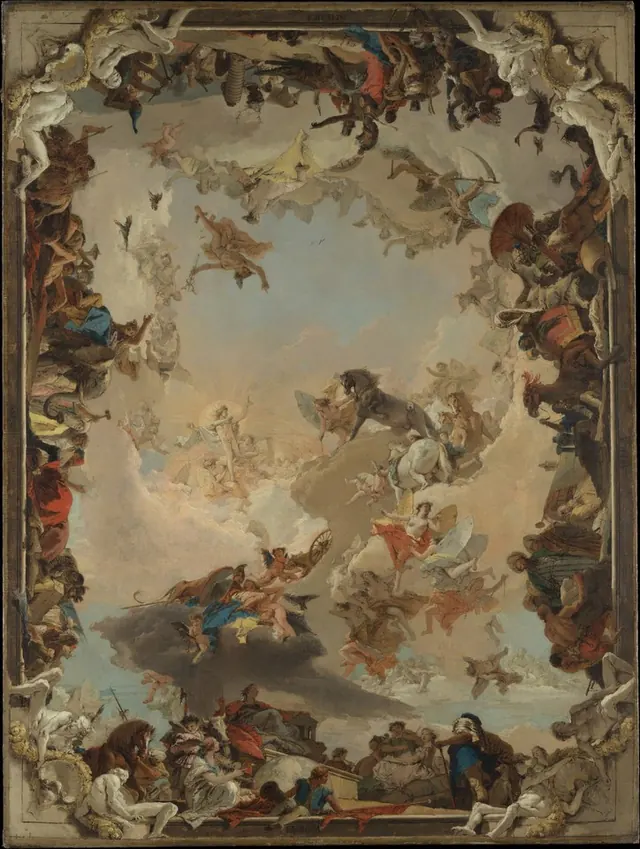
The painting’s story and details
Ancient gods float among clouds, while the four parts of the world gather around the sky. Tiepolo presented this sketch to Würzburg’s prince-bishop on 20 April 1752 as a proposal for the ceiling above his ceremonial staircase. Nearly two metres high, the oil painting helped the patron imagine the future fresco. A whole world would appear above his residence.
Apollo is distinguished by a golden radiance. Nearby, horses are prepared for his daily journey through the sky, surrounded by other gods representing the planets. The figures are seen from below in pronounced foreshortening. Feet and hands sometimes approach us more closely than heads. Tiepolo is already accounting for a viewer beneath the vault. On a flat canvas he tests the illusion of height intended to open above people climbing the staircase.
A broad area of blue sky remains in the middle. Clouds and bodies pass around it, leaving the eye room to move. Without this interval, the many characters would form a crowded gathering. Instead, air and height seem to extend behind them.
The lower edge bears Europe’s Latin name. Nearby are architecture, richly dressed figures and objects associated with the arts and authority. In the completed fresco, Europe and the Würzburg court would receive particular emphasis as a setting for artistic patronage. This geography distributes places of honour. One court becomes associated with the cultural achievements of an entire continent, while the magnificent commission itself provides visible evidence of that patronage.
Tiepolo placed America, Asia and Africa along the other sides. Clothes, animals, weapons and headdresses distinguish their groups. These attributes allowed European viewers to recognise allegories of immense territories. This is a view shaped by eighteenth-century court culture and its choices about what counted as characteristic or unusual. Looking at the figures today, we can attend to that selection itself. Human diversity has been condensed into a few readily recognisable images.
The figures at the upper edge are inverted relative to those below. This can seem strange on a museum wall, but a ceiling could be viewed from several directions. The painted white sculptures in the corners likewise anticipate a connection with architecture. They make the passage from cornice to sky more convincing. The sketch reveals Tiepolo’s attention to a moving viewer. As a visitor climbed the stairs, new viewpoints and new groupings would come into view.
In a Baroque residence, the staircase was a ceremonial reception space. Before reaching the host, visitors could already experience the scale of his ambitions. The prince-bishop held spiritual and secular authority; ancient mythology could adorn his palace without implying a rejection of Christianity. Here art constructed the image of a cultivated and powerful patron. The sketch preserves the stage at which artist and client were agreeing on the world that would greet guests overhead.
More paintings to compare


Period, style and subject
- Movement
- Baroque
- Genre
- Myths & allegories
- Medium
- Oil on canvas
- Collection
- The Metropolitan Museum of Art
- Dimensions
- 185.4 × 139.4 cm
- Accession number
- 1977.1.3
Sources
Image provided under CC0. Image licence