The Pond
Victor Borisov-Musatov · 1902–1903
Explore the painting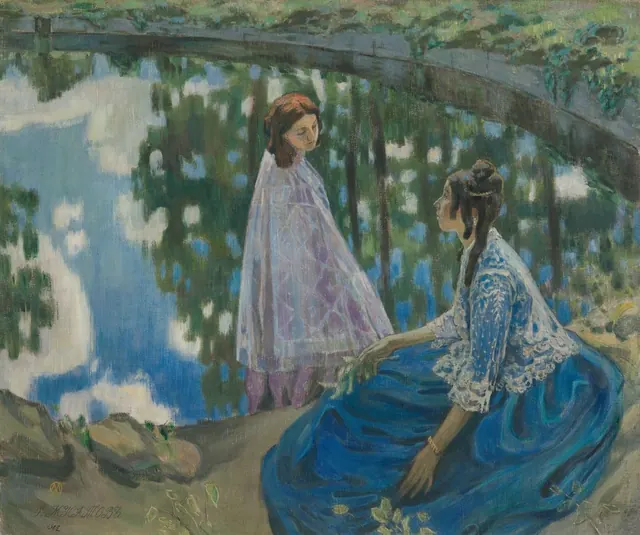
The painting’s story and details
Victor Borisov-Musatov began The Pond at Zubrilovka, the Golitsyn-Prozorovsky estate, in the summer of 1902 and completed it in Saratov by February 1903. His sister Elena and fiancée Elena Alexandrova posed. A particular summer with people close to him lies behind the unusual scene. He used a familiar place and real faces but changed how we see them together. The pool seems raised behind the figures, with the sky contained in its water.
His sister stands on the left, on steps descending towards the water. The near bank conceals her feet, placing her figure unexpectedly low against the pool. Her lilac cape forms an elongated pale silhouette, with vertical reflections of trunks behind it. Their adjacency connects a person with the water’s pattern. The face remains distinct enough to preserve an individual woman within that slender shape.
His fiancée sits on the right, her hands resting on a broad skirt. Blue clothing shows through white lace, while warm skin stands out among cool hues. Her profile faces left. No direct exchange of looks lets us reconstruct a conversation. The arrangement of two figures sustains attention instead of an event. Similar in scale, they occupy the bank differently: one elongated, the other spreading through a broad arc of cloth.
On the left there are almost no solid objects, only reflected clouds, trunks and blue openings. Yet the water looks like a substantial field of colour. The familiar horizon that would establish the sky’s height is absent. We recognize a reflection while also reading it as a background behind the women. This produces the scene’s strangeness. A familiar natural phenomenon unsettles our automatic expectations of depth.
The blue skirt occupies much of the lower right. Its edge curves around the figure, repeating the bank’s arc. Long folds range from near-black to turquoise. Similar outlines encourage comparison between cloth and water even though their materials remain distinct. Colour strengthens the connection. The woman remains on land, yet the broad blue area extends the pool into another part of the painting.
A stone rim marks the farther bank along the top edge. It provides a foothold among reflections but occupies very little space. The trees reflected in the water stand almost entirely outside the canvas. We must reconstruct part of the landscape from its reflected appearance. Things not seen directly become important.
Fine stems and small leaves cross the broad areas of bank and skirt at the bottom edge. They change the scale of looking. From a distance we see blue and green masses; up close, delicate plant forms and the canvas weave emerge. Tempera and pastel produce a matte surface. It softens transitions between objects, bringing skin, cloth and stone into one carefully coordinated arrangement of colour.
Borisov-Musatov worked at length to find the right blue and returned to studies of clouds. His imagined world grew from observation and studio work. The Pond shows why a Symbolist painting need not contain a mysterious object with one hidden answer. Perception of space itself changes here. Real people and an estate pool become a scene in which reflection demands as much attention as what stands before us.
Featured in tours
Love, marriage and encounters
Gods, lovers, spouses and people whose relationships remain unknown.
Russian life. Estate, city and village
How nineteenth-century painters depicted work, wealth, education and changes in everyday life.
How painting changed in the early twentieth century
Colour, the human figure and early experiments in abstraction.
More paintings to compare

Period, style and subject
- Movement
- Symbolism
- Genre
- Everyday life
- Medium
- Tempera and pastel on canvas
- Collection
- State Tretyakov Gallery
- Accession number
- 5603
Sources
Tretyakov Gallery reproduction. Noncommercial use with collection credit and source link. Image licence