Self-Portrait
Vincent van Gogh · 1889
Explore the painting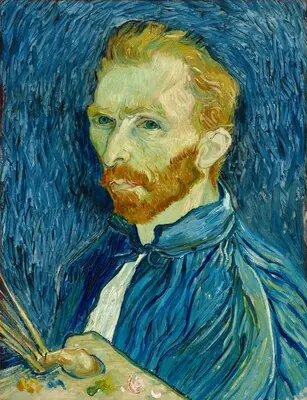
The painting’s story and details
Van Gogh holds brushes and a palette. This self-portrait was made in 1889 at the Saint-Paul-de-Mausole asylum in Saint-Rémy after a severe episode of illness. In his letter to Theo of 5–6 September, he also explained a practical reason for painting it. He needed to return to figure painting, and no other model was available. His own face became accessible material for resuming work.
Greenish shadows define the cheekbones, pale yellow covers the forehead, and blue strokes surround the eyes. In the letter, Van Gogh described himself as thin and very pale when he began. We can compare his words with the image. Yet the greenish skin also belongs to a deliberate colour scheme. Its hue alone cannot establish a diagnosis or reveal what he felt at a particular moment.
The red beard stands out against blue. Close up, it consists of short red, orange and green strokes. Van Gogh explicitly described the pale head against a dark violet-blue background as a colour effect. He was carefully constructing the face’s expressiveness. Even when addressing his own condition, he remained an investigator of how neighbouring colours alter one another.
A palette carrying small portions of paint enters from below. Brushes rise along the left edge, gathered firmly in his hand. These objects identify his occupation as clearly as tools in a craftsman’s portrait. After an interruption caused by illness, that matters particularly. We see someone once again able to hold and use the materials of his work.
Blue strokes around the head turn with its contour. On the right they curve near the shoulder; on the left they extend almost vertically. The strokes curve around the figure and draw the eye back to the face. The surface reveals how much movement of the brush went into depicting a person sitting still.
The blue working clothes almost merge with the background. Long folds, dark seams and a pale strip of shirt distinguish them. Face and hand remain the principal light areas. Working clothes, brushes and palette show him returning to his occupation after illness.
The letter describing the portrait also discusses picture storage costs, canvases and a future exhibition. Illness, financial worries and professional plans coexisted in his daily life. The palette restores that fuller picture. The familiar image of a suffering artist becomes more complex when, beside the pale face, we recognize someone assessing results, ordering materials and preparing to exhibit new work.
Featured in tours
After Impressionism. Four different answers
Seurat, Cézanne, Van Gogh and Gauguin changed painting for different reasons.
Portraits. How people presented themselves
Rulers, merchants, artists and private patrons before a viewer.
More paintings to compare
 Vincent van Gogh
The Bedroom. Second version
September 1889 Vincent van Gogh
Self-Portrait
1887 Vincent van Gogh
Madame Roulin Rocking the Cradle (La berceuse)
1889 Vincent van Gogh
Irises
1890 Vincent van Gogh
Self-Portrait with a Straw Hat (obverse: The Potato Peeler)
1887 Vincent van Gogh
Wheat Field with Cypresses
1889Period, style and subject
- Movement
- Post-Impressionism
- Genre
- Portrait
- Medium
- oil on canvas
- Collection
- National Gallery of Art, Washington
- Dimensions
- Overall, 57.79 × 44.5 cm
- Accession number
- 1998.74.5
Sources
Reproduction of a public-domain artwork. Image licence