Saskia van Uylenburgh, the Wife of the Artist
Rembrandt van Rijn · probably begun 1634/1635 and completed 1638/1640
Explore the painting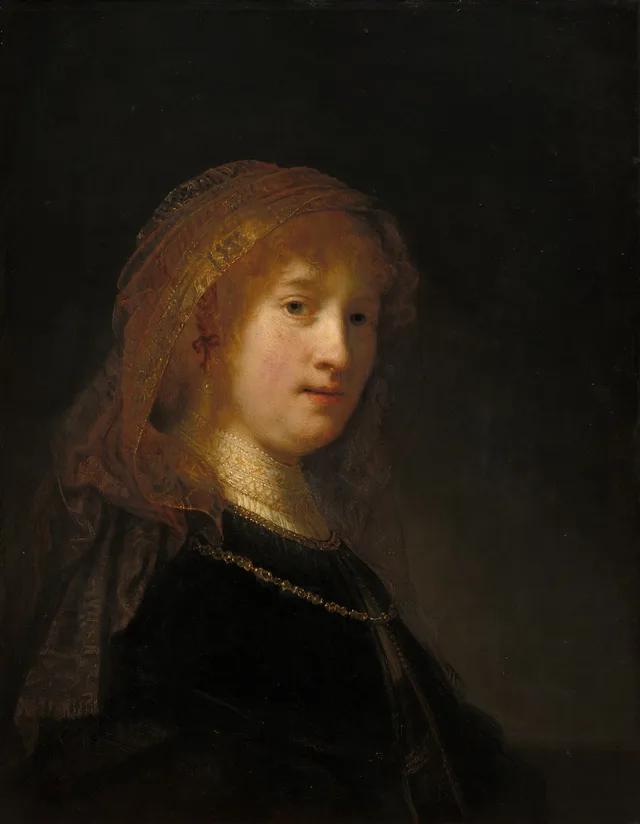
Saskia turns toward the viewer over her shoulder. Rembrandt probably began the portrait in 1634–1635, shortly after their marriage, and completed it around 1638–1640. She came from an influential Leeuwarden family. Her relative Hendrik van Uylenburgh was an Amsterdam art dealer and Rembrandt’s business associate. Their meeting belonged to a world where family and professional connections overlapped.
The face is lit more softly than in many of Rembrandt’s formal portraits. Light touches forehead, cheek, and lips while the farther side stays shaded. The turned head suggests a brief, personal encounter. Yet the effect is carefully constructed: the sitter’s movement becomes a means of enlivening a fixed image.
A translucent veil covers the hair and falls over the shoulders. Light passes through it, softening the head’s boundaries. Related shades of gold, auburn, and brown connect hair, skin, and cloth in a gently emerging area against the dark background.
A high white collar with a fine pattern marks the neck, clarifying the head’s turn above the dark dress. Small passages of careful detail convey the quality of the costume. The family portrait retains social dignity: Saskia wears fine clothing appropriate to her position although almost all surrounding space is hidden.
A gold chain crosses the chest in short bright links. Less luminous than the face, it supports the overall warmth. Rembrandt distributes detail unevenly. Chain and collar establish the dress, while much of the garment disappears into shadow. Enough information is supplied to recognize it, then attention returns to the face.
Hair and veil meet darkness through gradual transitions rather than a single hard outline. The figure avoids looking cut out and placed against a backdrop. Such handling suits an intimate portrait, where a slight shift in illumination can suggest the presence of someone familiar.
Saskia died in 1642; of the couple’s four children, only Titus survived infancy. These events give the portrait the weight of family memory, although it was made earlier and was not conceived as an image of bereavement. The distinction matters. A young woman appears during her marriage, while knowledge of her later fate changes our encounter with her gaze.
More works by Rembrandt van Rijn


- Medium
- oil on panel
- Collection
- National Gallery of Art, Washington
- Dimensions
- 62.5 × 49 cm
- Accession number
- 1942.9.71
Sources
Museum reproduction. Public domain, NGA Open Access. Image licence