The Niccolini-Cowper Madonna
Raphael · 1508
Explore the painting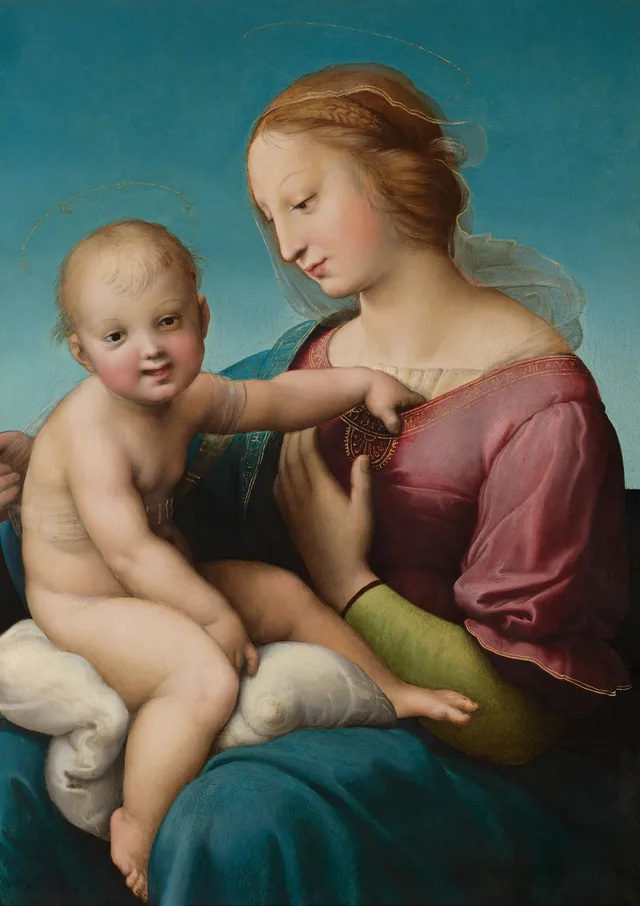
The child pulls at his mother’s neckline and turns toward us with a smile. Raphael painted this Madonna in 1508, as his Florentine period ended and his work in Rome at the pope’s invitation began. Religious painting offered him a setting for exploring bodily movement, human closeness, and the arrangement of figures into a clear composition.
The child sits firmly on the cushion, supporting himself with one hand. His other arm reaches toward Mary while his face turns toward the viewer. Three movements occur together without disturbing his balance. The body has weight, a soft belly, and short legs. For Christian viewers, this physicality mattered because the subject was God taking human form.
Mary bends her head toward her son. Their eyes do not meet, so the scene remains open beyond the pair. The mother watches the child, the child addresses us, and viewers gain a place in this small circle of attention. Tenderness arises from the positioning of bodies and hands, without tears or ceremonious gestures.
A Latin inscription is tucked into the dress’s neckline. It records the date and Raphael’s identity as a painter from Urbino. The signature appears to decorate the garment, although it belongs to the artist outside the sacred story. Biblical time and the particular year 1508 meet on the same narrow strip of fabric.
The white cushion receives the child’s weight while blue fabric covers his mother’s knees. Light and dark areas distinguish overlapping bodies. Despite the complicated pose, it remains easy to follow the legs and arms. Such clarity is characteristic of High Renaissance painting. The impression of natural ease depends on careful organization.
Fine halos hover above the heads without obscuring hair or interrupting the blue sky. Compared with the gold backgrounds of many medieval images, this setting shares much more with the visible world. Sacred figures remain recognizable while approaching ordinary human experience. This change in religious painting developed within church culture and its patronage.
The double name recalls former owners. By the seventeenth century the picture belonged to Florence’s Niccolini family; later it entered the collection of the English Earl Cowper. Such transfers turned domestic devotional images into sought-after works by a celebrated master. A modern viewer may not share the first owner’s faith yet still understand the mother’s and child’s gestures.
More works by Raphael


- Medium
- oil on panel
- Collection
- National Gallery of Art, Washington
- Dimensions
- 80.7 × 57.5 cm
- Accession number
- 1937.1.25
Sources
Museum reproduction. Public domain, NGA Open Access. Image licence