Saint George and the Dragon
Raphael · c. 1506
Explore the painting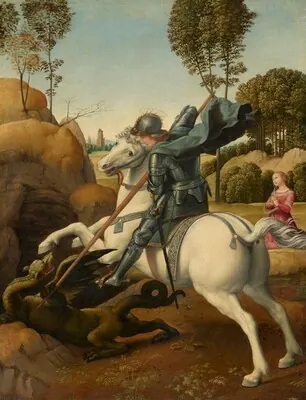
The painting’s story and details
Raphael’s small painting joins the legend of Saint George to early sixteenth-century diplomacy. A warrior drives his lance into a dragon while the rescued princess prays in the distance. Raphael painted it around 1506 while working in Florence and maintaining connections with the court of his native Urbino. Less than thirty centimetres high, the panel rewards close inspection.
George leans over the horse’s neck, directing his lance downwards. His raised hand and the long shaft form a diagonal across the painting. The horse rears and the cloak flies back. These movements convey the force of the blow within a tiny panel. The warrior’s face nevertheless remains calm and clearly visible. Raphael organizes the action so that even a violent encounter remains accessible to sustained, close looking.
A blue garter bearing the letters HONI appears over the armour on his leg. These begin the motto of England’s Order of the Garter, whose patron was Saint George. In 1504, Henry VII admitted Guidobaldo da Montefeltro, Duke of Urbino, to the order. The emblem therefore links the saint to specific contemporary chivalric honours.
The dragon presses against the ground beneath the white horse’s raised forelegs. Its dark body contrasts sharply with pale hair. This helps separate the combatants, while the creature remains capable of resistance: it turns its head and grasps at the lance. Victory is still an action requiring effort.
The princess kneels on the right, behind the rider. Her joined hands continue the religious meaning of the scene. According to the legend, after her rescue she led the subdued dragon into the city; the city’s rescue was accompanied by its inhabitants’ conversion to Christianity. The story concerns both an individual’s rescue and an entire community’s conversion.
Raphael inscribed his name on the horse’s harness. The small work represented his skill beyond the Italian court. The National Gallery identifies its intended recipient as the English envoy Gilbert Talbot, associated with the grant of the order to the Duke of Urbino. It was formerly thought to be a direct gift to the king. The distinction matters: diplomatic relations depended on people who carried honours and represented their monarch. A valuable artistic gift could reinforce that personal connection.
Saint George was the patron of the Order of the Garter, so the religious subject closely suited the circumstances of the gift. Its recipient could contemplate the saint’s deed, Raphael’s skill and the emblem of a chivalric community in one image. In such a gift, devotion accompanies the pursuit of political recognition. The blue garter places a contemporary courtly honour inside Christian legend, giving relations between Urbino and England an exalted form.
More paintings to compare


Period, style and subject
- Movement
- Renaissance
- Genre
- Religious art
- Medium
- oil on panel
- Collection
- National Gallery of Art, Washington
- Dimensions
- Overall, 28.5 × 21.5 cm
- Accession number
- 1937.1.26
Sources
Reproduction of a public-domain artwork. Image licence