The Alba Madonna
Raphael · c. 1510
Explore the painting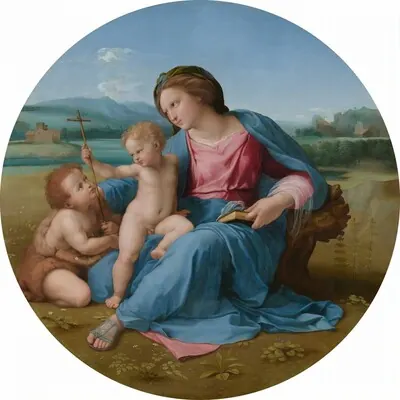
The painting’s story and details
Mary sits on the ground beside two children. Jesus accepts the slender cross held by the young John the Baptist. Their meeting resembles a family scene, although the object at its centre already recalls the future Crucifixion. Raphael painted it around 1510, shortly after moving from Florence to Rome to work for Pope Julius II. The circular format, called a tondo, was familiar to Florentine patrons from religious paintings and painted trays associated with childbirth. This work’s original purpose remains uncertain.
Mary leans towards the children, sustaining the movement of the whole group. A book remains in her hand, with a finger marking her place. Her low position belongs to the Madonna of Humility tradition, which places the Virgin directly on the ground. It made the sacred figure approachable for personal devotion while preserving her exceptional place in the Christian narrative.
Jesus reaches towards the reed cross. The gesture connects his infancy with the end of his earthly life. Curator Gretchen Hirschauer explains it as acceptance of the future Crucifixion. Viewers familiar with the Christian account of salvation could read the picture in this way. An ordinary childhood movement acquires a meaning understood through the viewer’s religious experience. The peaceful encounter allows contemplation of suffering without depicting the execution itself.
John kneels in an animal-skin garment. Artists used it to identify the future wilderness preacher even when depicting him as a child. He looks upwards towards Jesus, his body turned into the group. Raphael brings the adult biblical figures’ attributes into a meeting of children, connecting different moments of sacred history.
Mary’s sandal projects at the lower left, her knee rises on the right, and her head inclines back towards the children. Her broadly spread figure fills the circle while leaving room for the two boys. The draperies make this complex pose easy to follow. The arrangement demonstrates a High Renaissance concern with coordinating a convincing body, movement and a balanced composition. Its apparent simplicity comes from the placement of the parts while the figures remain active.
Water, buildings and blue mountains appear in the distance. Landscape extends the space behind the compact group. The National Gallery suggests a possible influence from Leonardo’s landscape settings. Raphael retains individual details while reducing their contrasts so that the encounter around the cross remains central.
The name Alba Madonna comes from later Spanish owners. Acquired for Nicholas I in 1836, the painting entered the Hermitage; Andrew Mellon bought it in 1931. An image associated with Mary’s humility became the subject of expensive international transactions. The contrast belongs to the history of how art is used. The same object could support prayer, enhance an owner’s prestige and enter a national collection. In a museum, viewers decide how much its religious meaning matters to their encounter with it.
Featured in tours
Christian images. From mosaic to Caravaggio
Icons, manuscripts, domestic devotional pictures and church altarpieces.
More paintings to compare


Period, style and subject
- Movement
- Renaissance
- Genre
- Religious art
- Medium
- oil on panel transferred to canvas
- Collection
- National Gallery of Art, Washington
- Dimensions
- Overall (diameter), 94.5 cm
- Accession number
- 1937.1.24
Sources
Reproduction of a public-domain artwork. Image licence